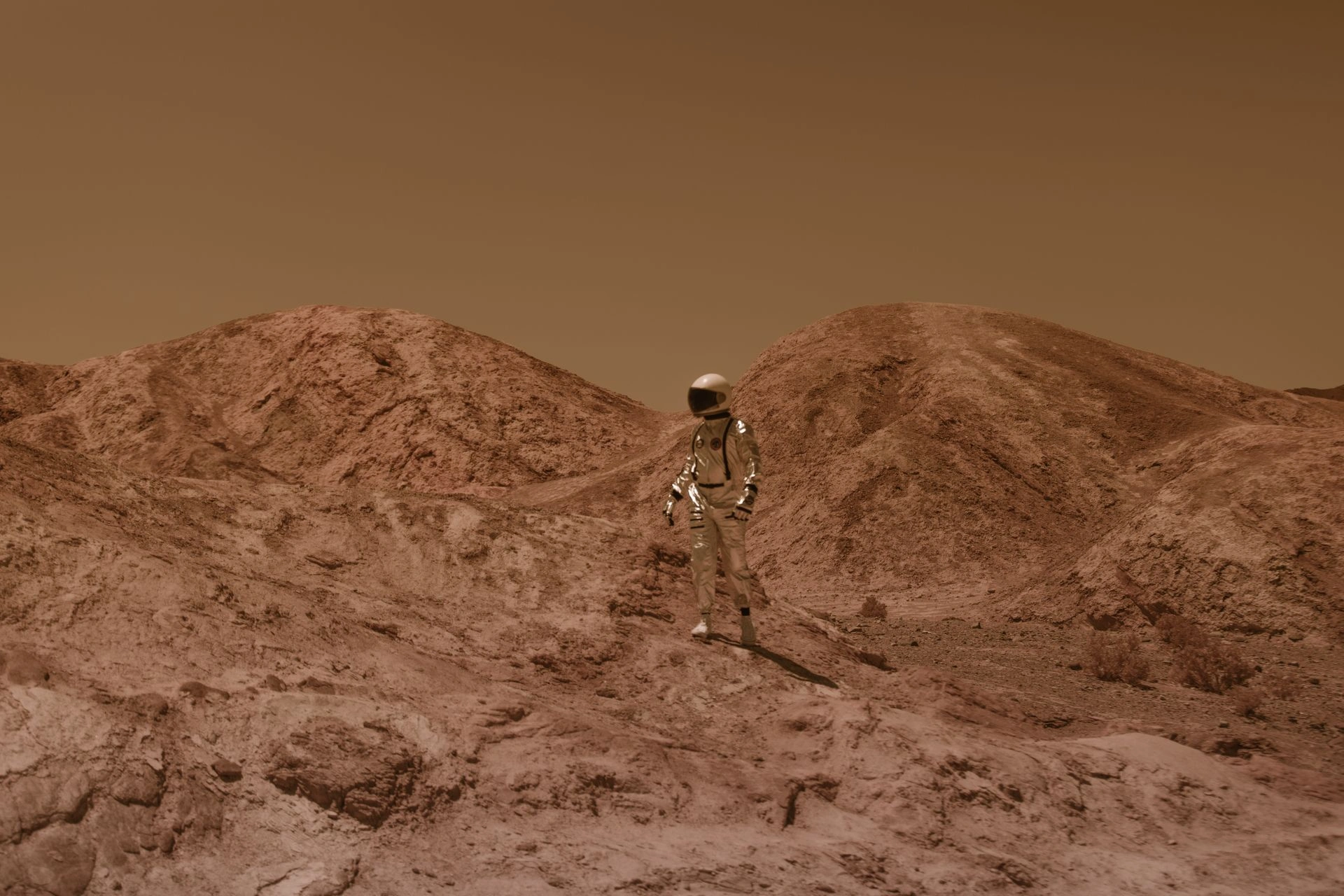
As the race to colonise Mars gathers pace, one question receives far less attention: could long-term life in the Red Planet’s low gravity leave its first settlers and their children condemned never to return to Earth? Harry Margulies explores the risk
The dream of colonising Mars has captured human imagination for generations. It represents the ultimate expression of exploration: a new world, a new frontier and perhaps a backup home for humanity if Earth ever becomes uninhabitable.
And in the coming decades, that dream will finally move beyond science fiction. SpaceX is planning a self-sufficient Martian city of more than 1 million people as its ultimate goal while NASA is developing technologies intended to make human missions to Mars possible as early as the 2030s.
But before we celebrate becoming a multi-planetary species, we should understand what colonising Mars would actually mean. It would not be a matter of planting a flag, building a few habitats and watching a new civilisation emerge. Mars would be an unforgiving environment where every basic assumption about human life would have to be recreated from scratch.
The first challenge is simply getting there.
Mars is not a neighbouring continent waiting to be explored. It is, at its closest, tens of millions of kilometres away, and the journey typically takes around 6 to 9 months using current technology. During that time astronauts would be exposed to radiation, isolation, psychological stress and the dangers of travelling through deep space. A malfunction cannot be fixed by calling Earth for immediate assistance. Help is months away.
But arriving on Mars would only mark the beginning of the struggle. The first settlers would land on a planet where almost nothing needed for human survival exists in a usable form. They would have to create an entire civilisation while surrounded by an environment actively hostile to them. Martian dust would become a constant enemy. It is fine, abrasive and capable of penetrating seals, machinery and living spaces. Every airlock, habitat and piece of equipment would have to be designed with the expectation that the dust is always trying to get inside.
With no inherent infrastructure, settlers would need to build everything that a modern society takes for granted. They would need systems to extract and purify water, produce oxygen, manufacture tools and replacement parts, generate energy, grow food and manage waste. They would need agriculture in artificial environments, medical facilities, education systems and some form of law and order.
In other words, they would not simply be explorers but builders of a completely new human society.
And they would have to do all this while living inside artificial bubbles. Their homes, farms and workplaces would exist inside pressurised environments separated from a planet with almost no atmosphere suitable for humans. Every bubble would represent a potential point of failure. A damaged habitat could mean death.
But even if we solve all these engineering challenges, an even deeper issue remains: would Mars colonisation be a one-way trip?
The obvious obstacle is Mars’ gravity. The planet has only about 38 per cent of Earth’s gravity. At first glance, this seems like an advantage. A 100-kilogram mass would weigh about as much on Mars as a 38-kilogram mass does on Earth.
But our bodies evolved under Earth’s gravity. We know from experience that while humans can spend long periods in microgravity, astronauts who have spent months aboard the International Space Station have experienced muscle loss, bone density reduction and balance problems as a result.
They undergo rehabilitation after returning to Earth but Mars presents a different challenge. It’s not zero gravity, but it’s still a radically different environment. Over years, the human body could adapt. Bones, muscles, balance systems and cardiovascular functions could gradually change in response to Martian conditions.
A person who has lived on Mars for years might become physically adapted to that world. Returning to Earth’s gravity could become increasingly difficult, perhaps even dangerous.
The exact timeline is uncertain. Human biology is complex, and we do not yet know whether, or how quickly, lasting adaptation would occur. But it is possible that after years or decades, a Martian immigrant could find Earth’s gravity profoundly challenging.
A child born on Mars would face an even greater challenge. Growing up in roughly one-third gravity could shape their body in ways we cannot fully predict. Their skeleton, muscles and physical development might be fundamentally different from those of Earth-born humans. Returning to Earth could be an expedition to a planet where they no longer truly belong.
None of this means we should abandon the dream of settling on Mars. Human history is a story of people entering environments that once seemed impossible. The first ocean voyages, polar expeditions and space missions all appeared unrealistic before they became reality.
Perhaps future technology will solve problems we cannot yet imagine. Perhaps artificial gravity, advanced life-support systems and medical breakthroughs will make Mars more accessible than we believe.
But we should approach Mars colonisation with humility. It’s not simply the next step in exploration but an attempt to create a human world on a planet that was never designed for us. Paradoxically, it is on Mars that we discover just how closely our existence is tied to Earth.
So while the conquest of Mars may become humanity’s greatest achievement in the decades to come, at the same time it raises a profound ethical question: are we looking to create a colony of humans on Mars or are we, in fact, creating a new branch of humanity? One that is destined to be permanently exiled from its home world.

Harry Margulies is a journalist, author, commentator and public intellectual whose work interrogates religion, politics and morality with sharp wit and fearless clarity. A second-generation Holocaust survivor, he was born in Austria and spent time in an Austrian refugee camp before moving to Sweden. Educated by Orthodox rabbis throughout his childhood, he ultimately abandoned faith in his teens – a journey that has shaped his lifelong commitment to secularism, critical thinking and freedom of expression. His latest book, Is God Real? Hell Knows, has been described by ABBA’s Björn Ulvaeus as “funny, sharp, and unafraid.”
READ MORE: ‘NASA’S ‘grow your own Mars home’ takes root‘. When it comes to the future of space exploration, we shiitake nothing for granted.
Do you have news to share or expertise to contribute? The European welcomes insights from business leaders and sector specialists. Get in touch with our editorial team to find out more.
Main Image: RDNE Stock project/Pexels