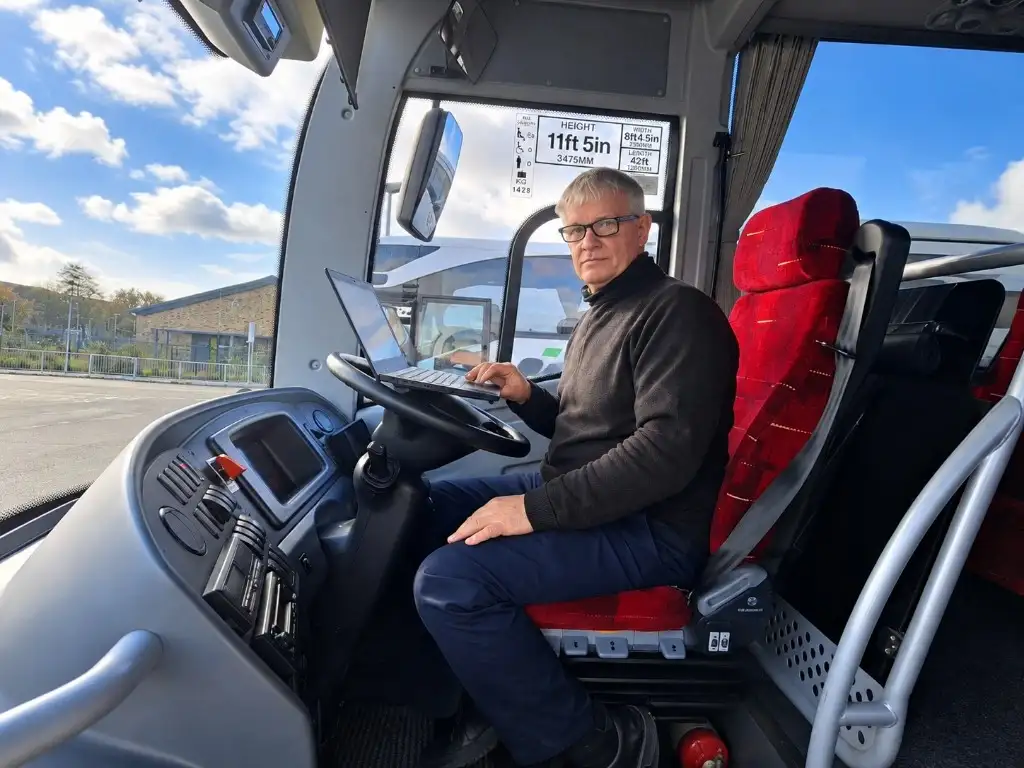
At 61, coach driver Kevin Peddie is building a new dating platform, LoveHuddle, from his home in South Wales with little money and no tech background. He speaks to Dr Stephen M. Whitehead about how enterprise can offer purpose in later life
Recently, Kevin Peddie drove a rugby team to Swansea. The match gave him a four-hour break, which he spent in the driver’s seat of an empty coach, laptop open, arguing with three different AI assistants over the wording of a safety policy. Players drifting back to the coach asked if he was alright. He was – he was working.
Kevin, 61, drives school runs and private hire for a local firm, 30 hours a week, “just to keep my head above water and to pay the bills”. The rest of his waking hours belong to LoveHuddle, the dating and social discovery platform he has spent two years designing and the past seven months building from his home in Neath, southwest Wales.
I’ve interviewed Kevin three times as part of my research into men and ageing. As he told me, “I wake up thinking about LoveHuddle.
“I’m at work, it’s LoveHuddle. I come home, it’s LoveHuddle. I’m working at night on LoveHuddle.”
Ask Kevin to sum up LoveHuddle in one word and, after some protest at being put on the spot, he lands on it: connection.
“Because it covers dating, relationships and meeting people,” he added.
The idea began with a friend. Kevin says a man he speaks to almost every day, who lives with disabilities, was scammed more than once through well-known dating apps. What stayed with Kevin was the question his friend asked afterwards: why can’t I just meet somebody and talk to them first? Why does it have to begin with swiping?
LoveHuddle is his answer: “I’ve seen the gaps, and I want to build the solution.”
His plan is for members to enter a social environment of themed spaces built around shared interests and everyday life. Verified members would meet in small, structured, time-limited ‘Huddles’, where conversation comes first and the decision to connect comes after. It could lead to romance, friendship or simply company for someone who is lonely.
However, he’s not looking to pick a fight with the industry’s giants.
“There’s nothing inherently wrong with existing dating apps. I’ve used them myself,” he said.
“They have connected millions of people. I’m out to do something different. You don’t all drive the same car to work. You have a choice.”
He plans to make the core of it, meeting and talking, free. Income is to come from optional low-cost extras and if those don’t cover the costs, a subscription, he insists, will stay small.
He added: “We need to make a living out of it. But I’m not there to rip people off.”

In my research, I use ‘the last masculinity’ to describe men’s experience of their identity in later life. It begins somewhere around the sixties doorway, when work ends or is taken away, the body starts making its own announcements and a man discovers the world has quietly begun to write him off. Some of the men I interview respond by stepping back, but a few refuse.
Kevin is one of the refusers, and he knows exactly what he is refusing. When I ask how it feels to be doing this at 61, he answers with a question of his own: “Why can’t I at my age still succeed in life? Why can’t I, just because I’m old?
“You’re never too old to create something. You could be 61 or 80. If you have an idea, ambition and the determination to build it, why should age stop you?”
He’s not the standard entrepreneur. There’s no MBA, no corporate career, no network in tech and no investors queuing at the door. He has driven taxis and coaches, mucked out stables and done most of the work on his own house himself. “What I don’t know, I will research until I know how to do it.”
What he does have is an inventor’s restlessness. Sitting in his taxi between fares, he once wrote more than 100 children’s stories about a retired London cab. Around 2010 he ran websites that earned him about £2,000 a month, before closing them down to marry and live abroad. LoveHuddle is the latest outing for a mind that has never stopped tinkering.
There is something more personal at stake too.
“I’m doing this for my self-esteem,” he explained. “For people saying I can never make it. I want to prove to the world that I can do something that people really want.”
“Money matters, but it’s not the point,” he added.
“Of course, I want LoveHuddle to become financially successful and provide security for me and my family.
“But that isn’t my main motivation. I want to see an idea I believe in become something real, take it as far as I possibly can, and hopefully create something that people genuinely value and remember.”
Could Kevin have done it at 31? He doesn’t think so.
“The technology wouldn’t be there to help me, and AI wouldn’t have been there to help me.”
For a man with no technical training, the tools of the past few years have opened a door that was closed to him for most of his working life. Age, in his case, has arrived at the same moment as opportunity.
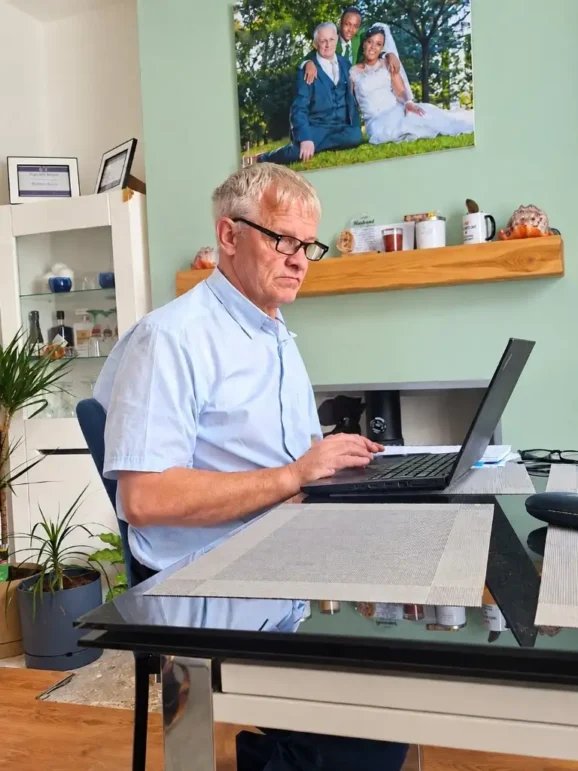
Kevin found his programmer, a 23-year-old based in Pakistan, through a LinkedIn advert asking for someone who “thinks like me” and would say plainly when something couldn’t be done. They have worked together on video for the past year and have never met in person. The programmer writes the code. The concept, the product flow, the safety philosophy, the website, the brand and the logo are Kevin’s.
None of that came naturally. When the programmer first asked for the complete user journey before he could build anything, Kevin had never designed a technology product in his life. So he learned, going backwards and forwards, throwing work away and rebuilding it.
He said: “I’ve learned more this year than I ever have in my whole life. Even at school.”
Safety is where he has put most of his thought. The planned system includes third-party identity and liveness checks, block and report tools, escalation to human review and AI designed to flag suspicious patterns rather than to play matchmaker. LoveHuddle is an Associate Partner of the Online Dating and Discovery Association, the industry body, which has supported Kevin on safety standards and best practice during development.
The reality is far from Silicon Valley. He checks his bank balance every day, admits marketing is his weak spot and would welcome a partner who shares the vision.
“It’s bloody hard to follow it through,” he told me. “It takes a lot of patience, a lot of persevering.”
But he’s not waiting for rescue: “I’m a fighter. If it starts off small, it starts off small.”
Kevin is aiming to launch LoveHuddle in the UK in early 2027, hopefully by the end of January. There is still programming to finish, and he would rather give it the time to be stable than rush it to meet a deadline.

What would he say to a 59-year-old with an idea and very little money?
“Think outside the box. It’s no good inventing the same thing again. You’ve got to do something that’s completely different. If you get it right and persevere, you can make it.”
Will LoveHuddle succeed? Kevin is honest about that too.
“It could take off, or it could take off slowly. But I do believe it will do well.”
It is the optimism of someone who has had enough setbacks to know they can be survived. He is tired some days, and he knows the start-up cannot give him everything. “I’m enjoying it,” he says. “It’s keeping me going.”
For me, whether the platform makes money is not the only measure. The last masculinity strips men of many things: the job title, the physical confidence, the sense of being needed. What it cannot take is the decision to keep getting up in the morning with something to do.
Plenty of men reach 61 and say, in effect, ‘That’s it, I’m switching off.’ Kevin, by contrast, is switching on.
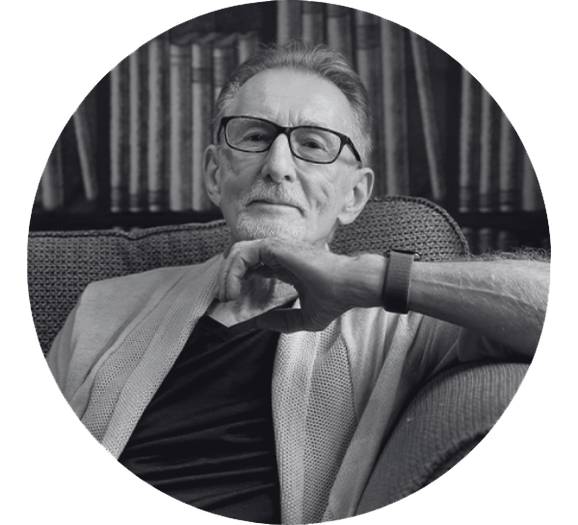
Dr Stephen M. Whitehead is a British gender sociologist and the author of more than 20 books, published by Routledge, Polity, Oxford University Press and Random House. A foundational figure in masculinity studies with over 35 years of research, he co-developed the concept of toxic masculinity and originated the frameworks of Total Inclusivity and healthy self-love. He was Senior Lecturer at Keele University from 1997 to 2015. He currently leads the Global AI Intimacy Study, an international investigation into how AI is reshaping human relationships, with fieldwork across Latin America and India. His next book, Where Have All the Good Men Gone? The Reordering of Intimacy, co-authored with Constanza Fernández Arce, will be published in 2027. He is The European’s Leadership and Organisational Culture Correspondent and lives in Thailand.
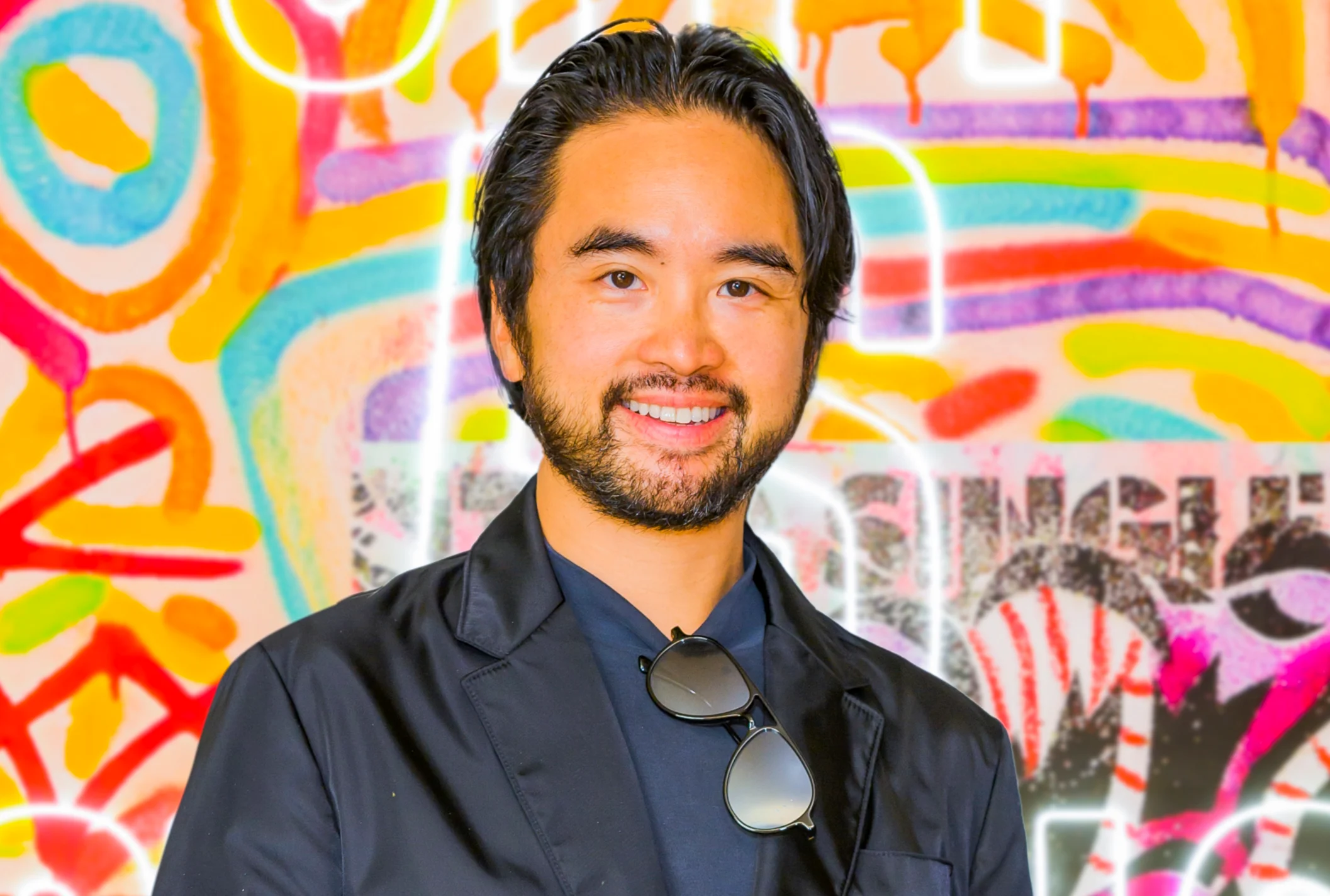
READ MORE: Losing the top job can help business heirs find their own identity. Two years after stepping down as chief executive of his family’s property group, New World Development, Hong Kong entrepreneur Adrian Cheng is building new business interests of his own. Dr Stephen M. Whitehead, who once advised him, says that escaping inherited expectations can give heirs the freedom to follow their own path.
Do you have news to share or expertise to contribute? The European welcomes insights from business leaders and sector specialists. Get in touch with our editorial team to find out more.
Main Image: Coach driver Kevin Peddie is launching LoveHuddle to help people find romance, friendship and companionship through conversation. Supplied