Big Tech is increasingly setting the terms for governments on both sides of the Atlantic, and Europe has proved far from immune. As the continent weighs how to respond, one of the world’s leading AI ethicists argues it must stop reacting to Washington and Beijing and build a vision of its own. Dario Migliorini reports
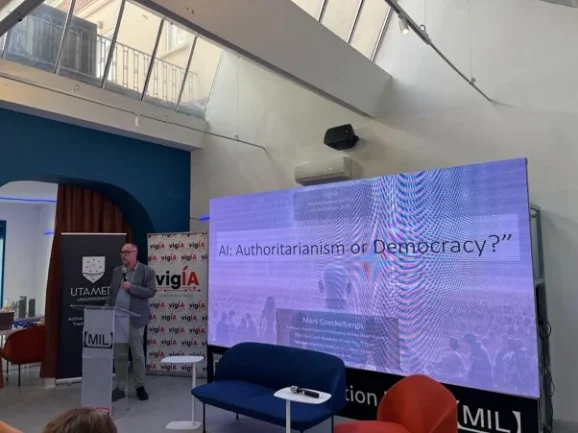
“Technology is not politically neutral.” With those words, Belgian philosopher Mark Coeckelbergh began his remarks at a roundtable on AI held in Madrid on 22 September.
The event, organised by the association VigíA and the Technological University UTAMED, brought together academics, representatives of local institutions and members of the business community.
Coeckelbergh, a leading international expert on the ethics of artificial intelligence and robotics, and a member of the United Nations Independent International Scientific Panel on AI, presented his latest research into how artificial intelligence is affecting democracies around the world.
He warned that “today we should be worried again about authoritarian forms of government like fascism”, and argued that advances in artificial intelligence and surveillance technologies are intensifying this threat, pointing to increasingly authoritarian and totalitarian tendencies among technology companies and their CEOs.
Coeckelbergh has labelled this trajectory as ‘technofascism‘. During his presentation, he described the close collaboration between Big Tech and the U.S government as an example of surveillance capitalism.
He also warned of the growing risk of technocracy. Throughout history, technology has been used to centralise power and increase control. Today, he argued, it is “Big Tech who want to steer the ship of the state”.
Recent statements by AI CEOs such as Anthropic’s Dario Amodei have contributed to an apocalyptic narrative surrounding the technology their companies are selling. Coeckelbergh suggested that such warnings also serve to strengthen the companies’ positions of power. “They want to say that they have the technology and also the solution.”
According to Coeckelbergh, AI can undermine democracy in several ways, including algorithmic unfairness, persuasion and manipulation that threatens individual autonomy as people become increasingly reliant on large language models (LLMs).
The imbalance of power between those who control artificial intelligence and ordinary citizens is made worse when people lack an understanding of how these technologies work.
Democratic societies have also been weakened by the polarisation and isolation fuelled by social media. “Democracy is threatened when there isn’t clear knowledge on what is true or not, and when there’s not a shared world to discuss”, said the Belgian philosopher.
Europe has not been immune to this autocratic and technocratic trajectory. American Big Tech companies have repeatedly demonstrated their influence across the continent, taking part in negotiations and meeting privately with heads of state.
One of the biggest controversies has involved the contract between Palantir and the UK’s National Health Service, which allows the private firm to access the data of millions of patients.
Despite reported widespread backlash, including decisions by several European governments to block defence procurement contracts with the company, some politicians have continued to support Palantir. They include Poland’s president Karol Nawrocki and the European Commissioner for Defence and Space, Andrius Kubilius, who has spoken in favour of the company.
Asked by The European how citizens can act within European democracies, Coeckelbergh answered that “elections still have an impact when politicians lose consensus and ground for their support and agreements with tech corporations.
There is still room for democratic action, to avoid resorting to violence for opposing the politicians in Europe that are also pushing to fall into a tech dystopia.”
At an institutional level, he emphasised the importance of Europe developing an AI framework that serves the common good. “The EU should develop its own vision instead of being reactive to the U.S and China.”
The question is whether AI itself could also be used to strengthen democracy. Coeckelbergh believes it can, although doing so would require a deeper transformation in the principles governing its development, with greater emphasis on the common good.
To regulate AI effectively, he argued, political institutions must become more participatory and deliberative. He proposed creating new institutions capable of linking technological development more closely to democratically elected bodies.
Global coordination and governance would also remain important as the international order becomes increasingly fragmented and stronger forms of nationalism re-emerge.
Ultimately, Coeckelbergh called for a rethink of the current economic framework to counter the model of surveillance capitalism taking shape in Silicon Valley.
He also stressed the fundamental importance of education and digital literacy. “What is required is knowledge, expertise and education about the technology, its potential and impact.”
Education and digital literacy are central to the work of VigíA, the association behind the Madrid roundtable. Introducing the event, VigíA vice-president Almira Zainutdinova stated that “one goal of the organization is to create digital and algorithmic literacy. Citizens have the right to understand what’s behind the technological tools that are being used, as in their algorithmic profiling and data extraction.”
Bridging the gap between those who design technologies and the people who use them would help citizens ask more informed questions: “How do I know if the info this model generates is right? How does it extract them?”
The association is working with academic institutions around the world to develop educational programmes covering AI ethics and digital rights.
“Leaving critical thinking to AI risks delegating a fundamental human skill. Technology should expand human capabilities and not substitute them,” said Zainutdinova.

Dario Migliorini is a journalist who reports on international relations, human rights, and the weakening of democratic institutions. With an MA in Media, Peace and Conflict Studies from the University for Peace, he examines how power is concentrated and abused, ranging from criminal networks to the companies now shaping democratic life.
READ MORE: Rethink AI governance or risk an uncontrolled intelligence explosion. As AI begins helping to develop and evaluate its own successors, flawed assumptions and biases could multiply with each generation, fuelling an ‘intelligence explosion’ in which increasingly capable systems become harder to govern. To avoid this, stronger independent evaluation and oversight are essential, argues Vendan Ananda Kumararajah.
Do you have news to share or expertise to contribute? The European welcomes insights from business leaders and sector specialists. Get in touch with our editorial team to find out more.
Main image: A Metropolitan Police live facial recognition camera at Charing Cross in London, highlighting the growing use of surveillance technology and concerns over privacy, civil liberties and democratic oversight. Credit: gruntzooki/Wikimedia Commons (CC BY-SA 4.0).