When it comes to the future of space exploration, we shiitake nothing for granted
NASA has invested $2million in a project to create habitats on the Moon and Mars using…mushrooms.
Its vision is for mankind to grow its own eco-friendly homes in the cosmos with live fungi, instead of traditional materials like metal and glass.
The project foresees astronauts hauling lightweight flat pack frames containing dormant mushrooms to distant worlds, and ‘activating’ them on arrival.
By simply adding water, the mycelia thread-like part of the fungus can grow around that framework to build fully-functional habitats “with extreme precision”.
Frames would consist of a three-layered dome with water ice on the outside, cyanobacteria in the middle and an inner layer of mycelia, which feeds and grows around it.
NASA launched its “Mycotecture Off Planet” project out of NASA’s Ames Research Center in California’s Silicon Valley in 2020.
The Center has now received $2million as part of the space agency’s Innovative Advanced Concepts (NIAC) program to “propel” that research forward over the next two years.
It is hoped a demonstration mission in low orbit will soon follow with the “ultimate goal” of growing homes on surfaces of the Moon and Mars.
According to NASA, the idea could also be used on Earth.
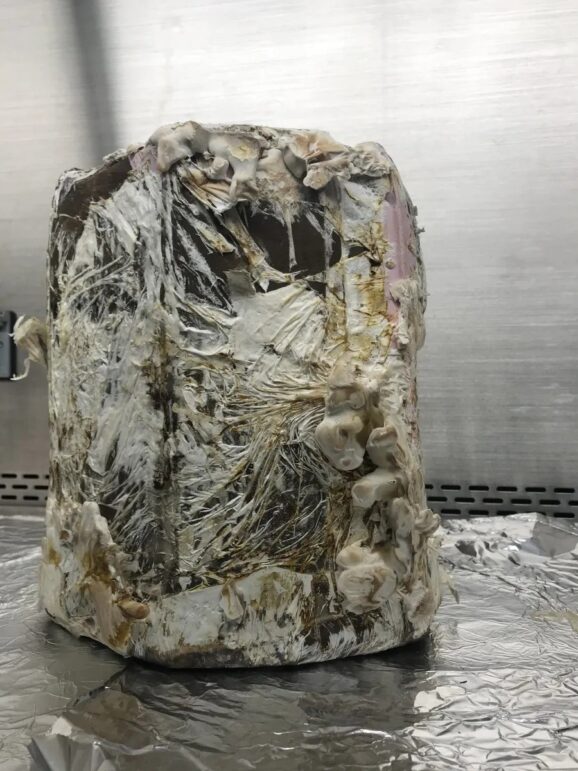
A stool constructed out of mycelia after two weeks of growth. The next step is a baking process that leads to a clean and functional piece of furniture.
© 2018 Stanford-Brown-RISD iGEM Team
John Nelson, NASA’s NIAC Program Executive, said: “Mycotecture Off Planet exemplifies how advanced concepts can change how we envision future exploration missions.
“As NASA embarks on the next era of space exploration, NIAC helps the agency lay the necessary groundwork to bring innovative visions to life.”
NASA Administrator Bill Nelson added: “As NASA prepares to explore farther into the cosmos than ever before, it will require new science and technology that doesn’t yet exist.
“NASA’s space technology team and the NIAC program unlock visionary ideas – ideas that make the impossible, possible.
“This new research is a steppingstone to our Artemis campaign as we prepare to go back to the Moon to live, to learn, to invent, to create – then venture to Mars and beyond.”
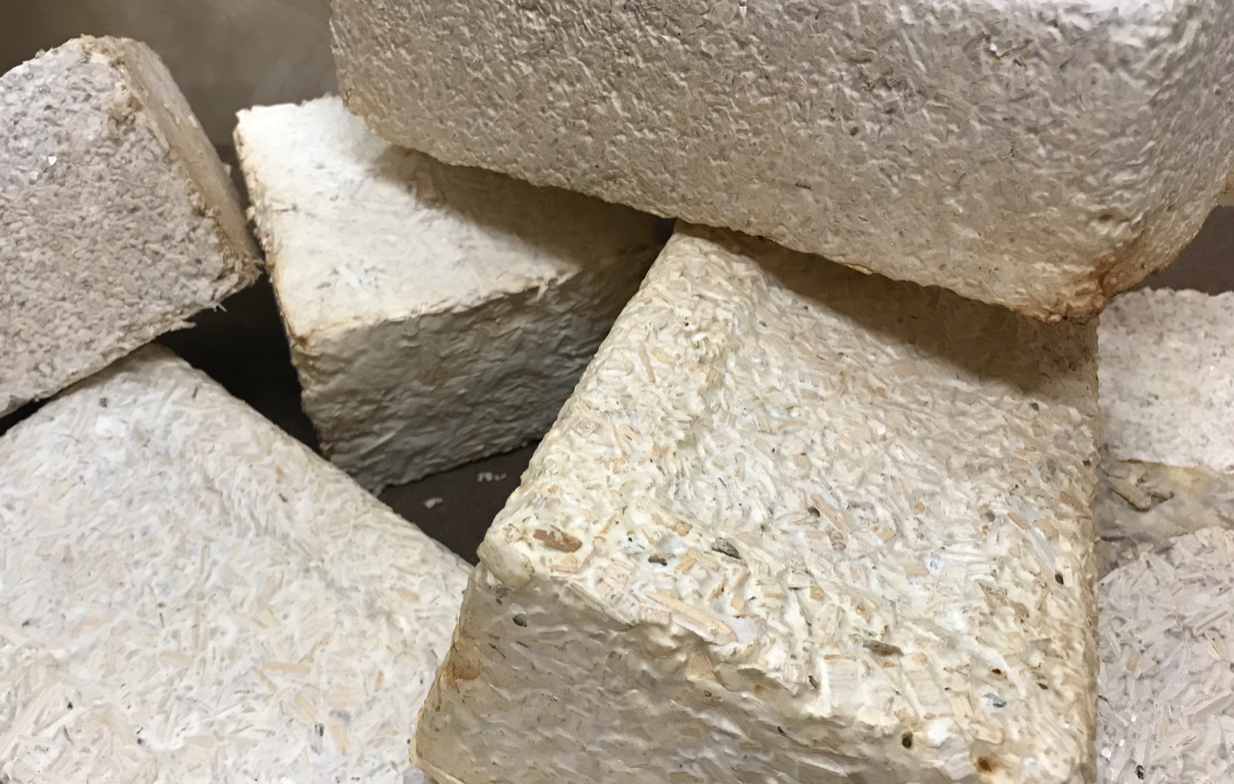
Main image: Bricks produced using mycelium, yard waste and wood chips as a part of the myco-architecture project. Similar materials could be used to build habitats on the Moon or Mars. © NASA