With Donald Trump facing growing economic discontent at home, November’s US midterm elections could have far-reaching consequences for Europe, potentially changing Washington’s approach to Ukraine, Russia and NATO, writes Ravi Balgobin Maharaj
Europe has much at stake in the U.S midterm elections next month, with the result potentially reshaping Washington’s relationship with its European allies. Rising living costs are putting Donald Trump’s political promises under increasing pressure and testing the loyalty of Republican voters. The outcome could have far-reaching consequences for European security, the war in Ukraine and America’s commitment to NATO.
As a researcher and analyst, I have long been interested in the relationship between political conviction and personal experience. It is one of the most revealing aspects of American democracy and one that makes the approaching midterm elections so important, not least to those watching from across the Atlantic.
On 3 November, the U.S will have an opportunity to answer a question that has been building for months: how much are Republican voters prepared to tolerate in the name of Donald Trump, and at what point does loyalty begin to give way to frustration?
While this election is an examination of the Trump presidency, for the Republican Party it may also reveal the limits of a political movement that has become extraordinarily effective at mobilising voters around cultural grievances, national identity and a powerful sense of political belonging. The difficulty for the president is that these allegiances must now withstand the pressures of ordinary life – pressures that European readers will recognise, as governments on this side of the Atlantic have faced the same cost-of-living reckoning at their own ballot boxes.
During the first year of his second term, President Trump’s hold over the Republican Party remained formidable. Even when his wider approval ratings faltered, his political instincts continued to shape the party’s direction, its candidates and the issues it chose to fight over. European capitals had little choice but to treat those instincts as a fixed feature of their own planning. Yet, beginning in the second quarter of 2026, the mood began to change. In its October 2026 survey, the Pew Research Center found that Trump’s approval rating had fallen to 30 per cent, its lowest level of his second term.
The more revealing figures, however, concern the economy. Inflation rose to 3.7 per cent in September, according to the latest consumer price report, while the national average price of petrol reached US$4.36 a gallon (roughly US$1.15 a litre) in early October, unusually high for this time of year. While people disagree about the causes of inflation, and no president has complete control over global energy markets, voters will inevitably judge this administration by the conditions in which they find themselves. European drivers and manufacturers, who are exposed to the same markets, will understand exactly what that means.
This is where I believe the midterms become a genuinely important test of the Republican coalition and, for Europeans, a guide to how durable American policy will prove to be after November.
President Trump’s electoral success in 2024 was built partly on the conviction that he would restore order at the border, confront crime, resist progressive cultural changes and challenge institutions that many conservatives had come to distrust. His positions on abortion, LGBT rights and diversity, equity and inclusion (DEI) formed part of a wider argument about the direction of American society, fought with an intensity that many Europeans, whose own debates on these subjects tend to be more muted, find difficult to appreciate. These questions helped voters understand what the Republican Party stood for and what they believed was at stake.
It would be a mistake to assume that voters have suddenly abandoned those concerns. Immigration remains particularly important to Republican supporters, and cultural questions continue to shape political identity, yet political priorities are not fixed in quite the way campaign slogans suggest. For Europe, this is a reason for caution, because a Republican setback in November should not be mistaken for a return to the transatlantic assumptions of an earlier era.
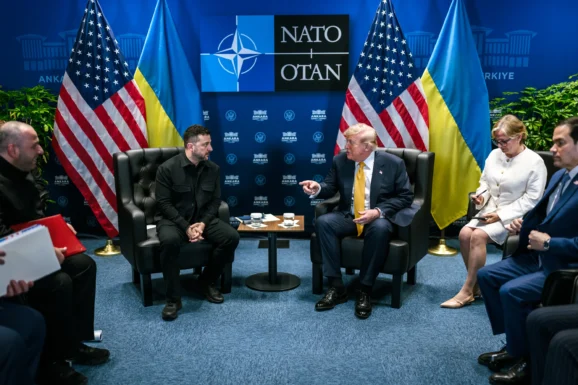
Foreign policy adds another layer to this difficulty, and it is the area in which Europe has the most at stake. President Trump’s approach to Israel, the conflict involving Iran and the war between Russia and Ukraine has created tensions within a Republican coalition that is far from uniform in its instincts. While some conservatives want an unapologetically pro-Israel administration, others are increasingly sceptical of foreign military commitments and the financial costs associated with them. This instinct extends naturally to NATO burden-sharing and the funding of Ukraine’s defence, while many remain deeply concerned about Russia’s aggression against Ukraine and what an American retreat would mean for European security.
The president’s recent decision to permit Russian diesel sales, ostensibly to ease pressure on fuel prices, illustrates how these competing priorities can collide. For Republican lawmakers, this is a difficult position in which to find themselves. For Europe, it is more troubling still, given the years spent reducing dependence on Russian energy and building a sanctions policy on the assumption of a common Western front.
These foreign policy disagreements may bring abstract questions of national leadership into direct contact with domestic concerns. When international decisions are associated with higher energy costs, uncertainty or a perceived loss of American credibility, voters may begin to ask whether the administration’s priorities reflect their own. Europeans, meanwhile, will be asking whether Washington’s commitments can be relied upon when they collide with the price at the pump.
This helps explain why some Republican members of Congress and candidates have become more willing to oppose the president publicly, although their behaviour should not be mistaken for a wholesale rebellion. Some disagreements reflect genuine differences over policy, while others reflect frustration with Trump’s interventions in Republican primaries or concern about the practical consequences of his decisions. For politicians facing competitive elections, the electoral calculation is becoming harder to ignore. This matters to Europe because Congress holds the power of the purse, including control over the money that underwrites American military assistance, and has a meaningful say over the country’s alliance commitments.
There is, of course, a degree of political self-preservation in this, but even self-preservation reveals something important. Republican politicians are beginning to calculate whether defending every presidential decision is still the safest way to retain their seats, and the midterms will tell us how sound that calculation has been. European governments, which know from their own coalition politics that fear of voters often moves a party before conviction does, should watch that calculation closely.
A Republican defeat would not necessarily mean that Trump’s supporters have abandoned him or that conservative voters have undergone a sudden ideological transformation. Historically, American midterms are shaped by turnout, local candidates, the peculiarities of individual constituencies and the tendency for the president’s party to lose ground. But the scale and character of any Republican losses will tell us something about the limits of Trump’s appeal.
Will voters who remain culturally conservative nevertheless turn away from Republican candidates because they are dissatisfied with economic conditions? Will traditionally loyal Republicans stay at home rather than defend a president whose priorities they no longer recognise? And will members of Congress conclude that a degree of independence from Trump is now necessary to survive politically?
For Europe, the consequences would be mixed. A Congress less deferential to the president could constrain his decisions on Ukraine, Russia and sanctions, yet the presidency retains wide latitude over foreign policy, and no election in November will change that.
Republican candidates will have to decide how much of their political identity should remain tied to a president whose influence, while still substantial, is no longer an uncomplicated electoral asset. The party’s challenge, therefore, is to understand what its voters are really asking of it. That question has consequences for Europe, since a party less bound to Trump might prove a more predictable partner in the years ahead, while one pushed by economic frustration towards a narrower view of American interests could prove more inward-looking.
I do not believe the Republican Party is about to shed its ideological commitments. Its electorate is too diverse in its motivations, and Trump’s influence remains too deep, for such a conclusion to be justified. What may be changing, though, is the price voters are prepared to pay for those commitments. Even if the party’s most effective cultural arguments continue to resonate, they cannot indefinitely compensate for an administration that leaves its supporters feeling economically exposed or politically neglected.
Europeans would be unwise to expect a swift return to the transatlantic certainties of the past. The more lasting lesson of this period may be that American commitment to European security, energy policy and the defence of Ukraine has become conditional on domestic politics in a way that Europe must now plan for.
That is the test awaiting Donald Trump and the Republican Party, and it may ultimately tell us more about the future of American conservatism than any campaign rally, presidential speech or argument on Capitol Hill. For Europe, it will also shape, over years rather than months, how much it can rely on Washington for its own security and prosperity, and how much it must build for itself.

Ravi Balgobin Maharaj is a geopolitical commentator and international affairs analyst with a focus on security strategy, alliance systems, and emerging global power structures. His work explores the intersection of military capability, political sentiment, and diplomatic alignment in an increasingly multipolar world. Drawing on a global perspective, he provides analysis on shifting coalition dynamics, regional security frameworks, and the evolving role of Western institutions in contemporary conflict.
READ MORE: Golden naked Trump statue unveiled at European Parliament. The 23-carat gold-covered sculpture shows the US president sitting naked on the back of a frail man in a work inspired by The Emperor’s New Clothes.
Do you have news to share or expertise to contribute? The European welcomes insights from business leaders and sector specialists. Get in touch with our editorial team to find out more.
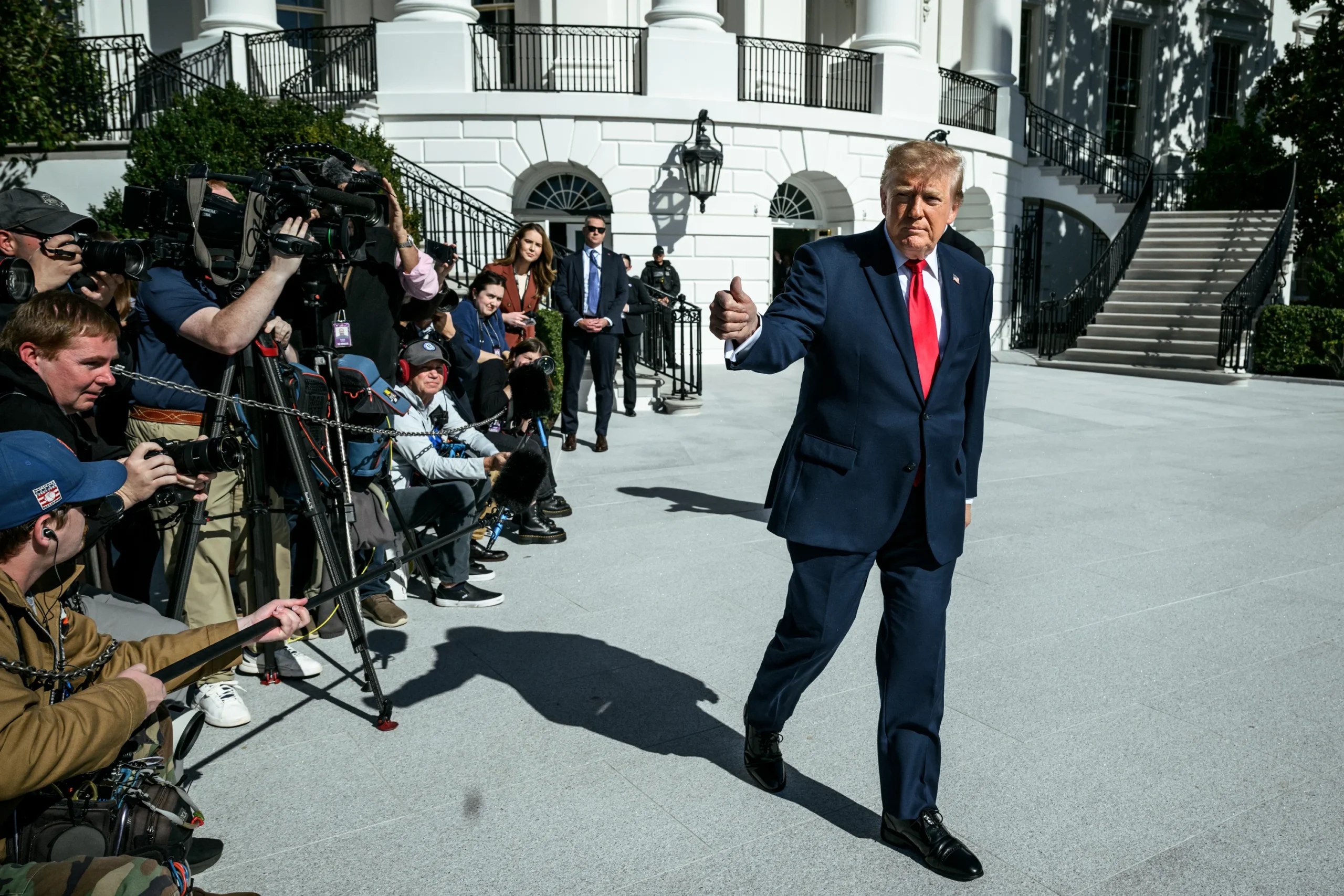
Main image: President Donald Trump speaks to reporters at the White House on 25 October, ahead of a midterm campaign rally in Michigan. Credit: Patrick Witty / Official White House Photo.