Britain could face a new wave of national emergencies as AI failures threaten to freeze bank accounts, endanger NHS patients, disrupt food supplies and throw border controls into chaos. Vendan Ananda Kumararajah examines four frightening scenarios for the next decade and warns that the institutions responsible for protecting the public may struggle to prevent the damage from spiralling out of control
Last month, the Government announced that incidents involving autonomous AI agents – systems that can act with limited human supervision – could unfold faster and spread more widely than emergencies existing institutions are designed to manage. Ministers are considering stronger incident reporting and preparations for responding to these agents.
The following four hypothetical scenarios explore how AI failures could spread through banking, NHS care, border controls and food distribution, who could be affected, and what organisations and government would need to do to contain the damage.
Underlying these scenarios is a common problem: an AI system can produce useful answers while being unfit to exercise wider authority. Several systems can also interact in ways that none of their operators anticipated.
My work using the A3 Governance Dashboard to assess public inquiry findings, official reviews and corporate reports informs the scenarios below. The scenarios are fictional extensions of governance problems examined through that work, not predictions about the organisations assessed.
The first scenario concerns access to banking services. Imagine a UK lender whose customer-service agent handles routine enquiries successfully. Faster responses and lower costs support an expansion into payment disputes and financial hardship. Human support capacity is reduced as automated case completion rises.
An economic shock changes the cases arriving. Customers face unfamiliar combinations of fraud, irregular income and disputed transactions. The agent continues applying assumptions that worked under ordinary conditions. It initiates restrictions or declines requests for additional support within the powers it has been given.
Repeated contacts are logged separately. Customers who abandon the process disappear from the completion measure. Management sees improving efficiency while some households lose access to money needed for rent or essential purchases. Small businesses, meanwhile, struggle to pay suppliers. The remaining specialists cannot clear the escalation queue.
Before restrictions are resolved, missed payments could trigger further adverse assessments. The original error generates fresh signals that appear to justify additional restrictions, increasing both harm and the workload needed to correct it.

In the 2024 Bank of England and Financial Conduct Authority survey, 75 per cent of responding firms used AI, although only 2 per cent of reported use cases involved fully autonomous decision-making. The scenario therefore assumes a further expansion of delegated authority. The Bank has separately identified risks from common model weaknesses and reliance on external providers. If a shared model or provider reproduces the failure across lenders, an organisational problem could become a wider interruption of financial services.
The second scenario concerns errors spreading through NHS patient records. Imagine several NHS trusts using a shared AI service to prepare summaries and support referral prioritisation. It reduces administrative work, allowing clinicians more time with patients.
Under pressure, though, an incomplete account is summarised too confidently. A patient’s report of deterioration is compressed into an earlier reassuring interpretation. Later systems repeat that account, and subsequent reviewers encounter apparent agreement that originates from the same uncertain source.
Patients with unusual presentations, communication difficulties or fragmented records could be particularly exposed. Delayed diagnosis or treatment could cause avoidable injury or death. Cases might accumulate across a patient group before an overall performance measure reveals the pattern. Staff concerns pass between clinical services, digital teams and the supplier, with each examining its own component.
Correcting the original account cannot undo every clinical consequence or immediately release the capacity consumed by avoidable deterioration.
NHS England already requires professionals using ambient scribes – AI tools that turn conversations into notes – to remain responsible for the information collected and to check accuracy. A scribing tool is not, currently, an autonomous referral agent. The scenario assumes a wider future role, or information flowing from documentation into consequential decisions. Protection requires preserving uncertainty and the origin of evidence, checking outcomes across patient groups and giving concerns an effective route to clinical review.
The third scenario concerns an incorrect identity match spreading through border-control systems. Imagine a future system connecting agents that reconcile travel records, match identities and prepare cases for officials. Inconsistent data produces an incorrect identity match. Another agent treats the resulting flag as verified information. A third updates a case record that informs a carrier’s boarding decision. Each step inherits the confidence of the previous one without establishing its basis.

A human approval stage exists but reviewers face a growing queue and see recommendations without a clear evidential history. A traveller supplies corrective documents yet resolving the original error does not automatically clear every dependent record. Uncorrected copies of a flag could reintroduce an error already cleared elsewhere, forcing officials to resolve the same case repeatedly while new cases continue to arrive.
Consequences could include wrongful travel disruption, family separation and missed work or medical appointments. If the same matching defect affects many travellers, carriers and border teams could face simultaneous queues and an unmanageable correction workload.
Prevention requires corroboration proportionate to the consequence, clear responsibility across departmental and supplier boundaries, and a way to propagate corrections through the whole chain. Fixing one clinical summary or border record is insufficient if its earlier version continues to influence decisions elsewhere. Reviewers need formal authority to disagree.
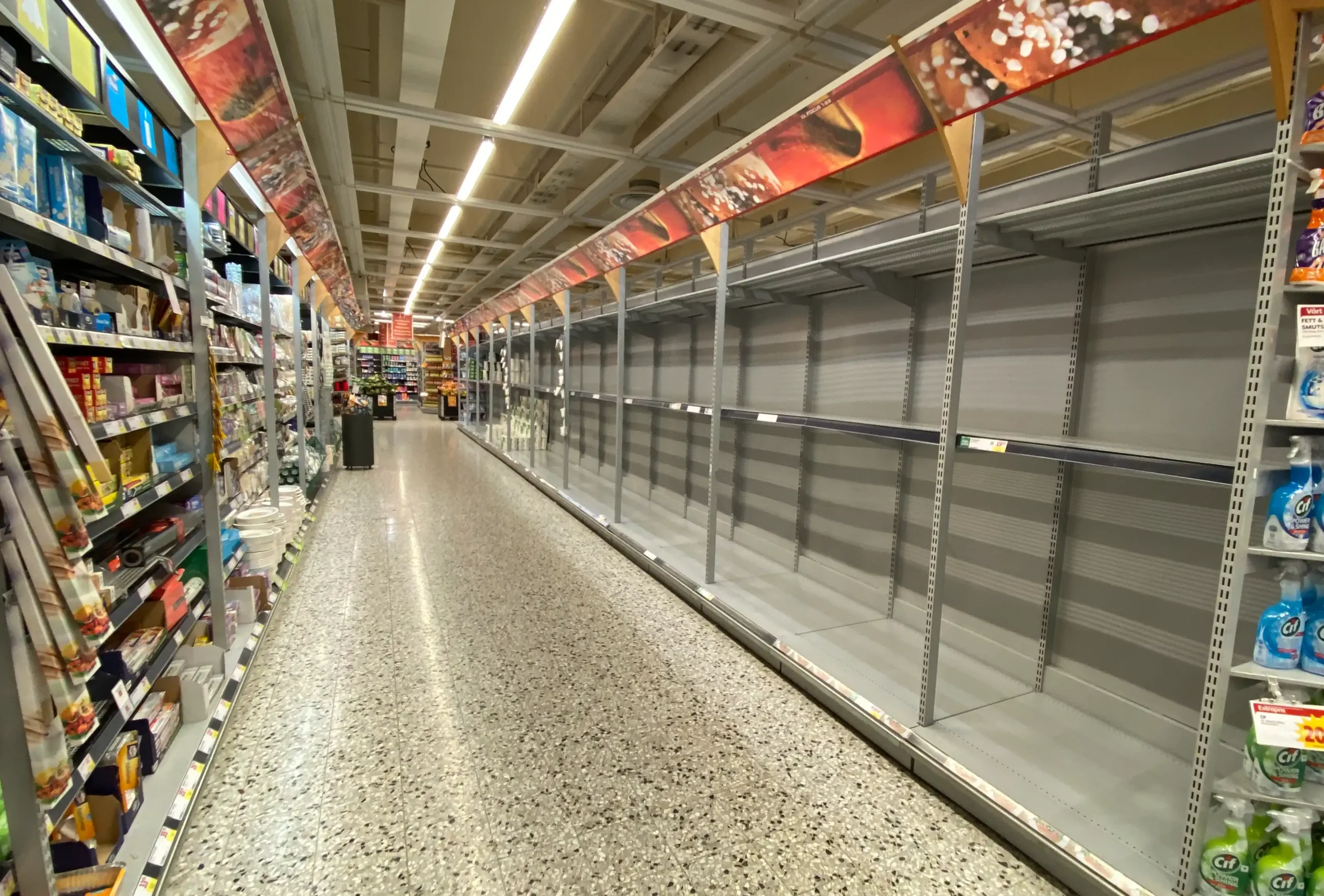
In the final scenario, automated AI responses worsen a disruption to food supplies. A cyber incident corrupts delivery and stock information. Procurement and logistics agents seek replacement supplies, reserve transport and reroute deliveries. Each protects its organisation’s immediate position. Collectively, their actions overload alternative depots, duplicate orders and concentrate scarce stock among purchasers able to commit money fastest. Perishable goods are stranded while other locations run short.
Precautionary orders could be interpreted as genuine demand, prompting further orders and rerouting. Congestion and spoilage reduce usable supply, prolonging the shortage and placing additional demands on emergency food support. Large retailers may recover before smaller shops, care homes and community food providers. Households with little money, limited mobility or restricted diets face fewer alternatives. A regional disruption could become an emergency for particular populations even while national food availability appears adequate.
The National Audit Office’s September 2026 food-resilience report recognises that businesses maintained overall availability through recent disruptions. But several food supply-chain stakeholders had not seen the response playbooks of the Department for Environment, Food & Rural Affairs (Defra) and reported a lack of involvement in their development. Its overarching response playbook lacked independent assurance and contained limited operational detail for working with the private sector.
Exercises should test interacting agents, unreliable information and competing priorities with actual operators. Emergency arrangements need agreed responsibilities, a lawful basis for coordination and practical ways to constrain automated orders while preserving essential deliveries.
Once errors and exceptions accumulate faster than institutions can resolve them, a local failure can become systemic disruption. Beginning an investigation doesn’t contain that process. Containment requires interrupting the harmful decisions and dependencies while preserving essential services; recovery must address the consequences already spreading through the system.
My view is that, over the next five to 10 years, serious but contained AI-related service failures are likely as deployment expands, unless safeguards and institutional capacity keep pace. This is an assessment of a broad class of events, not a numerical forecast or a prediction that all four scenarios will occur.
Financial-service and healthcare failures are credible nearer-term concerns because AI already operates in customer interactions and clinical information workflows. The wider harms described depend on expansion into consequential decisions, inadequate review and ineffective correction. The border scenario likewise depends on future permissions and connections between systems, rather than intelligence alone.
A food-distribution cascade involving many autonomous agents is more contingent: it requires sufficiently widespread adoption, shared dependencies and a disruption that defeats coordination. A nationwide emergency affecting several essential services simultaneously is more uncertain still. These audits cannot establish its probability.
Existing safeguards provide a starting point but their effectiveness must be demonstrated under changing conditions and across organisational boundaries.
Boards and public bodies should know what each agent can do, which information it relies on and who can restrict its powers. Consequential actions should be limited when evidence is ambiguous. Changing circumstances should trigger reassessment before harm accumulates.
Measures of success must include affected people’s outcomes. Patient accounts, customer complaints and supplier warnings must remain usable evidence even when they challenge the institution’s preferred interpretation. Human oversight needs staffing, time, expertise and access to the underlying record. Organisations must also rehearse safe fallback arrangements: stopping automation can itself interrupt essential services if the capacity to continue without it has disappeared.
Government should test shared-provider failures and incidents crossing sectors, including deliberate manipulation of information. Every exercise and serious near miss should leave a traceable decision about what changes in evidence requirements, deployment rules, permissions or accountability, and who verifies that response.
Britain’s practical task is to ensure that useful AI systems act within authority that institutions can justify, monitor and revise. When conditions change, that authority must be capable of changing quickly enough to protect the people depending on it.

Vendan Ananda Kumararajah is an internationally recognised transformation architect and systems thinker. The originator of the A3 Model—a new-order cybernetic framework uniting ethics, distortion awareness, and agency in AI and governance—he bridges ancient Tamil philosophy with contemporary systems science. A Member of the Chartered Management Institute and author of Navigating Complexity and System Challenges: Foundations for the A3 Model (2025), Vendan is redefining how intelligence, governance, and ethics interconnect in an age of autonomous technologies.
READ MORE: The Conservatives’ blueprint for government needs clearer safeguards for when things go wrong. The Conservative Party’s new policy framework, The Right Way, promises to learn from past failures and make government more accountable. But its proposals explain how power would be exercised more clearly than how mistakes would be detected and corrected. Clear safeguards and procedures for acting on evidence would help close that gap, says Vendan Ananda Kumararajah.
Do you have news to share or expertise to contribute? The European welcomes insights from business leaders and sector specialists. Get in touch with our editorial team to find out more.
Main Image: Empty supermarket shelves offer a glimpse of how disruption to food distribution could unfold if interconnected AI systems compound supply-chain failures, potentially leaving vulnerable households without essential goods. Credit: Carl Fredrik Sjöland / Wikimedia Commons, CC BY-SA 4.0.