After visiting Plato’s Academy and Aristotle’s Lyceum in Athens, the birthplace of honest intellectual examination, Mike Leidig argues that journalism must recover its public purpose and build a business model that rewards trustworthy reporting
While in Athens for business meetings about NewsX, my not-for-profit initiative to make independent journalism sustainable, I decided to spend some time visiting two places that seemed particularly appropriate to the discussions I was having. They were not the Acropolis or the Parthenon, magnificent though those monuments are, but two much less celebrated sites where some of the foundations of Western intellectual life were laid: Plato’s Academy and Aristotle’s Lyceum.
Journalism was built around an extraordinarily important idea: that society needs people willing to establish facts, question authority, examine evidence and tell the public what they have discovered. Those principles are not decorations around the profession but the very reason it exists.
Yet somewhere along the way, much of the industry seems to have become more concerned with the business of attracting attention than with the business of establishing truth. Traffic, clicks, engagement and distribution have become measures of success. Sponsored content, native advertising that resembles editorial content, public relations dressed up as reporting and journalism shaped by predetermined causes increasingly occupy space that should belong to independent inquiry.
I visited the sites with two companions, one of whom had a particular passion for the idea that somewhere on those ancient grounds we might find ourselves walking in the footsteps of Socrates, Plato, Aristotle and perhaps even Alexander the Great. Finding the sites was almost as revealing as visiting them.
We’d been advised by AI that the Big Bus sightseeing tour was the best way to reach Aristotle’s Lyceum. At the departure point, the Big Bus salesman turned to me and explained that he’d been in Athens for 25 years and had never heard of the place. The rival red sightseeing bus company, whose representative we had so confidently dismissed on the recommendation of AI, had the Lyceum clearly marked on its map, complete with a nearby stop. It got three ticket sales. I noticed, however, that our original salesman had begun looking up the Lyceum on his telephone.
At the Lyceum, we walked through the gardens and around the ancient stones, trying to picture Aristotle discussing ideas with his students, questioning assumptions and examining the evidence for what he believed. What struck me was how peaceful it was, and how few people seemed interested in visiting.
Plato’s Academy was an altogether different experience. Further from the centre, it required a determined walk through residential neighbourhoods to reach a public park that, at first glance, might have been mistaken for a rather neglected school playing field.
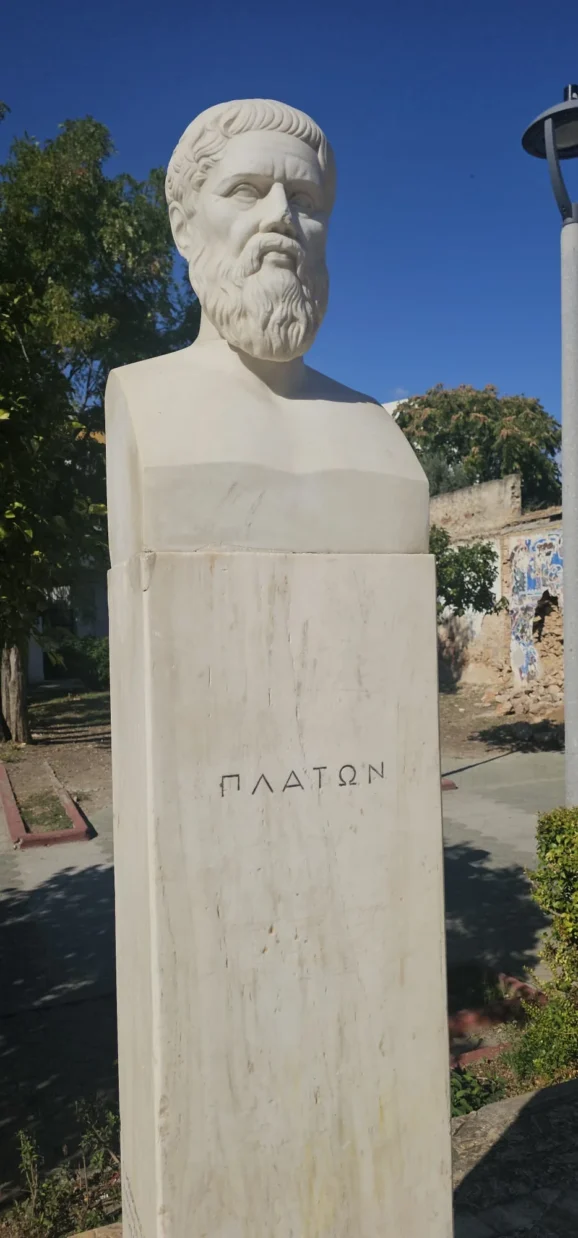
People were gathered near a bust of Plato, talking, laughing and enjoying the public space. There was nothing wrong with that, of course. A park should belong to the people who live around it. But I found myself wondering how many knew, or had been encouraged to discover, what had happened here more than 2,000 years earlier.
Nearby stood the Plato Digital Museum, a shipping-container-like structure that promised some interpretation of the site’s history. Unfortunately, it was Monday, when the museum was closed.
There may be more ambitious plans for the area, and I certainly would not claim that nothing has been done to preserve it. But as a visitor, I was struck by the gulf between the importance of the ideas associated with this place and the modest way that importance was communicated.
Plato’s Academy was not just another collection of ancient buildings but, rather, a place associated with the systematic questioning of knowledge itself, a tradition that helped shape philosophy, science, education and our understanding of society. Yet the physical place seemed almost an afterthought, and that brought me back to the subject that had taken me to Athens in the first place: journalism.
The parallels are not exact, but they are worth considering. Just as it’s possible to visit Athens and see the great tourist attractions without ever discovering the Lyceum, it’s possible to consume enormous quantities of modern media without encountering much original, independent journalism. The infrastructure remains. The websites, brands, newsrooms, platforms and distribution networks are all there. But what happened to the purpose?
I don’t believe the answer is to recreate some imagined golden age of journalism. Instead, it is to recover the principles that made journalism valuable in the first place and build an economic system that rewards them. The guiding principle is simple: trust over traffic.
This doesn’t mean abandoning technology, commerce or innovation. Artificial intelligence and new distribution models offer remarkable opportunities, provided they strengthen the journalist’s ability to investigate and verify rather than replace reporting with automated content. And a sustainable business model should reward the production of trustworthy information, not merely the number of people persuaded to click on it.
Perhaps what stayed with me most from Athens was that neither of the places we visited required a monumental reconstruction to become more meaningful. A little more attention to their history, better interpretation, clearer signposting and a greater sense of why they are important could transform a visitor’s experience. The same may be true of journalism.
We don’t necessarily need to invent a new purpose for the profession as we already have one, and it’s every bit as relevant today as it was when newspapers first began holding power to account. What needs rebuilding is the system around it.
As we walked away from Plato’s Academy, I thought of my friend’s delight at the possibility that her footsteps might have crossed the same ground as those ancient philosophers. There was no grand monument necessary to inspire that feeling, just an understanding of what had happened there and its timeless significance.
Perhaps journalism’s future begins with something equally simple: remembering what it is for.
Michael Leidig is a British journalist based in Austria. He was the editor of Austria Today, and the founder or cofounder of Central European News (CEN), Journalism Without Borders, the media regulator QC, and the freelance journalism initiative the Fourth Estate Alliance respectively. He is the vice chairman for the National Association of Press Agencies and the owner of NewsX. Mike also provided a series of investigations that won the Paul Foot Award in 2006.
READ MORE: AI firms are paying millions for journalism — so why are many reporters still skint? AI companies are striking multi-million-dollar licensing deals with some of the world’s biggest publishers, but as newsrooms scramble to monetise decades of reporting, many experts fear the AI boom could leave smaller publications and freelancers struggling to survive, write Michael Leidig and Rob Hyde.
Do you have news to share or expertise to contribute? The European welcomes insights from business leaders and sector specialists. Get in touch with our editorial team to find out more.
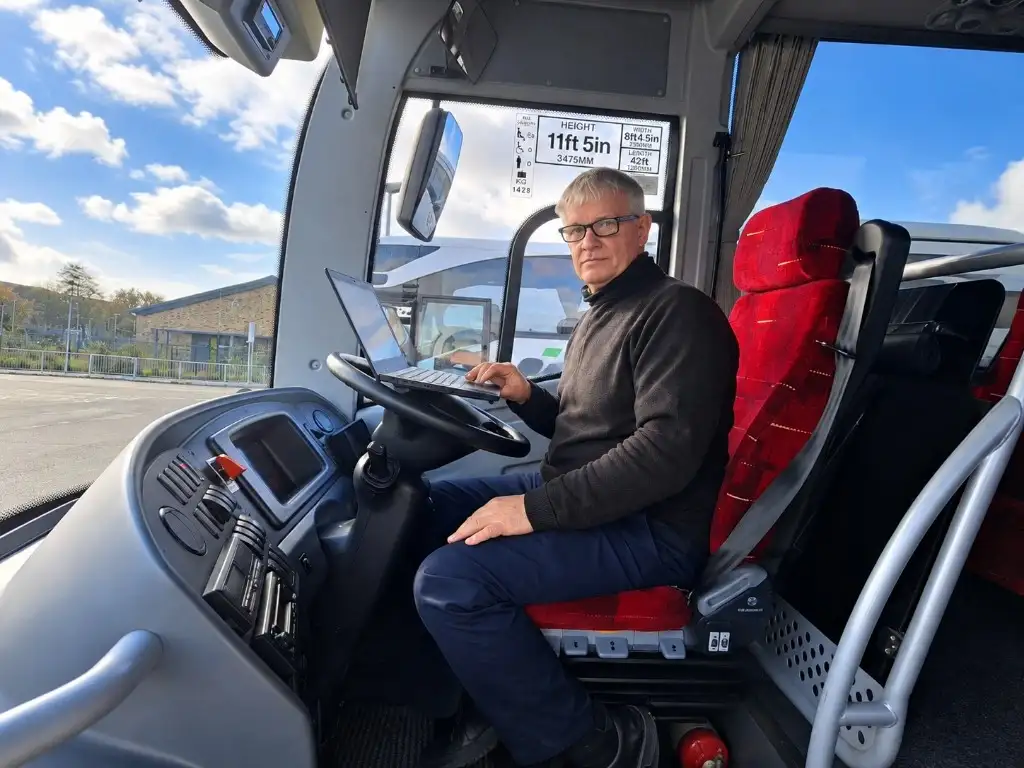
Main Image: Andrea Piacquadio / Pexels