Europe’s AI rulebook is taking shape, but what if the next major failure comes not from a lack of compliance but from governance systems that appear sound while drifting out of control? Vendan Ananda Kumararajah, creator of the A3 Governance Dashboard framework, argues that compliance alone may not be enough to detect governance drift
Europe now has a landmark AI law. The EU AI Act has created a legal architecture for classifying and controlling high-risk systems, and organisations across the continent are busy building policies, registers, oversight committees and compliance processes to meet its requirements.
That work is necessary, but a deeper question sits beneath the paperwork.
As organisations build policies, registers and oversight structures to demonstrate compliance, the more fundamental issue — whether governance itself remains coherent once systems come under pressure — remains largely unexplored.
What if the next generation of AI failures in Europe comes from systems that appear governed on paper while quietly drifting out of control?
That is the signal emerging from the A3 Governance Dashboard beta, a new assessment framework designed to evaluate governance systems through the lenses of ethical coherence, systemic distortion and agency fitness.
Most major institutions now know the governance choreography. They publish responsible AI principles, maintain risk registers, establish human oversight procedures and document audit and escalation processes.
All of this is necessary, but none of it guarantees that governance remains effective when systems are placed under real operational strain.
The questions that matter are often more foundational. Do ethical commitments actually influence deployment decisions? Are probabilistic outputs treated as more authoritative than the evidence permits? Do escalation mechanisms activate when something appears wrong? Is an organisation becoming dependent on synthetic interpretation? Can it recognise its own drift before the public does?
The A3 Dashboard was built to examine precisely the gap between governance as documented and governance as lived.
It does so through three interdependent dimensions: Aram (ethical coherence), Aanavam (systemic distortion) and Adhikaram (agency fitness).
Aram examines whether declared purpose, duties and stakeholder commitments genuinely shape decision-making. Aanavam explores how incentives, information quality, opacity and institutional defensiveness distort judgement. Adhikaram assesses whether those making or delegating decisions possess the authority, knowledge and adaptive capacity required to act responsibly.
The dashboard also measures what it calls ‘Triadic Sync’: the degree to which these three dimensions continue to move together as a system operates.
Early findings from the A3 Governance Dashboard beta suggest that this synchronisation, or its absence, is where governance often begins to fail.
Across 53 cases spanning AI governance, healthcare, infrastructure, financial crime, public administration, local government and environmental systems, a recurring pattern emerged.
For some examples, including cancer care and international water governance, the findings showed ethical commitments, low distortion and strong adaptive capacity operating in alignment. In those cases, high Triadic Sync translated into high overall integrity.
Alongside this, many of the 53 organisations performed reasonably well when individual dimensions were assessed in isolation.
Yet when Aram, Aanavam and Adhikaram were considered together, Triadic Sync scores were often significantly weaker than the individual pillar scores. In practical terms, governance architectures often appeared more resilient than their underlying synchronisation suggested.
That misalignment is the early warning.
The pattern is not merely theoretical. The beta corpus includes a longitudinal assessment of Volkswagen during the Dieselgate scandal. Long before the crisis became public, reporting already pointed towards opacity, strain and governance weaknesses. Following the scandal, all three dimensions showed severe deterioration.
Viewed through the A3 lens, Dieselgate becomes an example of a system gradually losing coherence before experiencing a highly visible failure. The warning signs existed before the scandal broke. They simply were not being measured in that way.
The dashboard is therefore not simply attempting to identify failure but also to distinguish between stable, strained and critical governance states.
That, in turn, raises a broader question about whether current approaches to AI governance are measuring the same dimensions.
The European debate on AI governance remains largely focused on classification: which systems are high-risk and which obligations apply to them.
That focus is understandable as regulation requires categories. Yet the A3 findings point towards a different question. Even when an AI system is correctly classified, fully documented and subject to formal oversight, how can organisations know whether governance itself remains coherent?
None of the core regulatory categories yet ask the question the A3 beta keeps surfacing: Are ethics, distortion control and agency fitness still moving together?
Advanced AI systems are becoming increasingly embedded within institutional decision-making. They help prioritise information, shape confidence, influence recommendations, reorder attention and accelerate decision processes. In some environments they already affect how organisations interpret evidence and respond to uncertainty.
The governing question is therefore changing. Under what conditions should an intelligent system, or a human-AI arrangement, be permitted to interpret, recommend, influence, escalate or act? Triadic Sync offers one possible answer to this: not when ethics, information integrity and agency fitness are falling out of alignment.
The A3 Governance Dashboard remains a beta instrument and is presented as an applied demonstration rather than an independently certified governance standard.
Even so, the patterns emerging across the current case set raise important questions for European policymakers, regulators and institutional leaders. Can ethics, distortion and agency be treated as separate compliance domains when many governance failures appear to emerge from the way they interact? Can institutions detect governance drift before a crisis occurs? And how should organisations evaluate AI-enabled decision-making when the systems themselves increasingly shape confidence, interpretation and action?
The EU AI Act provides an important legal framework. The next challenge is developing governance intelligence: the ability to recognise when ethical commitments, information integrity and decision-making capacity begin drifting apart before intelligent systems fail in public.
Compliance can demonstrate that obligations have been identified, and audit can demonstrate that procedures exist. Triadic Sync is intended to show whether governance remains coherent under live conditions.
That is the frontier Europe is now approaching, and one that law alone cannot cross.

Vendan Ananda Kumararajah is an internationally recognised transformation architect and systems thinker. The originator of the A3 Model—a new-order cybernetic framework uniting ethics, distortion awareness, and agency in AI and governance—he bridges ancient Tamil philosophy with contemporary systems science. A Member of the Chartered Management Institute and author of Navigating Complexity and System Challenges: Foundations for the A3 Model (2025), Vendan is redefining how intelligence, governance, and ethics interconnect in an age of autonomous technologies.
READ MORE: ‘Is Europe regulating the future or forgetting to build it? The hidden flaw in digital sovereignty‘. As Europe builds on the GDPR and AI Act, the next frontier lies beyond rulebooks and penalties, writes Vendan Kumararajah, who argues that digital sovereignty will endure only if governance, legitimacy and distortion detection are engineered directly into the architecture of AI systems themselves, rather than imposed from outside through compliance alone.
Do you have news to share or expertise to contribute? The European welcomes insights from business leaders and sector specialists. Get in touch with our editorial team to find out more.
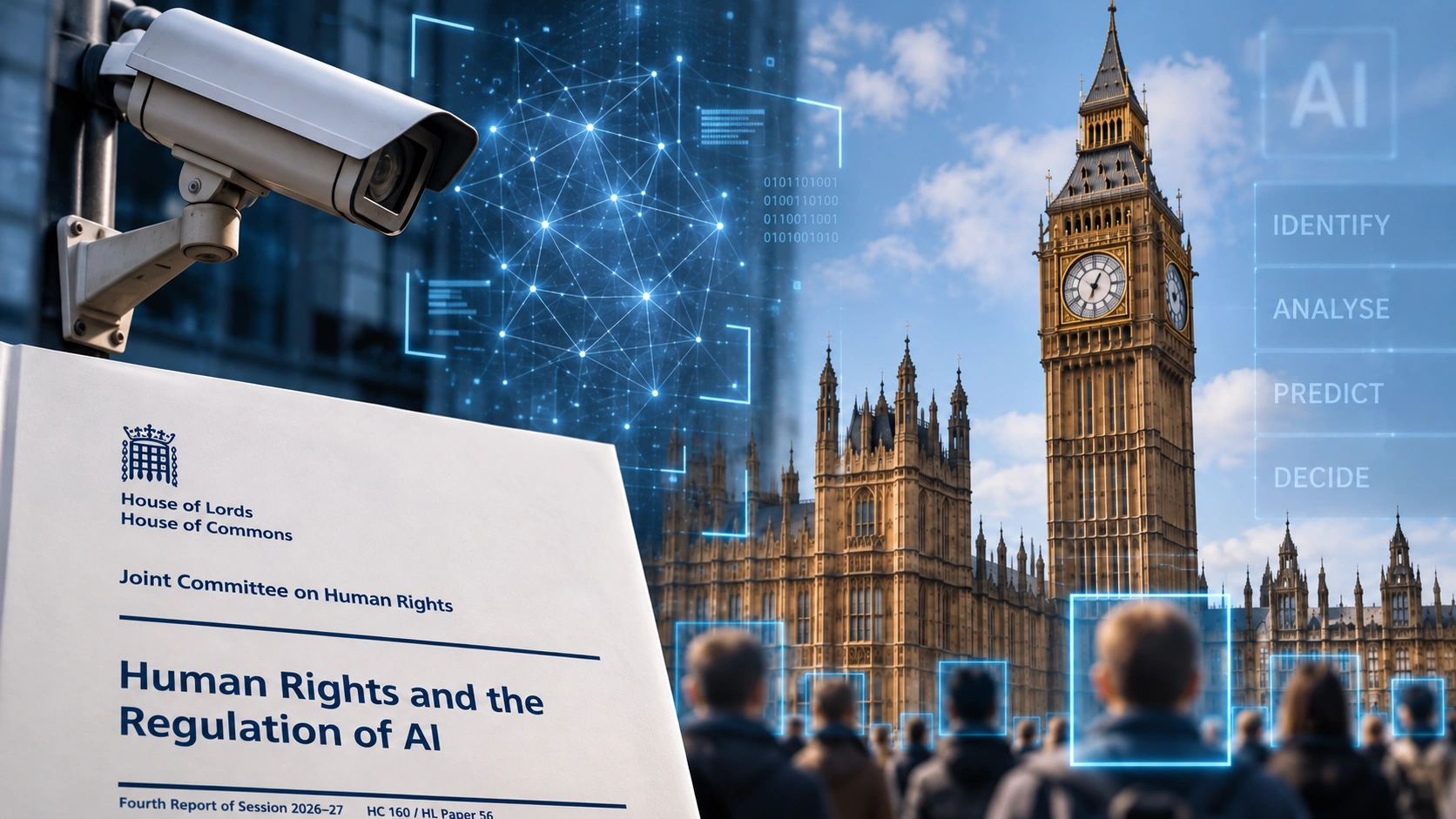
Main Image: AI-generated illustration accompanying Vendan Ananda Kumararajah’s argument that governance failures often begin as subtle signals of institutional drift long before a crisis becomes visible. Artwork: Belters News. Credits: Derived from a photograph of an ECG printout by Luan Rezende, via Pexels.