Modern medicine excels at isolating individual causes, but chronic illnesses often develop through interacting biological processes. Dr Tom Lonsdale argues that periodontal disease (gum disease) shows why researchers must look beyond simple chains of cause and effect
The achievements of modern medicine are remarkable. From the beginning of life to the end, from IVF to palliative care, clinicians and researchers routinely accomplish things that previous generations would have regarded as miracles.
Yet our appreciation and admiration should not dissuade us from questioning the concepts and methods upon which medicine depends.
During my years in veterinary practice, treating dogs and cats, I began to wonder whether our concepts of health and disease, and medical research methods, were giving us only a partial picture.
Modern medicine has been shaped by three immensely successful approaches. First, reductionism divides complex problems into smaller elements, allowing researchers to identify direct causal relationships such as vitamin C deficiency causing scurvy or contaminated water spreading cholera. Second, germ theory transformed our understanding and control of infectious disease. Third, medicine’s commitment to treating the sick and relieving suffering has saved and prolonged countless lives.
The difficulty arises when approaches developed to isolate direct causes of acute disease are applied to chronic and interrelated diseases. Such conditions may not operate as simple sequences in which one factor produces one predictable result. Several biological influences may interact, reinforce one another or change direction over time.
It’s true medicine has become highly effective at managing chronic conditions, but management is not the same as prevention or cure. A government estimate published in the previous decade suggested that caring for people with long-term conditions accounted for around 70 per cent of health and social-care spending in England.
We may therefore need to look again at the conceptual frameworks and research methods through which chronic disease is understood.
To this end, I believe that a cybernetic system can come to our aid. Cybernetic theory examines how systems communicate, regulate themselves and respond through control and feedback. Cybernetic methodology does not discard reductionism, germ theory or treatment. It asks how the individual components identified by those approaches interact within the wider biological system.
My own route towards this idea began with gum disease (periodontal disease) in dogs and cats.
During the late 1980s and early 1990s, my colleagues and I became increasingly aware of the prevalence of oral disease among the animals arriving at our clinics. Gum disease was then, and still is, extremely common, with veterinary guidelines estimating that some form of periodontal disease affects 80 per cent of dogs and 70 per cent of cats by the age of two.
There was no sudden revelation. The questions accumulated gradually. If periodontal disease was common, were we identifying part of the ageing process, a local infection or evidence of a wider biological problem?
We began to pay closer attention to the animals’ diets and behaviour. Many were fed industrially produced foods that required little ripping, tearing or gnawing. Their factory-made food did not require the vigorous oral activity associated with a carnivore’s natural feeding behaviour – the vigorous ripping at raw hide, the tearing and crunching on raw meat and bone.
We encouraged owners to replace processed food with appropriately selected raw meaty bones and other natural food. Where gum disease was already established, we carried out corrective dental treatment.
We gained an enthusiasm for our task when the majority of our patients showed marked improvement in their oral hygiene. In many cases, owners remarked on their pets’ renewed vitality and the improvement of a range of problems beyond the mouth, including skin conditions, digestive disturbances, lethargy, erratic behaviour and recurrent illness.
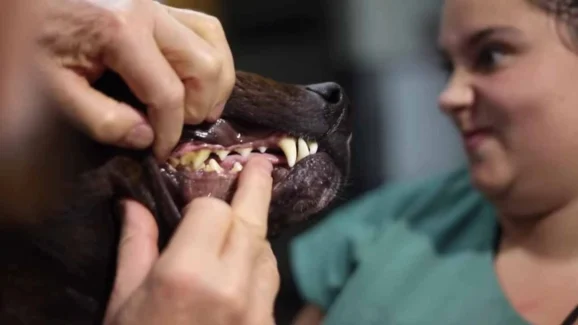
These were our clinical observations, not controlled scientific trials. Also, dietary change and dentistry were often combined therapy. Accordingly, it was not possible to determine with confidence if the improvements were due either to diet, dentistry or both.
However, a recurring and important question arose: was periodontal disease merely a local dental condition occurring alongside other illnesses, or was it a significant aspect of a wider biological system?
Changing the diet sounds like a single intervention but the word ‘diet’, a singular noun, conceals a multiplicity of factors and interactions. Diet involves nutrient quantity, quality and frequency. It involves food texture, chewing behaviour, mechanical cleaning and effects on the gums, and the environment in which oral microbes live.
Published research has reported that chewing raw bovine bones can reduce dental calculus in dogs, with implications for the preventative maintenance of healthy teeth and gums. Corrective dentistry reduces pain and lessens inflammation whether by removing diseased teeth or removing calculus from otherwise healthy teeth.
This led me to reconsider the role of bacterial plaque. Removing plaque and calcified plaque, calculus, was undoubtedly important, but I did not see the intervention solely as an application of germ theory in which harmful bacteria were targeted and removed. Instead, I viewed it as implementing a change to the environment of the mouth, with consequences for the organisms living within the plaque biofilm.
The condition of the mouth affected the microbes while the microbes affected the local gum tissues and the wider tissues of the body. Diet and oral activity influenced both. Local pain and inflammation could affect the animal’s behaviour and general condition, while its wider health could influence disease in the mouth.
These did not appear to be isolated events operating in one direction but, rather, parts of an interdependent system. In 1994, I set out these ideas in a paper published in the Journal of Veterinary Dentistry, Cybernetic Hypothesis of Periodontal Disease in Mammalian Carnivores.
The hypothesis proposed that periodontal disease and its interdependent links may play a regulatory role in wild carnivore populations by affecting the fitness and survival of individual animals. In domestic animals, processed feeding, reduced natural oral activity, veterinary treatment and prolonged survival may alter those relationships.
This remains a hypothesis rather than an established population regulatory mechanism, but it does illustrate the difference between a linear and a cybernetic question. A linear approach may ask which bacterium causes periodontal disease or which inflammatory pathway connects the mouth to another organ. Those are valuable questions, but a cybernetic approach goes further by asking how diet, oral activity, microbes, tissue damage, inflammation, behaviour and the animal’s wider condition modify one another over time.
The possible implications for human health should be approached cautiously. Observations from veterinary practice cannot simply be transferred into human medicine. However, neither should veterinary experience with animals be ignored. Leading-edge medical research often depends on animal experiments and testing.
Severe periodontal disease affects more than one billion people worldwide. Gum disease is associated with diabetes, cardiovascular disease, cancer and a host of chronic diseases. Exactly how these conditions interact, one with another, is increasingly being questioned.
At least some of these relationships may be reciprocal. Diabetes increases the risk and severity of periodontal disease, while periodontal inflammation may in turn make glycaemic control more difficult. Environmental, behavioural and biological factors can affect both conditions.
The question may therefore be broader than whether gum disease causes a particular condition in one direction.
My paper in the Journal of Periodontal Research, ‘Periodontal Medicine and the Limitations of Linear Causality: Time for a Cybernetic Framework’, published earlier this year, argues for a wider approach.
Periodontal disease offers an important case study. It is widespread and increasingly studied in connection with health beyond the mouth, yet many questions about those relationships remain unresolved. Researchers have identified numerous organisms, inflammatory processes, risk factors and associations connected with periodontal disease. The cybernetic challenge is to examine how those findings interact, regulate and reinforce one another within the whole system.
The next step should be to investigate whether periodontal disease and its wider relationships make greater sense when viewed through communication, control and feedback.
Rather than isolating one more mechanism from the rest, researchers should also test how the mechanisms already identified operate as parts of a communicating and regulating system.
If the cybernetic framework proves useful here, it may offer a better way of understanding other chronic and interrelated diseases that medicine manages over long periods without yet fully explaining or preventing them.
Medicine has advanced in great leaps. Potentially the next leap will be cybernetics, with new concepts and pathways providing improved treatment and prevention. To my mind, cybernetics offers the breadth needed to reveal how the whole biological system operates – and our place within it.

Dr. Tom Lonsdale BVetMed MRCVS is a distinguished veterinary clinician and author with over 50 years of experience. He is known internationally as a pioneer and authority on the nutritional and medicinal features of a natural diet for pets. Tom is a vocal advocate against what he perceives as collusion between the veterinary establishment and the pet food industry. He has earned the moniker, ‘The Whistleblower Vet’, for debunking misinformation about pet health.
READ MORE: What Yellowstone’s wolves could teach us about our pets’ health. The return of wolves to Yellowstone National Park changed the workings of an entire ecosystem. But according to Dr Tom Lonsdale, one possible regulatory mechanism has remained almost entirely overlooked: the predator’s mouth. Studying this could reveal whether modern feeding habits are leaving pet dogs suffering years of preventable oral disease.
Do you have news to share or expertise to contribute? The European welcomes insights from business leaders and sector specialists. Get in touch with our editorial team to find out more.
Main Image: Jonathan Borba/Pexels