The £9.5m operation on the SS Richard Montgomery will begin in September under strict safety controls in the Thames Estuary
Work to remove the three masts from the SS Richard Montgomery, the wartime wreck packed with explosives off the Kent coast, will begin in early September.
The U.S-built Liberty ship ran aground in the Thames Estuary in 1944 while carrying about 7,000 tonnes of munitions for the Allied war effort.
Most of the cargo was removed, but more than 1,400 tonnes of unexploded bombs and other explosives remain in the vessel’s forward holds.
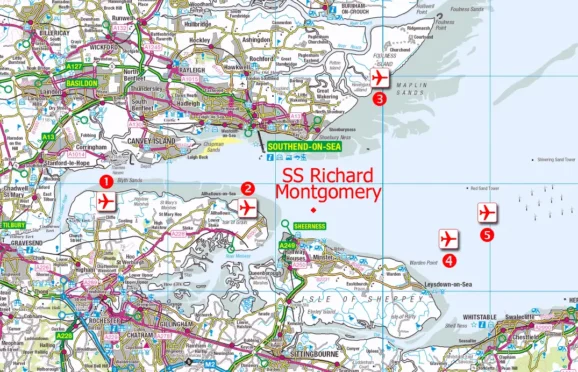
The wreck, which is continuously monitored and surrounded by an exclusion zone, is considered so dangerous that experts have long advised leaving the remaining explosives undisturbed.
But the government said specialist maritime engineers will now attempt to reduce the masts’ height to below sea level to ease pressure on its structure and reduce the risk of heavy objects falling onto the munitions below.
Specialist contractor Resolve Marine will build an underwater platform before cutting the masts – which are visible during all tides – over several weeks.
Expert advice had confirmed the work could be carried out safely without increasing the risk from the explosives still on board, it said.
Preparatory work will begin later this month before the main mast removal operation starts in September.
The masts will be taken to The Historic Dockyard Chatham, where they will be preserved by specialist conservation teams.
The government said they would later be displayed locally in Kent, with discussions continuing over their long-term home.
Keir Mather, the Aviation, Maritime and Decarbonisation Minister, said: “Safety and preservation of the masts are our absolute priorities.
“This carefully planned work has been informed by years of expert analysis and monitoring, which will ensure the wreck continues to be managed safely, protecting local communities, maritime traffic and the wider environment.”
An exclusion zone around the wreck, which lies around 1.5 miles off Sheerness, will remain after the masts are removed.
Mather added: “Keeping the masts in Kent will also preserve an important piece of the county’s maritime heritage, allowing future generations to learn more about the story of the vessel and the great sacrifices made by the Allied Forces during the Second World War.”
READ MORE: How the Battle of the Somme shaped the role of the modern military chaplain. This month marks the 110th anniversary of the Battle of the Somme, one of the bloodiest battles of the First World War. The five-month struggle proved a major turning point of the war, but the Somme also transformed the role of military chaplains in the British Army, shaping a modern ministry ready to accompany troops onto the front line, writes Dr Linda Parker.
Do you have news to share or expertise to contribute? The European welcomes insights from business leaders and sector specialists. Get in touch with our editorial team to find out more.
Main image: The rusting masts of the SS Richard Montgomery rise from the Thames Estuary off Sheerness, where engineers will cut them below the waterline in September to stop them collapsing onto the explosives still inside the wreck. Credit: Christine Matthews, CC BY-SA 2.0.