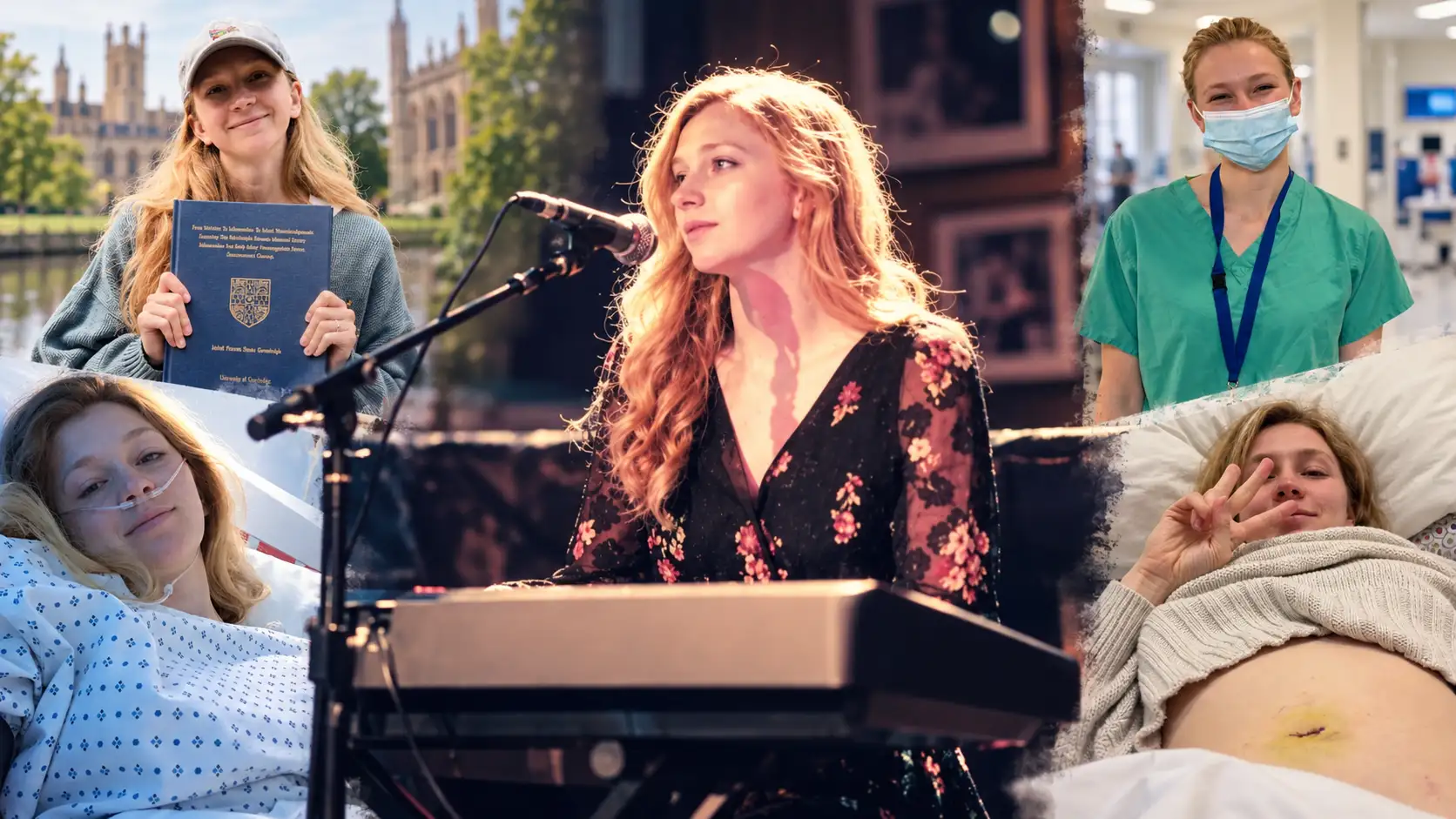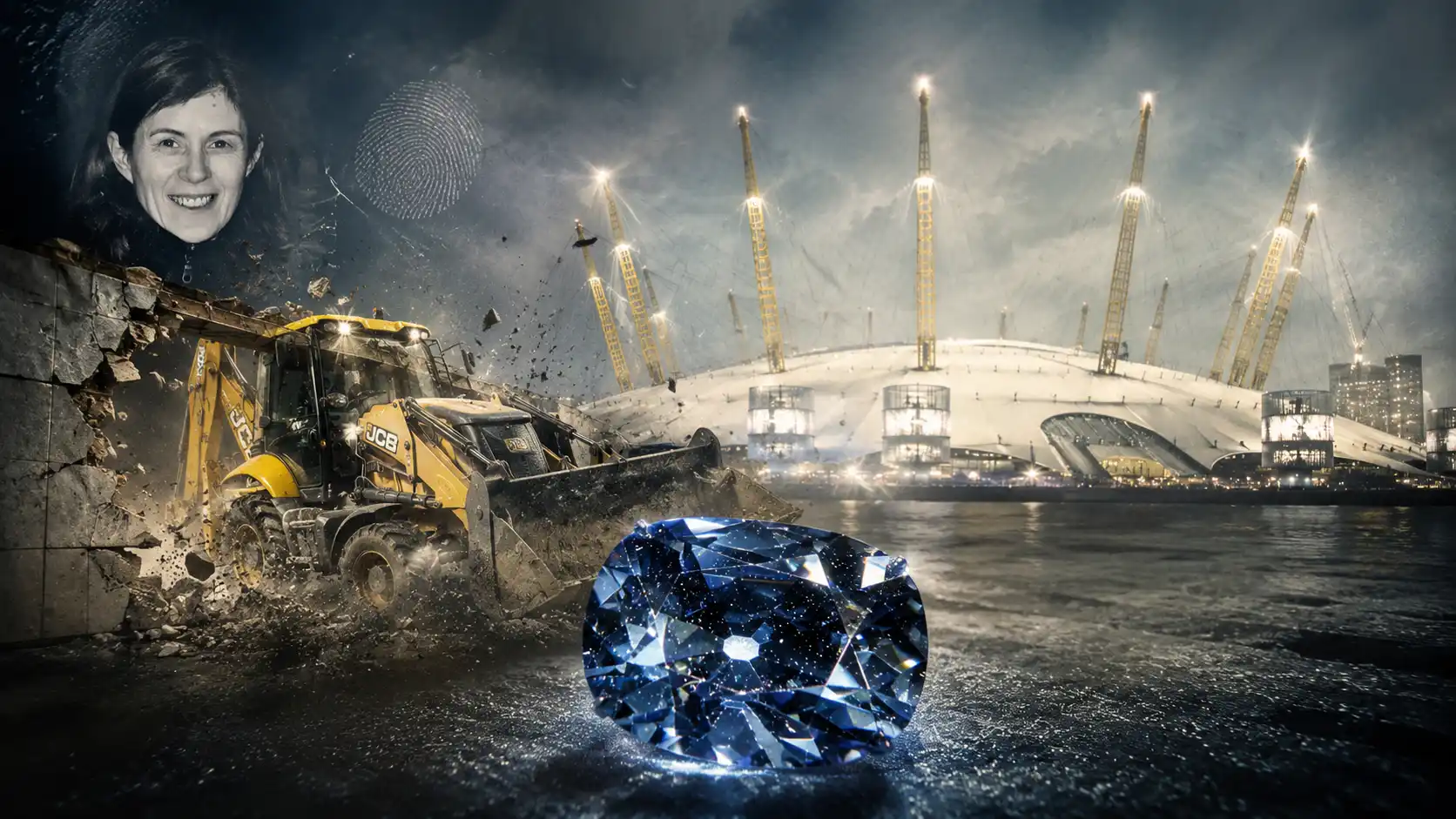
In November it will be 25 years since the trial began of the gang behind the attempted Millennium Dome diamond robbery. Writing about her experience for the first time in this exclusive for The European, former Dome Senior Host Julia Dawkins recalls the morning a JCB crashed through the building, armed police swarmed the concourse and she led a blind colleague and his guide dog to safety
The first thing I heard was an enormous crash.
Seconds later came the roar of an engine and a dirty yellow JCB hurtled past the glass-fronted office where I was working inside the Millennium Dome. Its windscreen was smashed, its bucket was raised, and the vehicle appeared to be completely out of control. Then it shuddered to a halt only yards from us.
I opened the office door briefly and looked out. The driver was wearing a mask. Three other men jumped from the vehicle. A duty manager ran into the room shouting: “Everybody has to get out, now!” She disappeared almost as quickly as she had arrived.
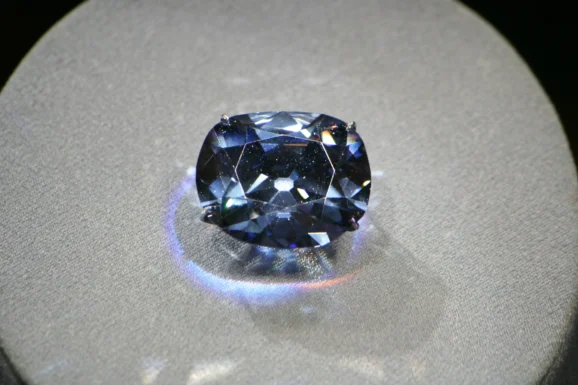
That was how I found myself caught in the middle of the attempted Millennium Dome diamond heist on 7 November 2000. In a few months’ time, it will be 25 years since the trial of the men responsible opened at the Old Bailey. The police operation, the gang’s plan and the extraordinary attempt to steal the flawless De Beers Millennium Diamond Collection, all £200 million of it, have since been retold in documentaries and television programmes.
I had started working at the Dome, now The O2, just over a year earlier.
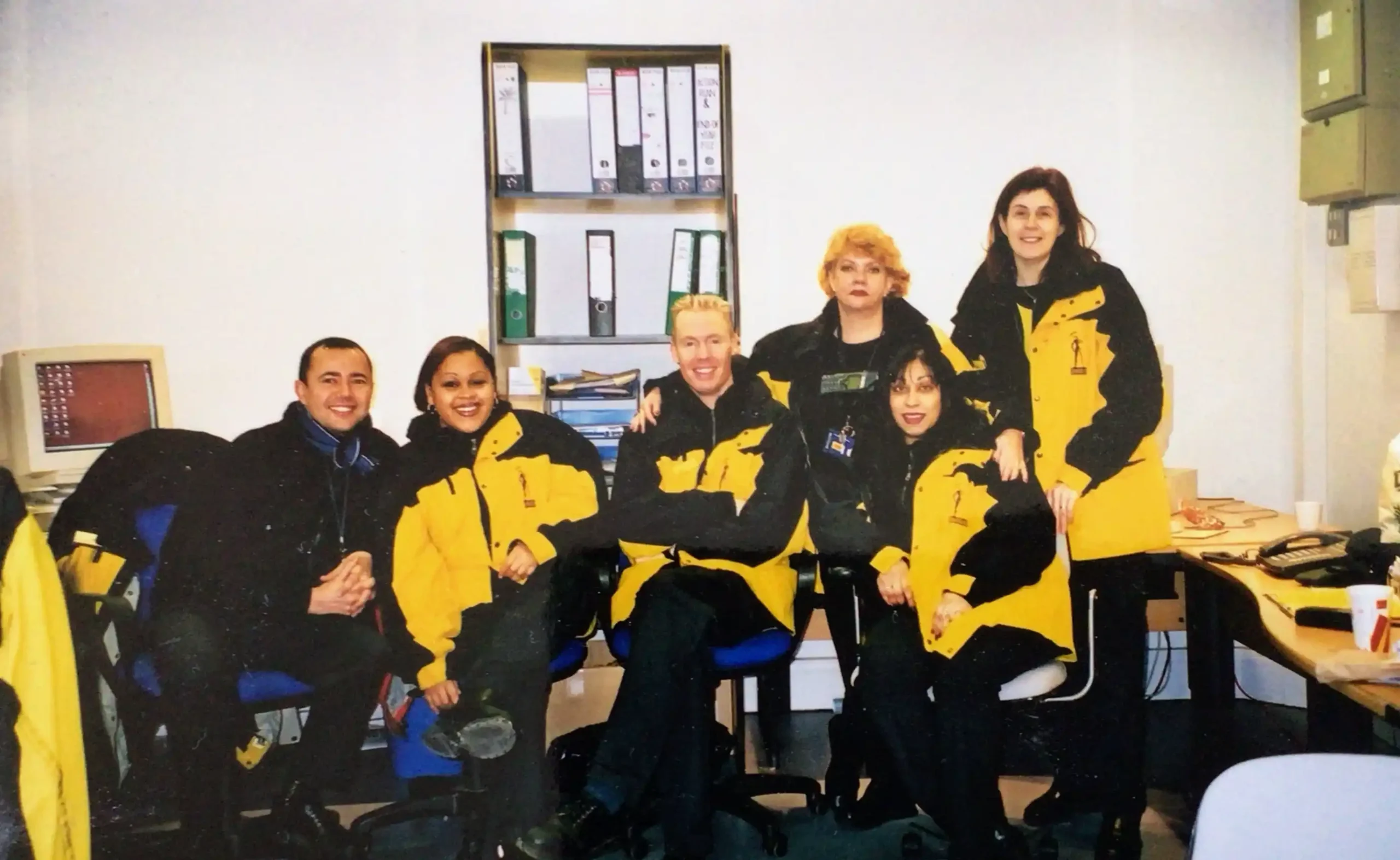
On 25 October 1999, I arrived for my first day of training as one of six Senior Hosts leading the Information Services team. We supervised 85 Hosts and ran 12 information points around the building. Our responsibilities included complaints, lost property, lost children, wheelchairs and first aid. The Millennium Dome was still a building site when our training began. We wore hard hats, luminous yellow jackets and green Wellington boots as contractors worked around us. Many of the boots were size eight or larger, which was not especially helpful when half the trainees were women. Routes through the site changed from one day to the next as trenches were dug and sections were cordoned off.
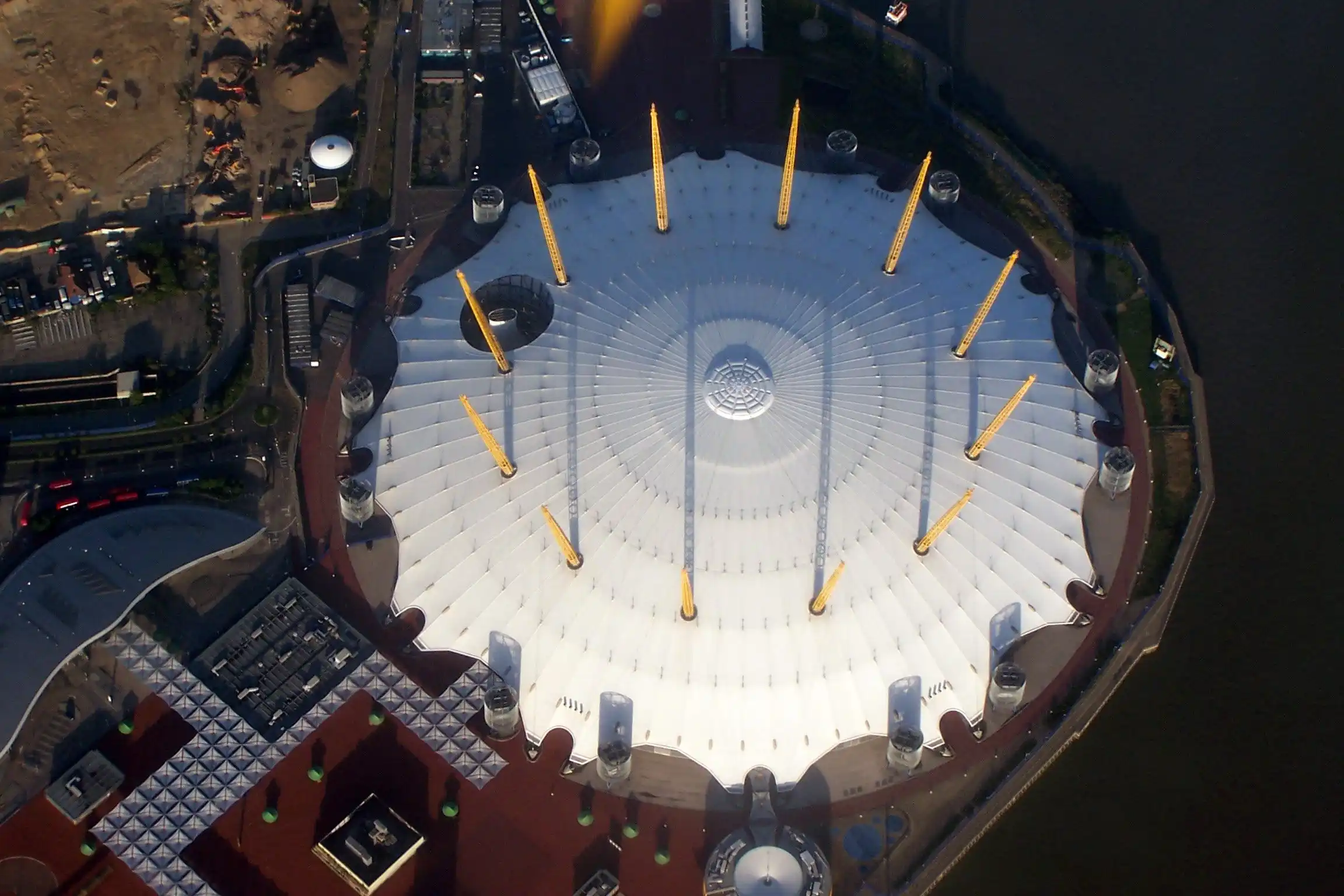
The Dome itself was unlike anything I had seen before. Its vast white canopy was supported by 12 yellow towers, representing the months of the year and the points on a clock. Inside, most of the exhibition zones remained unfinished. The Body Zone was the only one that looked recognisable. Its huge orange structure towered over the construction work.
The full complement of 800 Hosts arrived on 29 November. Senior Hosts were sent out to give tours armed with plans showing the positions of the 14 zones. The maps bore little resemblance to what we found on the ground. New staff asked where the toilets were. We went to the location shown on the plan and found they were not there. We hurried to another possible location and found them locked.
By 14 December, the Dome was finally ready for its first visitor trial.
Friends and family were invited to test the zones, restaurants and emergency procedures. Information Services staff were told to attend in ordinary clothes and behave as visitors. We sampled food from the sushi bar and watched the Millennium Show in the central arena. Aerial performers flew above us in harnesses to deafening music. I had little idea what the show was supposed to mean, but it was a magnificent spectacle.
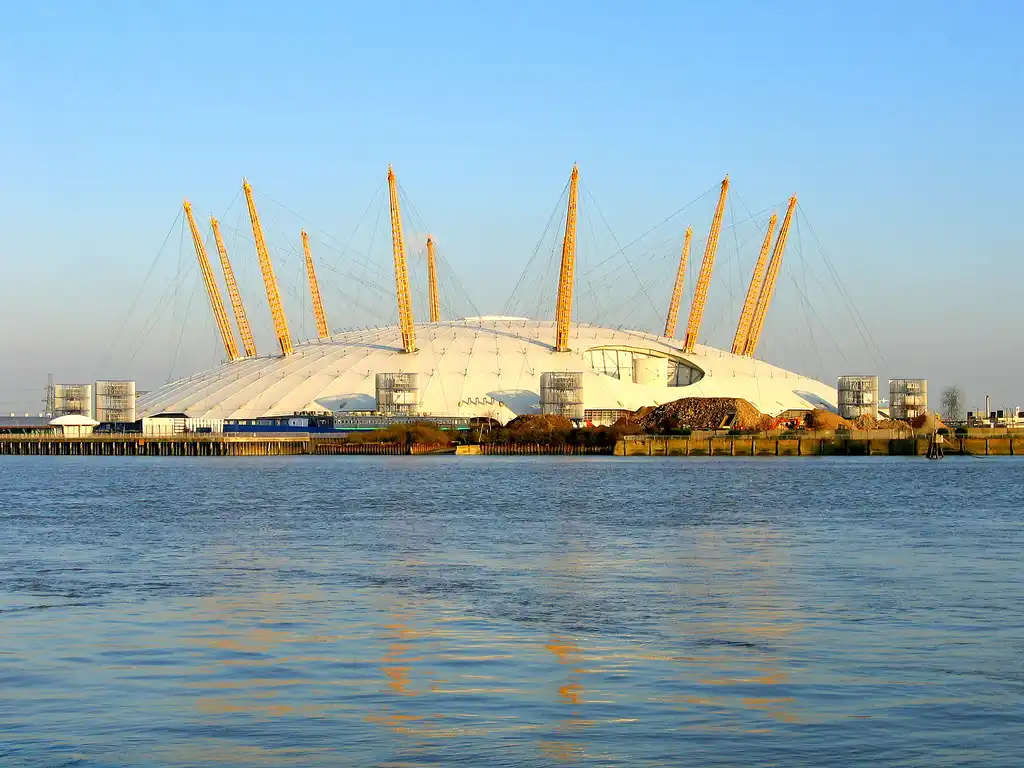
The Dome’s official opening on New Year’s Eve brought its own chaos. Thousands of invited guests were delayed by transport failures, ticketing problems and a bomb threat that proved to be a hoax. Some arrived shortly before midnight after spending hours waiting at stations in dinner suits and evening dresses.
Inside, there were politicians, celebrities and members of the Royal Family. The Queen and Duke of Edinburgh attended, along with Tony Blair, Cherie Blair and a long list of dignitaries. There were problems finding seats and meals for some of them. One of our Senior Hosts eventually took food trays from staff on their break and presented them to waiting VIPs. “Sorry, these are for the VIP’s, you will have to share,” she told the staff. She then handed over the plastic trays with half a bottle of champagne and said: “Do enjoy your meal.”
The following morning, the newspapers carried headlines including “Doom at the Dome”.
For the staff, the real work was only beginning. We answered questions, dealt with angry visitors and reunited lost children with their parents. We issued wheelchairs from a kiosk in Main Square. One was returned by taxi with a thank-you note and a flight label from Athens still attached. Senior Hosts were given electric scooters so we could respond quickly to incidents around the enormous building. We also carried Palm Pilots containing information about events and instructions for the day. They felt futuristic until their batteries ran out, which they often did when we needed them most.
Complaints became a daily feature of life inside the Dome. Visitors objected to queues, toilets and exhibits. One woman demanded action after water from a hand basin went into her designer handbag. Another emerged from the lavatories with orange juice spilled over an expensive pair of cream trousers.
Lost property was rarely dull. After the violinist Nigel Kennedy performed at the Dome, a violin was handed in. I opened its battered case and saw the name Antonius Stradivarius inside one of the sound holes. “Oh my goodness, it must be Nigel Kennedy’s violin, he played here last night!” I said. I had played the viola in my twenties and could not resist carefully bowing a few notes before the instrument was locked away and Kennedy’s team contacted. The incident escaped the press and, as far as I know, this is the first time it has ever been made public.
By November, we thought we had seen almost everything the Dome could produce.
Then came the heist.
At about 9.15am on 7 November, I was in the Visitor Services Room checking the start-of-day procedures. Two Hosts were counting cash floats that would be delivered to the information points. Paul, one of our blind Hosts, was also there with his guide dog, Bella, who had settled into her bed beside him.
Around 15 minutes later, the crash echoed through the building. When the JCB stopped outside, I told the two Hosts handling the money to put the cash away. The duty manager then rushed in and ordered everyone to evacuate. “Leave that and go,” I told them. “I’ll help Paul and Bella.”
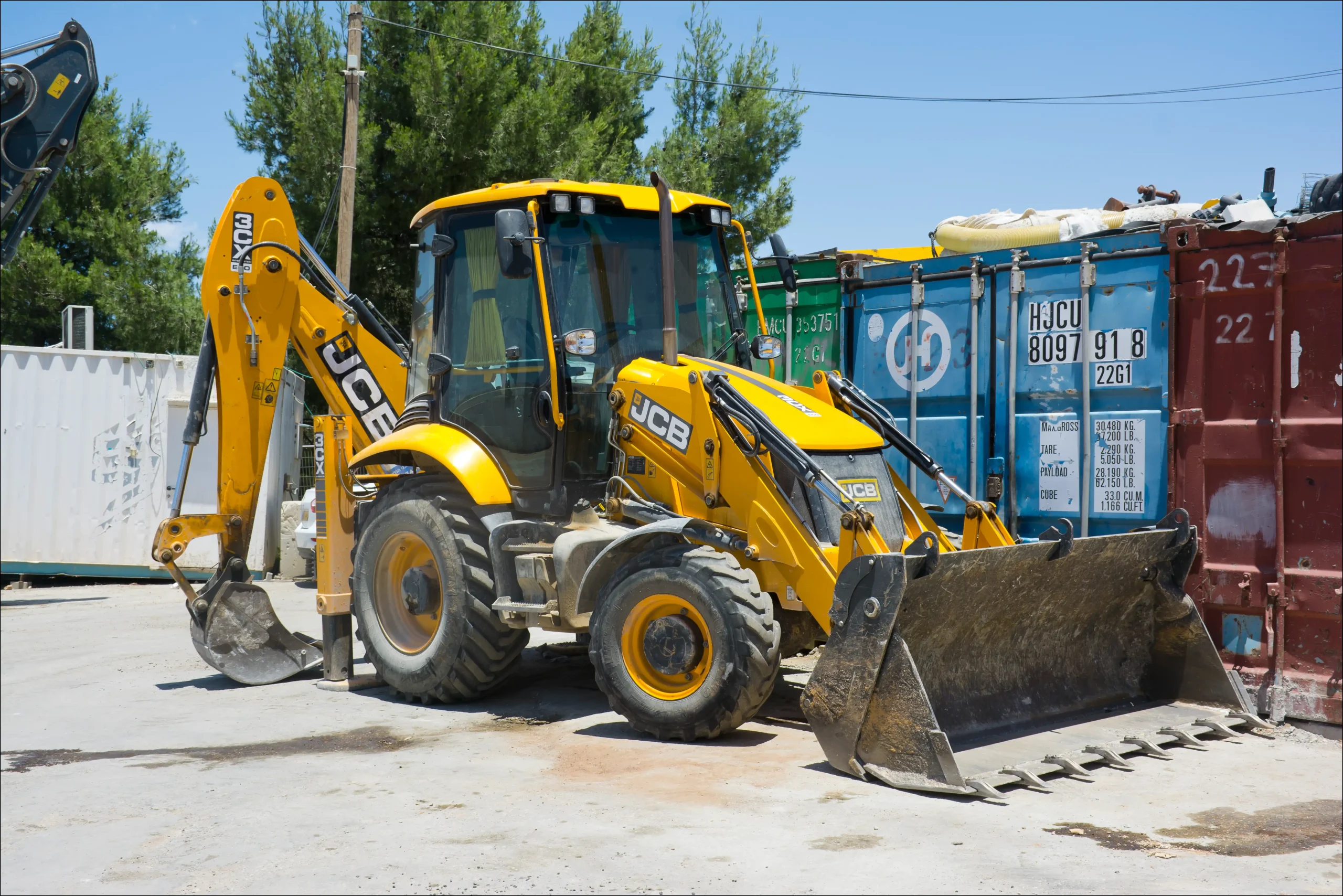
The two Hosts ran from the office and escaped through the hole the JCB had smashed in the Dome’s outer wall. Paul would not leave immediately. He wanted to gather his belongings. I tried to explain that the situation was urgent, then helped him put Bella into her harness.
Around us, men dressed in black and carrying guns were moving into position.
I took Paul’s arm and guided him from the office, with Bella beside us. As we moved, we heard explosions across the concourse. I later learnt that the robbers had released smoke grenades and the Flying Squad had used stun grenades. The noise was deafening.
Earlier that morning, I had seen cleaners working nearby. As the raid unfolded, they tore off their overalls to reveal police uniforms and pulled guns from their wheelie bins. Police had been waiting for the gang. Other Hosts were running from their posts. Two members of staff initially approached the JCB because they thought the driver might be having a heart attack. They saw the mask and fled.
Paul, Bella and I moved along the side of the Visitor Services Room towards the exit. An armed officer stepped in front of us. “You two stand still,” he shouted. He was dressed in black, wearing a gas mask and carrying a large gun.
We stopped.
More armed officers gathered around us. “Turn and face the wall you two. Hands against the wall.” I wondered whether the police believed we were involved. I stood with one arm close to Paul so he knew where I was. I described what was happening and stroked Bella to keep her calm. More explosions rang out. I tried to remind myself to stay calm. Paul then turned towards me and said: “It’s alright Julia, I’ve been in this situation before. I’m alright.” That came as a surprise. He later told me that he had once worked in a bank. I never learnt the full story.
The officer guarding us was replaced by another man wearing jeans, a bomber jacket and a cap. He held a pistol close to my shoulder. “This is the police and there’s a raid going on,” he told us, “but we’ve got it all under control.” I looked behind us and saw four men lying on the ground beside the JCB. Their hands were cuffed behind their backs and armed police surrounded them.
The officer told us we could leave so I guided Paul and Bella towards the exit, past more armed officers and into a nearby building where other Dome staff had gathered. Some were being comforted. Others were trying to explain what they had seen. I do not remember receiving any formal debriefing. I processed much of the experience by listening to other people and helping them talk through what had happened. The next day, I was interviewed inside the Visitor Services Room by the BBC and Channel 4. I do not believe either interview was broadcast.
Life at the Dome continued.
We worked until the end of its year-long run and gathered on 31 December for a final staff celebration. There was music, speeches and free champagne. At about 1.30am on 1 January 2001, the Dome’s chief executive, PY Gerbeau, spotted me crossing Main Square. He took my camera and asked someone to photograph us together. I still have the picture.
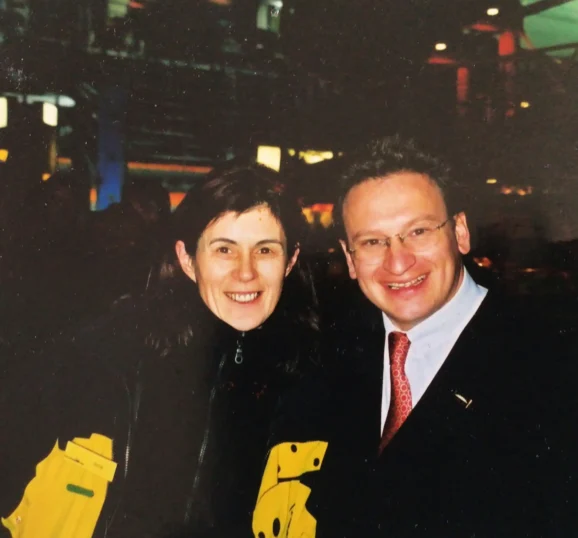
The story was not quite over.
In February 2002, I was summoned to the Old Bailey to give evidence. I took the oath in the wood-panelled courtroom and looked across at the accused men sitting nearby. I was asked where I had been when the JCB entered the Dome and what I had seen. Nobody asked about Paul, Bella or the terrifying journey from our office through a concourse filled with armed officers. I made sure the court heard about them anyway. Then came the words: “No further questions.” I stepped down from the witness box.
On 18 February 2002, Raymond Betson, William Cockram, Robert Adams and Aldo Ciarrocchi were convicted of conspiracy to rob. Betson and Cockram were jailed for 18 years each, while Adams and Ciarrocchi received 15 years. Kevin Meredith, who had been waiting in the getaway speedboat, was cleared of conspiracy to rob but convicted of conspiracy to steal and sentenced to five years. In January 2004, the Court of Appeal reduced Betson’s and Cockram’s sentences to 15 years and Ciarrocchi’s to 12. Meredith’s earlier appeal against his five-year sentence had been dismissed, while Adams died in prison following the trial.
My job at the Millennium Dome had been intended to last for one year.
It gave me friendships, extraordinary memories and experiences I could never have imagined, some of which would later find their way into my book, Spirit of the Dome. None was more extraordinary than the morning a JCB smashed through the wall and I found myself standing against it under armed guard, holding on to a blind colleague as police brought the great Dome diamond raid to an end.
READ MORE: Darling Buds and A Touch of Frost producer warns BBC ‘must rediscover its appetite for risk’. As former Google executive Matt Brittin takes charge as BBC director-general, Pip Burley, the producer behind The Darling Buds of May and A Touch of Frost, argues that the corporation faces a defining choice about its future. With Netflix, Amazon, Disney and YouTube changing how audiences consume content, and with the licence fee under growing pressure, he tells The European how the BBC must rethink its priorities, reduce its dependence on news and recover the confidence to back popular drama and comedy drama that can bring viewers back.
Do you have news to share or expertise to contribute? The European welcomes insights from business leaders and sector specialists. Get in touch with our editorial team to find out more.
Main image: Composite image created for The European. JCB photograph by Dr Zachi Evenor, CC BY-SA 4.0; Blue diamond photograph by 350z33, CC BY-SA 3.0; portrait courtesy of Julia Dawkins.