The return of wolves to Yellowstone National Park changed the workings of an entire ecosystem. But according to Dr Tom Lonsdale, one possible regulatory mechanism has remained almost entirely overlooked: the predator’s mouth. Studying this could reveal whether modern feeding habits are leaving pet dogs suffering years of preventable oral disease
In January 1995, 14 grey wolves from Canada were brought into Yellowstone National Park. Seventeen more followed in 1996, and by 1997 a total of 41 had been released. It was one of the most ambitious large-carnivore restoration projects of modern times, undertaken amid fierce political and legal opposition.
The population expanded rapidly. By the end of 2003, at least 174 wolves had some part of their territory within the park. Numbers later fell and stabilised at a lower level. At the end of 2024, the official count was 108 wolves in nine packs.
The popular version of what followed is now familiar: wolves reduced pressure from elk, vegetation recovered, beavers returned and even the rivers changed.
The reality is more complicated, and more interesting. Wolves certainly altered Yellowstone, but the scale and causes of the chain reaction (in ecological terms, ‘trophic cascade’) remain debated. Elk, bears, cougars, climate, vegetation, human hunting, territorial pressures and disease all interact. There’s no single lever and no settled, harmonious balance of nature. Instead, like everywhere else, we find a living system in continual adjustment.
Yellowstone, then, offers a rare opportunity to think not in straight lines of cause and effect, but, instead, in feedback loops.
Ecologists usually explain wolf numbers through food availability, competition, disease, pack conflict, territory and human killing outside the park. All are important, yet I believe another regulatory influence deserves investigation, operating in a central and indispensable part of the wolf’s anatomy: its mouth.
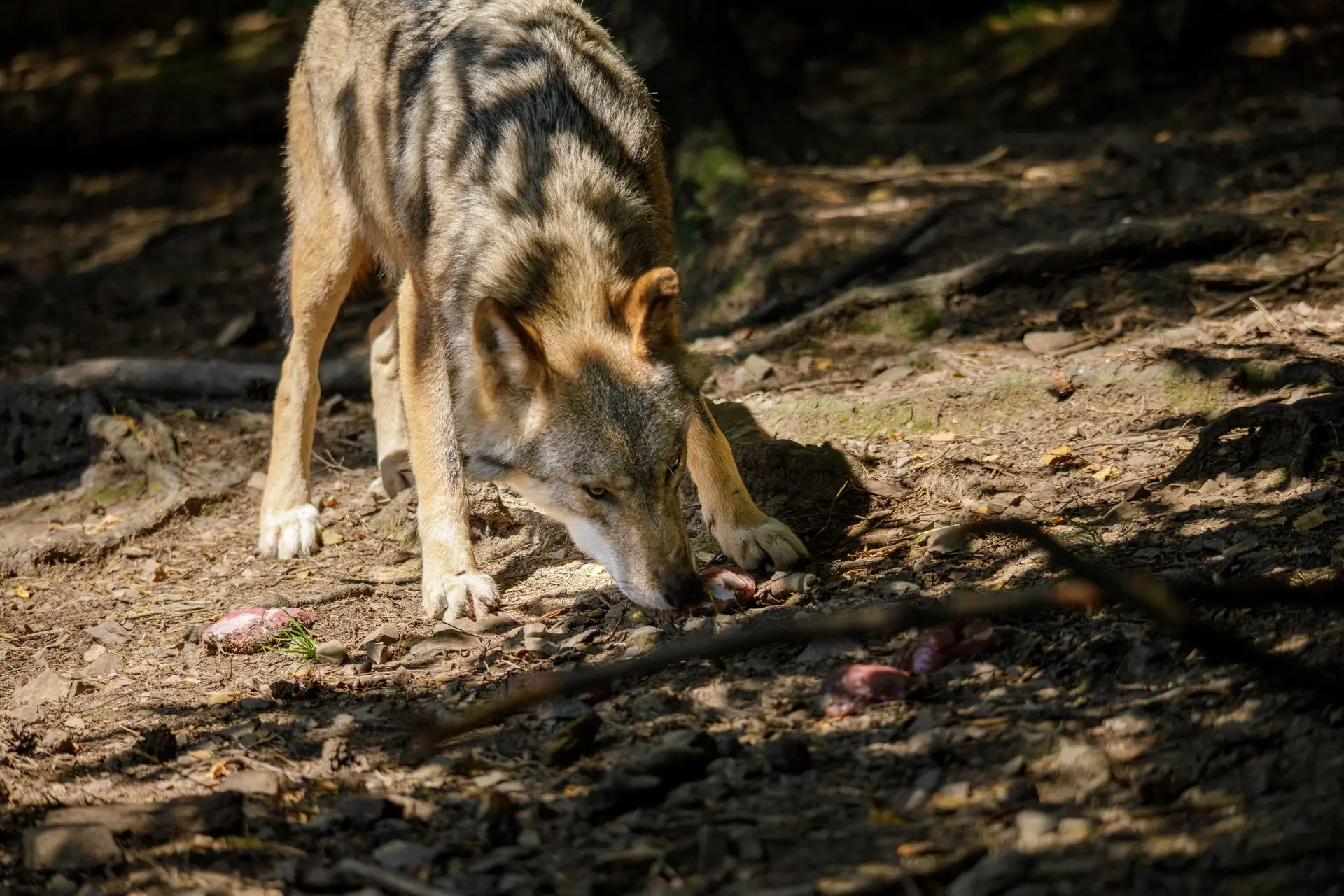
More than the mouth being the entrance to the wolf’s digestive tract, it is the animal’s principal working interface with the world.
Wolf teeth and jaws capture prey, tear hide, shear flesh, crush bone, defend territory and help establish status within the pack. The same activity that supplies nutrients also scours the teeth, stimulates saliva and massages the gums, combining food ingestion and oral maintenance in a single act.
But consider a wolf that is injured, ageing, undernourished, low in the pack hierarchy or otherwise unable to feed effectively.
It chews less, so dental plaque accumulates. Gingivitis may develop and, if the process continues, the tissues supporting the teeth begin to break down. The mouth becomes inflamed and painful, making eating harder. When feeding is disrupted, the wolf’s nutritional condition deteriorates and the resulting weakness further reduces hunting success.
This is a loop, and once established it begins to amplify itself. The periodontal destruction is not simply reversed. As oral disease advances in the wolf, anaerobic bacterial communities flourish within the plaque below the gum line, producing volatile compounds associated with the smell we recognise as bad breath.
For humans, halitosis may be a social embarrassment, but for a wolf – living among prey, rivals and pack members whose survival depends upon scent detection – it may have much greater biological consequences.
Odour makes hidden biological conditions perceptible at a distance. It requires neither light nor a clear line of sight, can travel around vegetation and terrain, and may linger after the animal has moved on. The wolf need not intend to communicate, nor the bacteria intend to produce information. It is enough that prey, pack members or competitors can detect the resulting chemical cue and respond to it.
In 1992, I proposed in my Cybernetic Hypothesis of Periodontal Disease in Mammalian Carnivores that oral disease and its odour may help modulate the survival of mammalian carnivores.
A wolf with diseased teeth and gums may be disadvantaged mechanically because it cannot seize, tear and chew as effectively. It may be disadvantaged systemically because chronic inflammation and infection impair its general health. But it may also be disadvantaged olfactorily: its internal deterioration is made externally perceptible through its breath and potentially detectable by prey, pack members or rivals.
A prey animal may react differently to the molecular pattern of periodontal disease it encounters. Pack members may use the same cue when assessing the wolf’s condition or status. The wolves don’t understand gum disease, but it doesn’t matter. The odour can still produce ecological consequences.
This remains a hypothesis, not an established Yellowstone finding. But that is a reason to investigate it. Researchers could compare oral health, breath chemistry, hunting success, social status, dispersal and mortality. They could examine whether prey respond differently to scent from healthy and periodontally diseased carnivores. They could test whether declining oral health correlates with changing pack position or survival.
Such research may reveal that the mouth is not simply one more organ affected by failing health but part of the mechanism through which failing health produces ecological consequences. It’s a holistic approach that offers a new way of understanding living systems.
Science often separates organisms into departments. Teeth belong to dentistry, digestion to nutrition, infection to microbiology, behaviour to ethology and population change to ecology. Yet the wolf does not experience these as separate subjects. They are parts of one functioning animal, embedded within a larger system of prey, competitors, territory and environment.
Thus, the science of cybernetics – which concerns communication, control and feedback within such systems – is perhaps a better lens on understanding the world. It asks how communication and reciprocal feedback among interacting components contribute to regulation of the larger system.
If investigation confirms that oral health influences survival among free-living wolves, we may find that we have underestimated the importance of oral health in the modified wolves living alongside us: dogs.

Human feeding systems have largely severed the natural connection between nutrition and oral activity. Minced, pulverised or soft commercial products, even when marketed as ‘natural’ or ‘raw’, may do little of the mechanical work for which carnivore mouths evolved. Calories arrive in a bowl whether or not the food cleans the teeth, exercises the jaws or massages the gums.
We have, in essence, kept the carnivore while removing much of the work of being a carnivore.
In domestic dogs, the consequences are not confined to the mouth. Periodontal disease can mean persistent pain, infection, difficulty eating and a reduced quality of life. In domestic animals, these effects can continue for years because food is still provided, adequate energy is supplied and survival no longer depends upon the mouth functioning naturally.
Food should therefore be judged not only by its ingredients, but by what it makes the animal do. Appropriately selected raw meaty bones, fed with practical care and never cooked, require dogs and cats to rip, tear, chew and clean their teeth as they eat.
The possibility raised by Yellowstone is that biological functions cannot always be removed or altered without consequences travelling through the wider system. This idea has significance for all of us, not just ecologists or even pet owners.
In dogs, I believe it can result in years of silent suffering and poor health even when it’s claimed they are ‘well fed’.
But a related failure to view oral health in the context of the wider body can also be found in human medicine. Periodontitis is associated with cardiovascular disease, diabetes and a growing range of systemic disorders. These relationships involve microbial, immune, inflammatory, metabolic and behavioural pathways and do not fit neatly into the one-germ, one-disease or one-cause, one-effect model of Western medicine.
The central proposition of my Cybernetic Hypothesis is that disease should not be viewed in isolation. It participates in networks of function, behaviour, communication and biological feedback, whether involving wolves, dogs or humans.
It just so happens that the wolf’s mouth may be a pivotal place in which that immense truth is written – a place that could reframe our understanding of health and disease.

Dr. Tom Lonsdale BVetMed MRCVS is a distinguished veterinary clinician and author with over 50 years of experience. He is known internationally as a pioneer and authority on the nutritional and medicinal features of a natural diet for pets. Tom is a vocal advocate against what he perceives as collusion between the veterinary establishment and the pet food industry. He has earned the moniker, ‘The Whistleblower Vet’, for debunking misinformation about pet health.
READ MORE: ‘Pampered Pooches or Modified Wolves? Dr. Tom Lonsdale on the Dangers of Dog Ownership‘. Advertisers and the media have made us believe that a pet dog is an essential part of every happy home — while glossing over the reality that even the most pampered pooches are still ‘modified wolves’, capable of causing serious harm. The result is a rising epidemic of dog attacks, writes Dr Tom Lonsdale .
Do you have news to share or expertise to contribute? The European welcomes insights from business leaders and sector specialists. Get in touch with our editorial team to find out more.
Main Image: Pascal Arnould/Pexels