First class delivery: China’s postal service puts humanoid robots to work across eight cities

John E. Kaye
- Published
- News, Technology
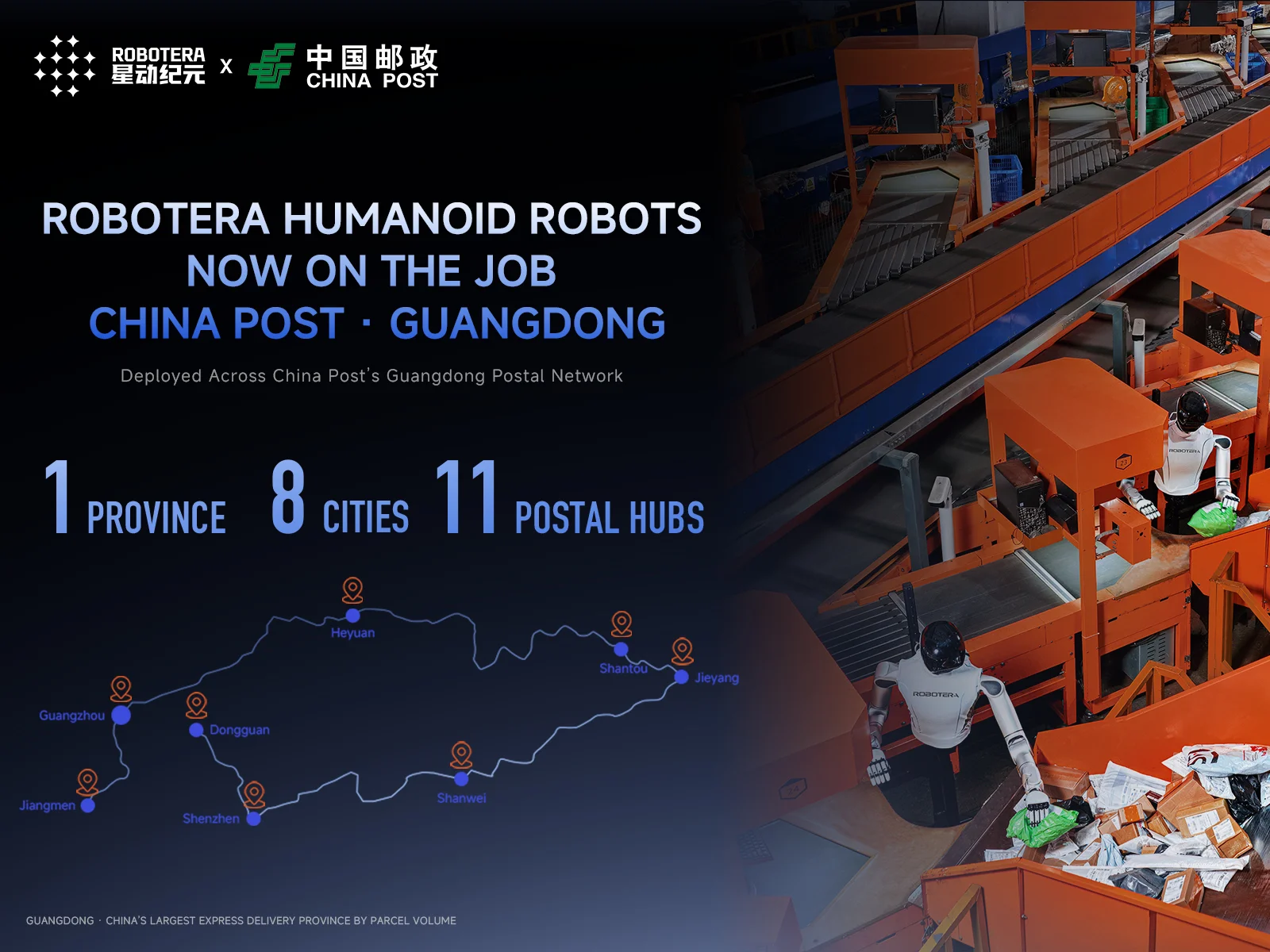
Robots capable of sorting more than 1,500 parcels an hour are being deployed across 11 postal hubs as China accelerates the use of artificial intelligence in its logistics industry
China’s postal service has begun deploying humanoid robots across eight cities in one of the largest reported rollouts of the technology in the logistics industry, it emerged today.
Beijing-based robotics company Robotera has expanded its partnership with China Post to 11 sorting hubs across Guangdong province, including Guangzhou, Shenzhen and Dongguan, in a major test of whether human-shaped machines can operate effectively alongside postal workers.
The company claims the deployment is the largest and most geographically extensive of its kind in the logistics sector, marking a significant step towards the commercial use of humanoid robots beyond factories and research laboratories.
The robots are being introduced to handle repetitive and physically demanding sorting tasks, particularly during peak shopping periods when parcel volumes can rise to several times their usual levels.
According to Robotera, its machines have achieved an average parcel induction rate exceeding 1,500 items an hour – comparable to experienced human workers – since trials began at Guangzhou Postal District Centre in March.
Some use the firm’s proprietary five-finger robotic hand, developed to improve the machines’ ability to manipulate packages.
The company says the technology could help postal operators address labour shortages and high staff turnover while allowing employees to concentrate on maintenance, quality control and coordinating operations.
It said: “Logistics sorting is labour-intensive, involving repetitive physical work under harsh working conditions. Persistent labour shortages and high workforce turnover add to the pressure, especially during peak shopping seasons, when parcel volumes can surge to several times their normal levels.
“Robotera’s humanoid robots help fill capacity gaps by taking on strenuous frontline tasks, supporting stable operations during demand peaks while allowing human workers to focus on higher-value roles such as robot maintenance, operations coordination and quality control.”
READ MORE: Humanoid robots could become the next K-pop stars. South Korean entertainment company plans machines that can perform music, model fashion and appear in thousands of live shows.
Do you have news to share or expertise to contribute? The European welcomes insights from business leaders and sector specialists. Get in touch with our editorial team to find out more.
Main image: Humanoid robots handle parcels at a China Post sorting facility in Guangdong, where Robotera has deployed its machines across 11 postal hubs in eight cities. The company says its robots can process more than 1,500 parcels an hour. Credit: Robotera
TOP STORIES
-
 First class delivery: China's postal service puts humanoid robots to work across eight cities
-
AI set to transform university librarians' jobs as 95% predict surge in demand
-
Washington Dulles unveils new concourse as $20bn airport expansion takes off
-
The European Autumn 2026 edition – out now
-
WATCH: Greenpeace drops giant David Attenborough boulder into North Sea – on site of £12bn windfarm
-
Himalayan nations demand urgent action as UN warns of irreversible glacier losses
-
6,000 march against ‘monstrous’ AI data centres as Scotland faces building boom
-
Shop till Ai drop? AI agents set to buy for us as tech boss warns of retail revolution
-
Specs appeal: Welsh Parliament bans smart glasses
-
European motoring legends behind Mercedes, BMW and McLaren to enter Hall of Fame
-
Putin 'plotting to break NATO without firing a shot', Latvian military analyst warns
-
British AI chip startup hits £5bn valuation as government backs bid to challenge global tech giants
-
World's biggest military airshow moves to ‘Britain’s Area 51’ after Iran war disruption at RAF Fairford
-
Lisa Nandy threatens crackdown on entertainment industry after David Walliams allegations
-
UK and European experts demand tougher AI laws as Australia considers criminal penalties after OpenAI breach
-
BBC loses bid to throw out Trump's $10bn defamation lawsuit over doctored Panorama speech
-
AI-generated CVs spark hiring crisis as a third of employers lose confidence in job applicants
-
MPs back calls for ‘Black English’ and ‘Asian English’ options on census
-
Nvidia hires top US lawyer to investigate CEO's alleged affair with Chinese spy
-
EXCLUSIVE – Comic Relief confirms David Walliams is no longer an honorary trustee and has ‘no formal association’ with charity
-
Why Airbnb and Uber take off in some cities but flop in others, according to scientists
-
Michael Jackson's Thriller jacket, Princess Diana's dresses and $3m Banksy painting go under the hammer
-
European entrepreneurs trust AI firms more than governments as four-in-10 look beyond Europe
-
Krakow massacre gunman named after hospital death as police officer fights for life
-
British Airways owner warns green fuel rules could ‘kill European aviation’