English accounts for as much as 70 per cent of translated titles in some European markets, raising questions over whether funding, changing reader tastes and new technology can help the continent’s smaller languages reach wider audiences, writes Isabella Russell
Europe is home to an extraordinary range of languages, but the books crossing its borders tell a less diverse story.
Translations from English account for between 50 and 70 per cent of translated titles in many European markets, according to the 2026 Books in Translation: Trends and Transformations in the European Publishing Market report.
But translation between smaller European languages remains far less common. A novel may travel more readily from English into Danish, Italian or Polish than directly between two of those languages, even when their countries are neighbours.
The imbalance exposes a contradiction at the heart of European publishing. Linguistic diversity is widely treated as part of the continent’s cultural identity, yet the economics governing which books reach new readers tend to favour the largest languages and safest commercial prospects.
For publishers, acquiring a foreign title involves more than recognising its literary merit. They must secure the rights, commission a translator, edit and produce a new edition, and convince booksellers and readers to embrace an unfamiliar writer.
Each stage adds cost and uncertainty, and those pressures can be particularly acute for independent publishers operating with limited budgets, and for authors whose work has no established international sales record.
There is a more basic economic problem too: acquiring a foreign title is an expensive bet before a single reader sees it. A publisher taking on a translated novel is committing to costs an English-language acquisition doesn’t carry, including the rights fee, a commissioned translation, and often a longer runway to build awareness for an author with no existing UK sales record. For a Danish or Polish novel with no prior English edition, there’s no sales data to de-risk the decision, so the publisher is betting on taste rather than track record.
That asymmetry shapes which books get taken on, and it bears hardest on smaller, independent publishers, the ones most likely to champion a lesser-known language in the first place, and least able to absorb a failed bet.
Britain offers a useful test case. As Europe’s largest English-language publishing market, it sits on the dominant side of the translation imbalance, yet its recent sales patterns suggest that readers may be more receptive to literature from elsewhere than publishers have traditionally assumed.
Japanese literature has undergone a striking rise in Britain. Nielsen figures reported by the Guardian showed that Japanese fiction represented 25 per cent of UK translated-fiction sales in 2022, while Japanese authors produced 43 per cent of the 40 bestselling translated fiction titles during the first part of 2024. The success has spanned literary fiction, crime and the increasingly visible category of Japanese “comfort” fiction.
That boom offers both encouragement and a warning. It demonstrates that translated literature can move from a specialist market into the commercial mainstream, but it also shows how quickly publishers can concentrate around a recognisable country, genre or visual formula once it begins to sell.
The wider sales data bears this out. UK sales of translated fiction rose from 2.9 million copies, worth £23.2m, in 2016, to 3.8 million copies, worth £40.7m, in 2025, and the momentum is still building: physical sales saw double-digit growth in 2025 alone, and 2026’s bestsellers are already tracking ahead of last year’s midway point. Japanese, French and Russian are now the most popular source languages, a shift from Swedish, French and Italian a decade ago.
Perhaps more revealing is who is buying. In 2025, 72.8 per cent of translated fiction was bought by under-45s, up from 67.6 per cent in 2016, and the largest single age cohort has shifted from 45 to 59-year-olds to 25 to 34-year-olds over the same period. Translated fiction isn’t a niche propped up by an ageing readership. It is skewing younger than the market as a whole, which should give publishers more confidence to bet on unfamiliar languages, not less.
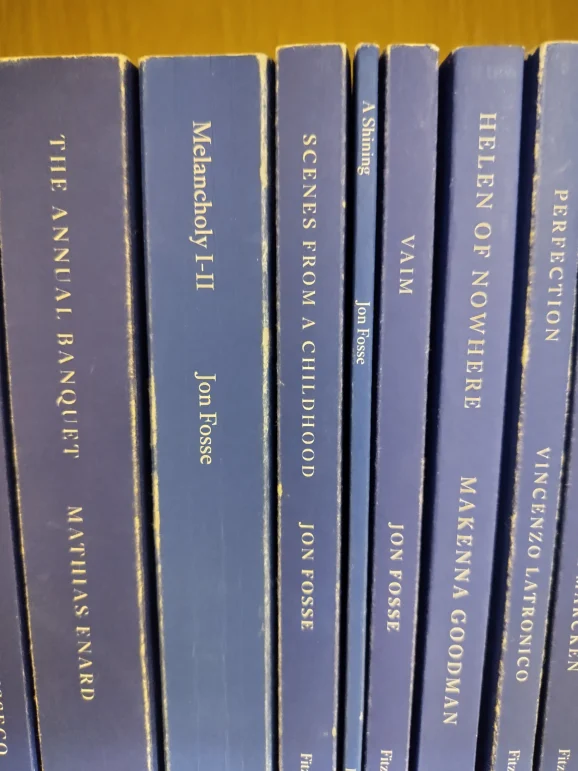
That gap between what the market assumes and what readers will actually embrace is best illustrated by a single small press. Fitzcarraldo Editions was founded in Deptford, southeast London, in 2014 by Jacques Testard, a French-born publisher who started the company from his kitchen table with a £70,000 loan, enough, by his own calculation at the time, to publish ten books and keep himself afloat for two years. The press built its identity around exactly the kind of writing the industry treats as commercially marginal: literary fiction and long-form essays, much of it in translation, by authors considered too difficult or too obscure for larger houses.
A decade on, four of Fitzcarraldo’s authors have won the Nobel Prize in Literature: Svetlana Alexievich in 2015, Olga Tokarczuk in 2018, Annie Ernaux in 2022 and Jon Fosse in 2023. Ernaux herself is a telling case. She was already a major literary figure in France, tipped for the Nobel for years, yet remained largely unknown to English-language readers outside academic circles until Fitzcarraldo began publishing her in translation. The press had made her its most published author years before the Nobel Committee took notice.
Testard has been direct about what he thinks that record disproves. Translated fiction, he has argued, carries none of the commercial curse the industry assumes it does; the real obstacle has been a kind of institutional incuriosity in English-language publishing, a sense that a dominant language doesn’t need to look outward. Fitzcarraldo’s authors, he points out, were already published by leading houses in France, Spain, Germany and Italy long before an English edition existed. The gap wasn’t literary merit. It was the Anglophone market’s willingness to bet on it.
The bet paid off commercially as well as critically: the press has now sold more than a million print units, against an industry average of around 250 copies for a new work of literary fiction. It remains a small operation, run by fewer than ten people, which makes the scale of its influence on what British readers now consider prestigious, translated fiction harder to dismiss as an outlier.
Britain’s experience is not representative of the wider continent though. Smaller European-language markets face the imbalance from the opposite direction: in markets with fewer than 10 million speakers, translations typically account for 20 to 40 per cent of annual book production, and direct translation between two smaller languages remains almost non-existent, typically routed through an English translation first. A single London success story, however striking, does nothing by itself to help a Danish novel reach a Polish reader, or a Greek one reach Finnish readers, without passing through a larger language on the way.
That is the gap the EU’s Creative Europe programme has set out to address. Through its “Circulation of European Literary Works” scheme, it now makes translator credit a condition of funding: publishers receiving support are required to work with professional literary translators and to name them visibly in the published book, ideally on the cover, alongside the source language. The scheme funds translation of around 500 titles a year from about 40 source languages into roughly 30 target languages, with grants running as high as €300,000 for consortium projects, and it specifically weights support toward less widely translated languages, the ones structurally least likely to travel on commercial merit alone.
The scale suggests a real appetite for intervention. The most recently completed round drew 189 project submissions for 46 funded places, competition that points to more translatable work, and more willing publishers, than the market alone is currently able to support.
Technology cuts both ways here. Some publishers now use machine translation as a triage tool, a way of gauging a manuscript’s potential before committing to a costly commissioned translation, but industry surveys suggest confidence narrows quickly once literary quality is at stake. A 2024 Society of Authors survey of nearly 800 UK writers, illustrators and translators found that 37 per cent of translators had used generative AI in their work, with over a third already reporting lost work and more than four in ten reporting decreased income as a direct result. More than three-quarters believed the technology would negatively affect their future income.
Yet literary translation itself has proven hard to automate. That’s why schemes like Creative Europe’s insist on named, credited human translators as a condition of funding: it functions as both a labour protection and a statement about where the value in a translated book actually lies.
Britain’s growing appetite for translated fiction and Fitzcarraldo’s decade of prize-winning bets point the same way: the market isn’t the fixed obstacle publishers have long assumed it to be.
But that evidence comes from one of Europe’s largest and best-resourced publishing markets, translating overwhelmingly into English. Extending the same curiosity to Europe’s smaller languages, so that a Slovak or Estonian novel can find readers in Lisbon or Helsinki without an English edition acting as gatekeeper, will take the kind of funding and publishing infrastructure that only continent-wide schemes like Creative Europe can sustain.
Whether that curiosity reaches the rest of Europe’s languages is no longer a question of reader appetite. It depends on whether the funding and infrastructure exist to carry it there.

Isabella Russell is a London-based contributor with a background in film, culture and communications. She holds a degree in Film and Television from the University of the Arts London, where her research explored European cinema and political history, and has worked as a freelance copywriter across editorial and consumer content.
READ MORE: Why Sweden is returning to printed books in the classroom. As Sweden rethinks years of rapid classroom digitalisation, Milosh Zezelj explores why one of Europe’s most technologically progressive education systems is now reinvesting in printed textbooks — and what the shift could reveal about attention, memory and the future of reading itself.
Do you have news to share or expertise to contribute? The European welcomes insights from business leaders and sector specialists. Get in touch with our editorial team to find out more.
Main image: Open books from across the publishing world illustrate the growing market for literature in translation, as readers increasingly look beyond their own language for new voices and stories. Picture: Megan Lee/Pexels