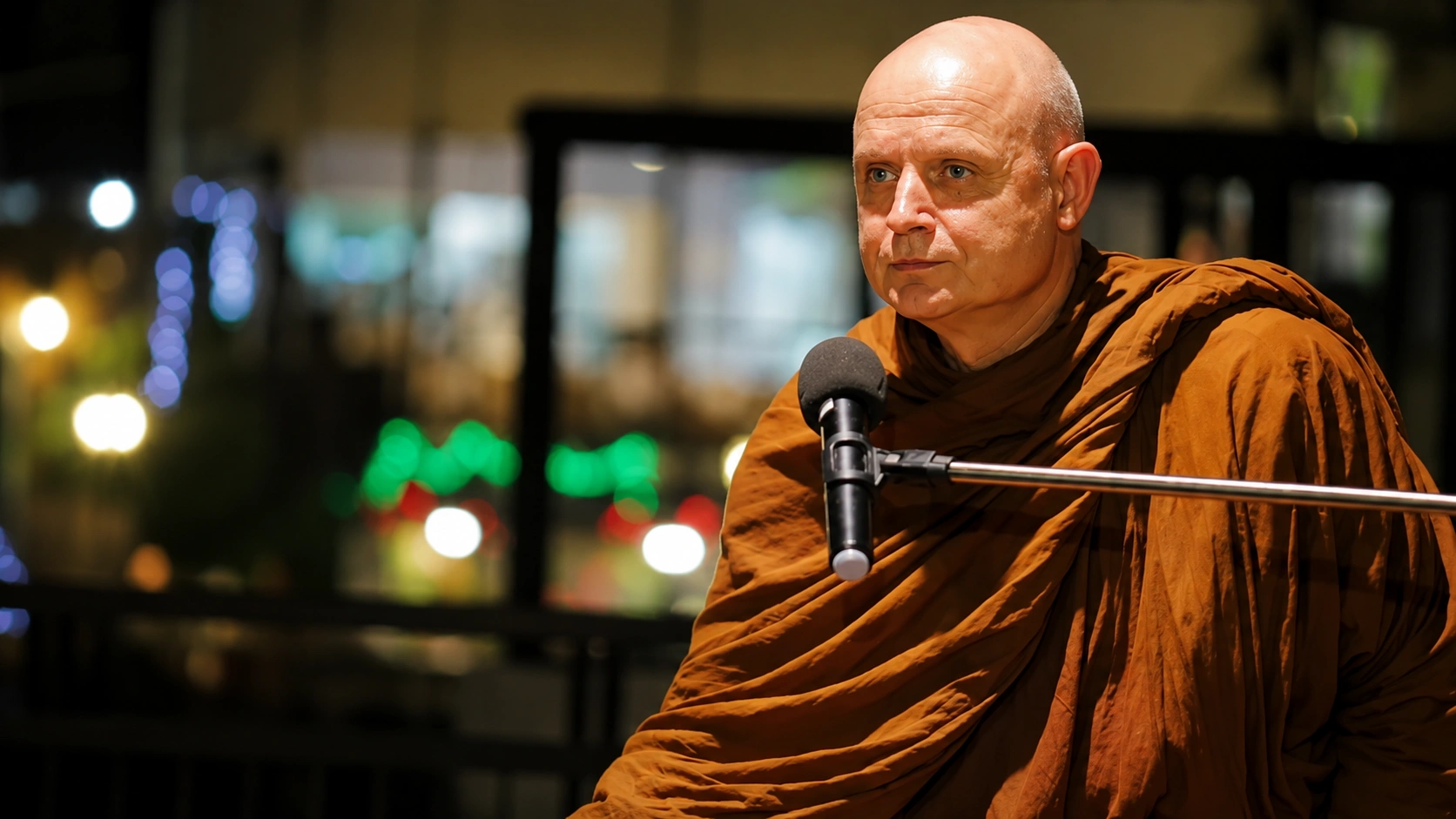
A British monk and a retired Englishman were born the same year. One left for Thailand at 20 and has just become the most senior foreign-born monk in Thai Buddhist history. The other stayed closer to home and is living the retirement the rest of us are promised. Stephen Whitehead asks why one system pays a man for growing old, while the other simply stops paying attention to him
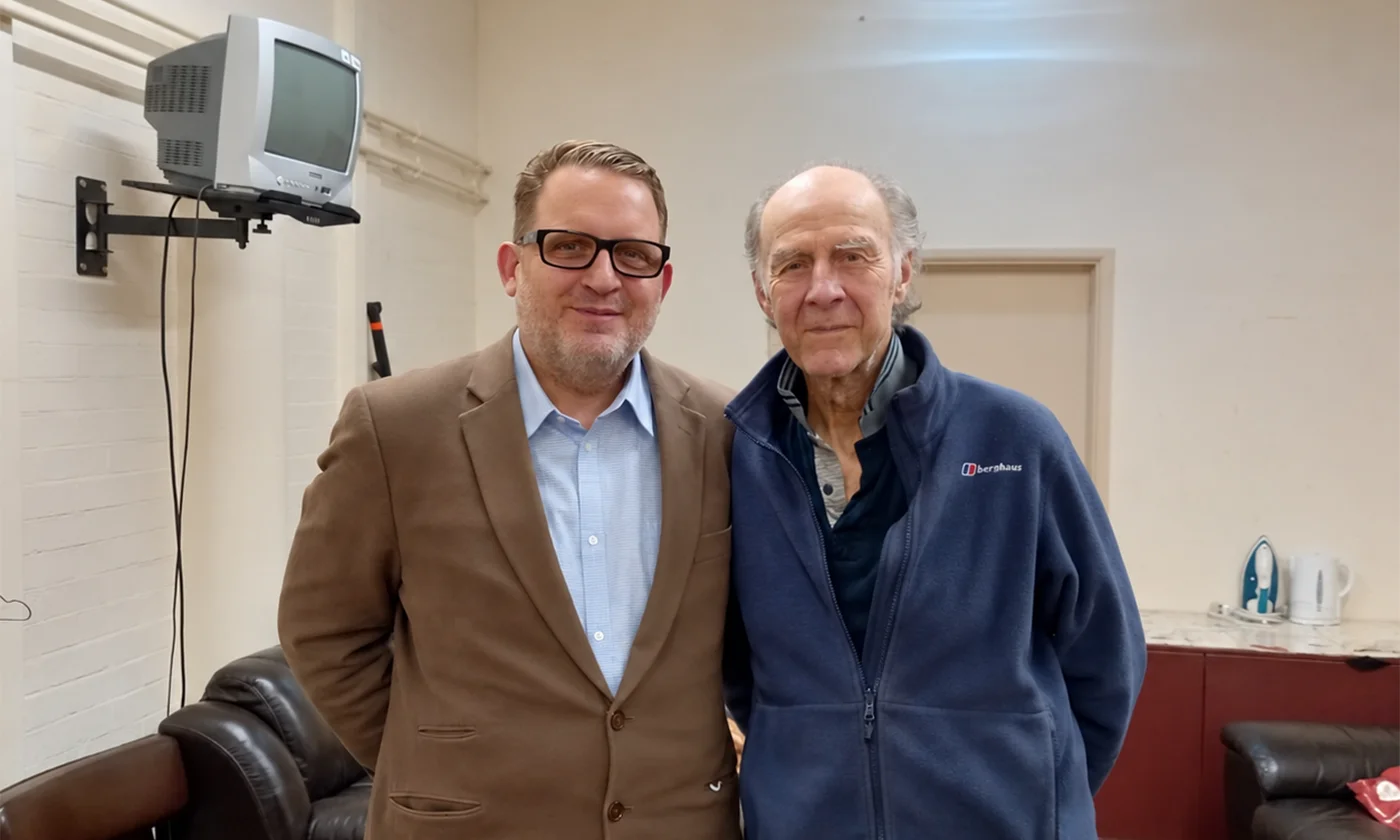
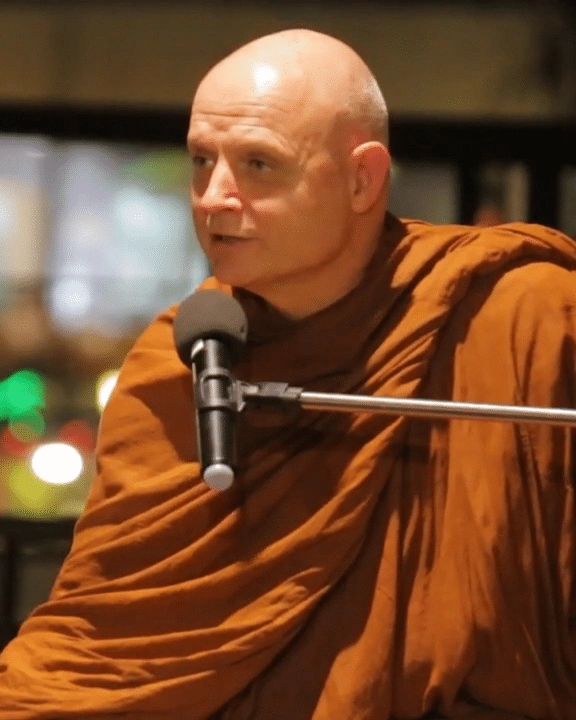
On July 12, a British-born monk living alone in a forest hermitage near Khao Yai National Park was promoted to Somdet Phra Ratchakhana, the second-highest rank in Thailand’s Buddhist monastic hierarchy. Ajahn Jayasaro, born Shaun Chiverton on the Isle of Wight in 1958, arrived in Thailand in 1978 as a 20-year-old searching for something his own culture hadn’t given him. Forty-eight years later, at 68, he became the first foreign-born monk ever elevated to the rank.
I want to hold that fact next to another man of exactly the same age. Call him Steve – one of the men I’ve spent the past year interviewing for a new book I’m writing, Old Men: The Last Masculinity. It’s about what happens to men once they reach 65 and the working identity that organised their entire adult life quietly switches off.
Steve was born within months of Shaun Chiverton. He didn’t get on a plane at 20 to move to Thailand, unlike Ajahn Jayasaro. Instead, he built the sort of adult life his generation was pointed towards – university, a career, a marriage with children and a home – and by most measures he has done retirement well. But there is no rank waiting for Steve at 68. No elevation, no ceremony. The only thing officially conferred on him was a bus pass.
Play the counterfactual the other way. If Shaun Chiverton had never got on that flight in 1978 – if he’d stayed in the UK and aged in the ordinary way his own culture prescribes – there’s a fair chance he’d be living something close to Steve’s life now. Or, a little further down that same road, he might be the version of an old man Western capitalism doesn’t really have a place for at all: in a care home, or on a bench somewhere, watching other people’s grandchildren go past. That isn’t a criticism of Steve, who is doing exactly what he was told a successful old age looks like. It’s a comment on the ceiling. Somewhere in his sixties, the system he lives inside simply stopped issuing promotions.
A monk in Thailand can remain in robes for life. A monk advances – if he advances at all – on the accumulated evidence of a life: conduct sustained over decades, teaching tested against real students, restraint proven under real provocation. Ajahn Jayasaro’s own ascent tells the story in miniature: he received royal monastic titles in 2019, 2020, 2021 and 2024, each elevation building on the last, none of them available to him at 30 or 40 or even 60. The rank he now holds could not have been given to a younger, sharper, more energetic version of himself. It required him to have become someone else first.
Steve’s version of the complaint, when it surfaces – and some form of it surfaces with almost every man I interview – sounds like this: I had 30, 40 years of accumulated judgement, and the day I turned 60, or 65, or in some professions 55, it stopped counting for anything at all. Religion solved this problem before capitalism existed. It’s worth asking why.
Religious civilisations evolved ways of increasing a person’s social value with age. Capitalism evolved ways of monetising youthful energy while devaluing learned wisdom. Look across several major faiths and a strikingly consistent architecture appears: seniority is part of the mechanism.
In Catholicism, cardinals lose their conclave vote at 80 but keep the title. In Shi’a Islam, the rank of Marja’ al-Taqlid – the highest tier of jurist whose rulings others may follow – presupposes decades of advanced study. Hindu philosophy builds the same idea into doctrine: the ashrama system names vanaprastha and sannyasa as later life-stages associated with withdrawal from household duty, renunciation and teaching. Quakerism, for all its anti-hierarchy, has the ‘weighty Friend’, whose judgement carries unusual gravity through years of demonstrated discernment.
The currency in these systems is the precise inverse of the currency capitalism trades in: memory, restraint, the capacity to sit with ambiguity without needing to resolve it immediately. The mellowing that arrives only after a person has been substantially wrong about something important and lived long enough to metabolise it.
Capitalism prices almost none of this. A management consultant, a tech founder, a television executive and an actuary – the working world’s default assumption, rarely stated but constantly enacted, is that a person’s value curves upward through their thirties and forties and then begins, gently or suddenly, to decline. Workers made redundant over 50 are three times less likely to be back in work within three months than those under 50. And 36 per cent of people aged 50 to 69 say their age puts them at a disadvantage when applying for jobs. Entire industries – advertising, media, much of tech – run on an unspoken understanding that 50 is late-stage. The evidence I’m gathering for my book suggests the psychological cost of this is severe and largely undiscussed: men whose sense of worth was built entirely on productive output lose, in a single afternoon of redundancy, not just an income but the only mechanism by which they had ever measured themselves. There is no promotion waiting for them at the far end of it, religious or otherwise. There is a leaving party and a pension – roughly what there was for Steve, at 68, the same age Ajahn Jayasaro was given a royal title.
The obvious defence of capitalism here is not a bad one, and it deserves stating plainly rather than waved away: markets reward what markets currently need, and in fast-moving, low-capital, technology-driven sectors, some abilities genuinely do change with age. That isn’t pure prejudice dressed up as economics. A younger worker really may outperform an older one in certain narrow domains, and pretending otherwise doesn’t help anyone.
But that defence only accounts for a fraction of the economy, and it has metastasised into a cultural assumption applied everywhere – to judgement-based roles, relationship-based roles, wisdom-based roles, where the opposite is almost certainly true. And it leaves the deeper question unanswered: is this a temporary immaturity capitalism will eventually correct, the way a young institution eventually develops the customs an old one already has? Or is it structural – built into a system whose entire operating logic is growth, disruption and novelty as value, in a way that is simply incompatible with a logic of accumulated wisdom no matter how long capitalism runs? Religious institutions have had centuries to develop the customs I am describing. Modern industrial capitalism is much younger. If the comparison holds, ‘immature’ might be generous. It may simply be a different kind of system, built to do something else, with no natural mechanism for ever producing what the sangha, the governing order of Buddhist monks, produced this July: a public, formal acknowledgement that a person had become, through time and conduct, more valuable than he used to be.
Ajahn Jayasaro will hold his new rank until he dies. Nobody in Thailand considers that strange. Steve, meanwhile, isn’t unhappy. Ask him and he’d likely tell you he has everything he needs.
But nobody is about to hand him anything either, and if you asked him what he’s for now, he might take a little longer to answer than he once would have. Perhaps the stranger arrangement is the one most of the rest of us live inside.
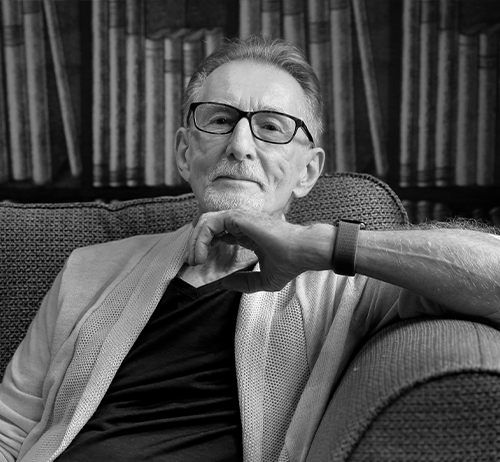
Dr Stephen Whitehead is a gender sociologist and author recognised for his work on gender, leadership and organisational culture. Formerly at Keele University, he has lived in Asia since 2009 and has written 20 books translated into 17 languages. He is based in Thailand and is co-founder of Cerafyna Technologies. His forthcoming book, Old Men: The Last Masculinity, will be published in 2027.
READ MORE: ‘How Britain turned Jason Arday into a symbol – and lost sight of the man‘. Celebrated as a symbol of Black achievement, Jason Arday later became the focus of intense scrutiny before his death at just 41. Dr Stephen Whitehead argues that, whatever the legitimate questions surrounding his scholarship, the public reckoning lost sight of the human being at its centre.
Do you have news to share or expertise to contribute? The European welcomes insights from business leaders and sector specialists. Get in touch with our editorial team to find out more.
Main Image: Ajahn Jayasaro. Credit: Buddhadāsa Indapañño Archives / CC BY 3.0