In the fourth of her popular stargazing series, Omara Williams continues her month-by-month guide to the night sky. This July, she focuses on the northeastern constellations — from Auriga and Perseus to Cassiopeia and Andromeda — and highlights this month’s planetary pairings and meteor showers
July brings long, warm nights and excellent conditions for stargazing. This month, we focus on the northeastern sky, where the Milky Way rises in a sweeping arc above the horizon. Using the Big Dipper as our guide, we’ll trace a path through four of the season’s key constellations: Auriga, Perseus, Cassiopeia and Andromeda. These mythological patterns are home to some of the brightest and most interesting stars in the northern hemisphere, and together they lead us to the Andromeda Galaxy — the farthest object visible to the naked eye.
The sky also offers the chance to see noctilucent clouds, which can appear after sunset as shimmering bands high in the atmosphere. Once darkness falls, the rich, winding band of the Milky Way becomes visible, and from there we can navigate from star to star, following well-known markers across the northeast.
To get the best view, find a quiet location away from streetlights and allow your eyes to adjust. A telescope or binoculars will reveal more detail, but many of July’s highlights can be enjoyed without any equipment at all.
How to find Capella in Auriga
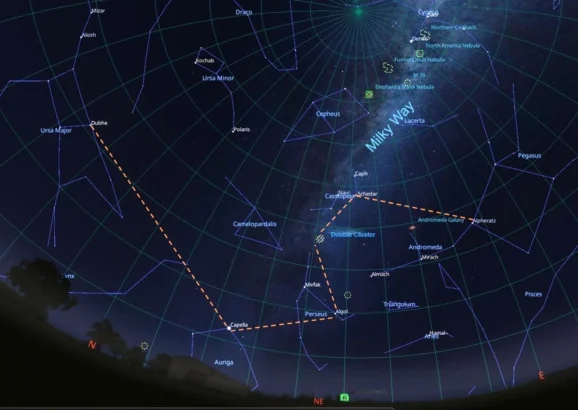
To find Capella, start by facing north and looking for the Big Dipper — one of the easiest star patterns to spot in the night sky. You can use my earlier guide about how to find the Big Dipper here. It looks like a large saucepan with a curved handle. Focus on the bowl of the Dipper and find the top right-hand star. This is Dubhe, the second-brightest star in the Big Dipper.
From Dubhe, draw an imaginary straight line down and to the right, heading towards the northeastern horizon. Along that line, you’ll come to a very bright, golden-white star. This is Capella, the brightest star in the constellation Auriga.
Auriga, also known as The Charioteer, forms a roughly hexagon-shaped pattern around Capella. Although the rest of the constellation’s stars are fainter, Capella is bright enough to spot even in light-polluted areas.
Capella is a remarkable star system made up of four stars in two pairs, located just 43 light-years from Earth. Its two largest stars are yellow giants, about ten times the diameter of our Sun, and they shine brightly in the night sky. Capella is the sixth-brightest star overall and plays a key role in learning how stars evolve.
In Greek mythology, Auriga is the charioteer who protects flocks and brings rain to the land. He is often shown carrying a goat — represented by Capella — and its kids in his arms.
How to find Algol in Perseus
Once you’ve located Capella in the northeastern sky, look to your right — roughly eastwards — and begin scanning for a loose, winding shape made of six medium-bright stars. This is the constellation Perseus, which resembles a snake-like line.
Start by identifying Mirfak, the brightest star in Perseus. It sits near the centre of the constellation’s curve and appears yellow-white to the naked eye. Just below and to the right of Mirfak is Algol, the second brightest star in Perseus — and the most famous.
Algol is known as the Demon Star because of how its brightness changes every few days. It’s actually a triple-star system, located about 94 light-years away. The three stars — a large blue star, a cooler orange subgiant, and a small white star — orbit and eclipse one another, causing Algol to regularly dim and brighten in a well-known cycle lasting just under three days. This makes it one of the most easily observed variable stars in the sky.
Above Perseus, at the top of its curving outline, look for two faint, fuzzy patches close together. These are The Double Cluster — a pair of open star clusters about 7,500 light-years away. Through binoculars or a small telescope, each patch reveals hundreds of hot young stars shining like a swarm of diamonds.
In Greek mythology, Perseus was the hero who beheaded Medusa and later rescued the princess Andromeda from a sea monster. His constellation lies directly between Auriga and Andromeda, forming part of the same celestial story.
How to find Schedar in Cassiopeia
From the Double Cluster above Perseus, look further up in the sky to find Cassiopeia, one of the most recognisable constellations in the northern hemisphere. It’s shaped like a large, slightly tilted “W” made of five bright stars. You’ll see it straddling the dense, starry band of the Milky Way, in a region full of open star clusters, distant galaxies, and nebulae.
The star to focus on first is Schedar, which sits at the bottom right corner of the “W”. It’s usually the brightest star in the constellation and has a soft orange glow. However, it sometimes competes for attention with Navi, the star at the centre peak of the “W”, which can briefly appear brighter due to unpredictable outbursts. Navi is more luminous overall, but farther away and less consistent in brightness.
Schedar is an orange giant, located about 228 light-years from Earth and shining with a brightness 800 times greater than the Sun. Navi, a blue subgiant around 600 light-years away, is even more powerful, radiating 40,000 times the Sun’s light.
Cassiopeia is visible all year round from northern latitudes and is a helpful guidepost for navigating the night sky. In mythology, it represents Queen Cassiopeia of Ethiopia, known for her vanity. According to legend, her pride offended the gods, who ordered the destruction of her kingdom. The queen then offered her daughter, Andromeda, to the fearsome sea monster Cetus as a sacrifice to appease the gods, but was later saved by Perseus — a story that connects this constellation to Perseus and Andromeda nearby.
How to find Alpheratz in Andromeda
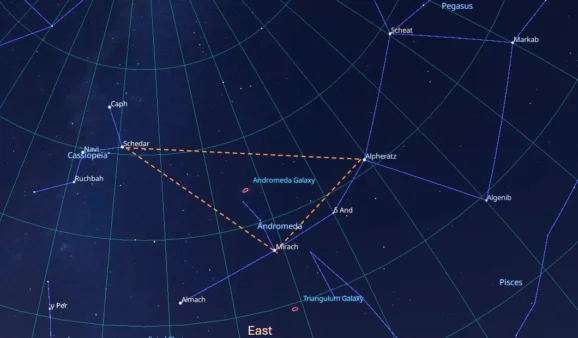
From Schedar in Cassiopeia, look to your right — eastward — to spot a bright star marking the top left corner of a large square shape in the sky. This is Alpheratz, and it’s part of the Great Square of Pegasus, a prominent asterism that’s easy to recognise on the eastern sky.
Although it sits on the border between Pegasus and Andromeda, Alpheratz belongs to the Andromeda constellation — a long, faint string of stars extending to the left of the square. Alpheratz lies 94 light years away and is a binary system in a close orbit, formed by a blue-white subgiant star 240 times more luminous than the Sun and a smaller white star.
To follow the shape of the Andromeda constellation, move one star left along its line from Alpheratz and you’ll reach Mirach, a distinctive red giant. Mirach is your key to finding the Andromeda Galaxy, which appears as a faint, fuzzy patch just above it in dark skies. If you imagine a triangle connecting Schedar, Alpheratz, and Mirach, the galaxy lies within it.
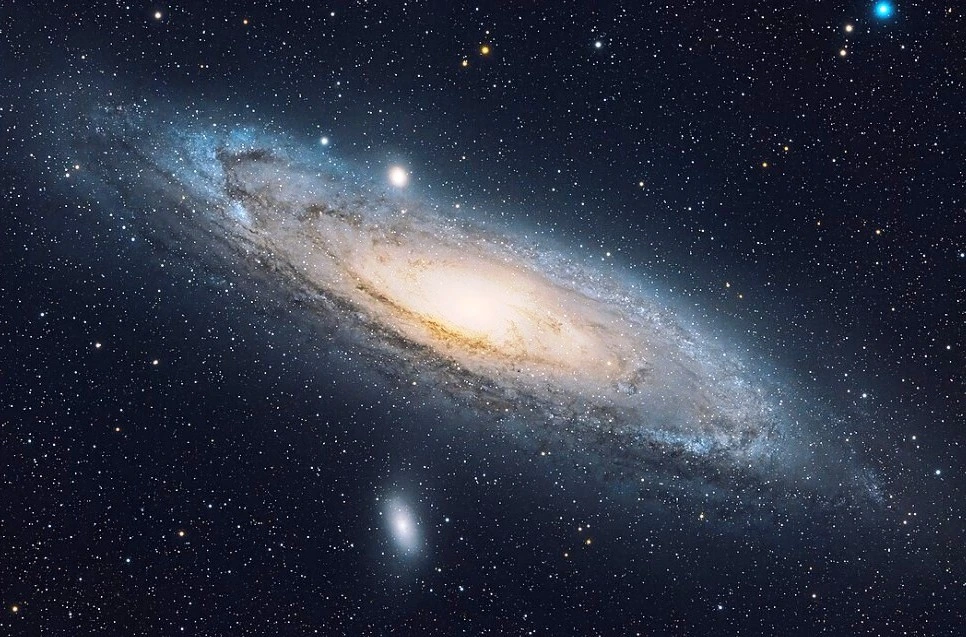
At around 2.5 million light-years away, the Andromeda Galaxy is the nearest large galaxy to our own and contains an estimated trillion stars. It’s slowly moving towards the Milky Way and is expected to merge with it in about 4.5 billion years — an event that will completely reshape both galaxies and the night sky.
In Greek mythology, Andromeda was the princess chained to a rock as a sacrifice to a sea monster, before being rescued by Perseus. The constellations of Andromeda, Perseus, Cassiopeia and Cepheus all appear close together in the sky, telling a story of danger, rescue and love that has been passed down for centuries.
These myths bring an extra layer of meaning to stargazing — turning a quiet evening under the stars into a journey through ancient storytelling.
Main Night Sky Events in July
July offers a mix of planetary pairings, lunar encounters and meteor activity. Most of these events are easy to observe with the naked eye from a dark, open location — ideally with a clear view of the eastern and southeastern horizons. For best results, allow your eyes to adjust to the dark for 15–20 minutes, and use a stargazing app or compass to help with direction if needed.
July 4 – Venus near the Pleiades star cluster
Look east after 2:30 a.m. to spot Venus, glowing brightly low on the eastern horizon. Just above it, you’ll see the Pleiades — a compact group of blue-white stars. This close pairing will be visible in the early morning twilight, and binoculars will reveal even more of the cluster’s detail.
July 10 – Full Moon (Buck Moon)
The Full Moon rises in the southeast after 9:30 p.m. and moves low across the southern sky. It’s easy to spot thanks to its brightness, and its low arc makes for excellent photography. Known as the Buck Moon, it marks the time when male deer grow their antlers.
July 13 – Venus near Aldebaran and the Hyades
From 3:00 a.m. onwards, look low in the eastern sky to find Venus shining just above Aldebaran, a bright red-orange star in the constellation Taurus. Nearby, the Hyades star cluster will form a loose V-shape. The trio makes a fine pre-dawn sight, and the contrast of colours is visible even without optical aid.
July 16 – The Moon near Saturn
After midnight, face southeast to find Saturn, appearing as a steady, yellow-white point of light. The waning crescent Moon will be just above and to the right of it. Although Saturn’s rings won’t be visible to the naked eye, the pairing stands out well in the early hours.
July 21 – The Moon near Venus
From around 3:00 a.m., look east for a striking grouping. The crescent Moon will sit close to Venus, and to their right you’ll find Aldebaran, the Hyades, and the Pleiades further above. This is a rare concentration of bright stars and planets in one part of the sky.
July 23 – The Moon near Jupiter
Just after 4:00 a.m., scan the eastern sky to find Jupiter rising. The Moon, now a thinner crescent, will appear just beside it. Jupiter is brighter than any star in that part of the sky, making this a simple and rewarding early morning target.
July 28 – Peak of the July Gamma-Draconids meteor shower
After midnight, lie on your back in a dark location and look towards the zenith — the highest point directly overhead. This minor shower can produce short bursts of activity, and conditions are ideal this year with a very thin Moon.
July 30 – Peak of the Delta-Aquarids and Alpha-Capricornids
Two meteor showers peak on the same night. From around midnight, face southeast and look slightly upwards. The Delta-Aquarids bring fast, faint streaks, while the Alpha-Capricornids are known for slow, bright fireballs. With the Moon already under the horizon, this is one of the best nights this month for meteor watching.
Catch Up on the Series
This article is the fourth in Omara Williams’ ongoing guide to the night sky. Each month, she focuses on seasonal constellations, celestial highlights and practical ways to navigate the heavens using just your eyes, a dark sky and a little patience. If you’ve missed any of the earlier instalments, you can catch up here:
- What to See in the Night Sky This June: From the Summer Triangle to the Galactic Centre
The third article in the series explores the iconic Summer Triangle and takes readers on a journey through Scorpius, Sagittarius and the core of the Milky Way. - Spot the Big Dipper — and Unlock the Secrets of the Spring Sky
This easily digestible guide explains how to use the Big Dipper to find major spring constellations including Virgo, Boötes and Leo, and introduces the Spring Triangle. - How to Get More Constellations Than Orion Under Your Belt
The first instalment helps readers navigate the winter sky via Orion, Gemini and Taurus, and explore the bright asterism known as the Winter Hexagon.

Omara Williams is a nuclear and software engineer whose multi-award-winning debut science-fiction novel, The Space Traveller’s Lover, shot to international bestseller status. Outside of her literary pursuits, she enjoys stargazing and chasing total solar eclipses.
All images: Supplied (Wikipedia/Commons Licence)