In the third of her stargazing series for The European, Omara Williams takes us on a tour of the summer night sky – from the Summer Triangle and the Milky Way’s galactic centre to the mythic constellations of Scorpius and Sagittarius. She also highlights this month’s must-see celestial events, including the Strawberry Moon, Mars near Regulus, and two dazzling meteor showers
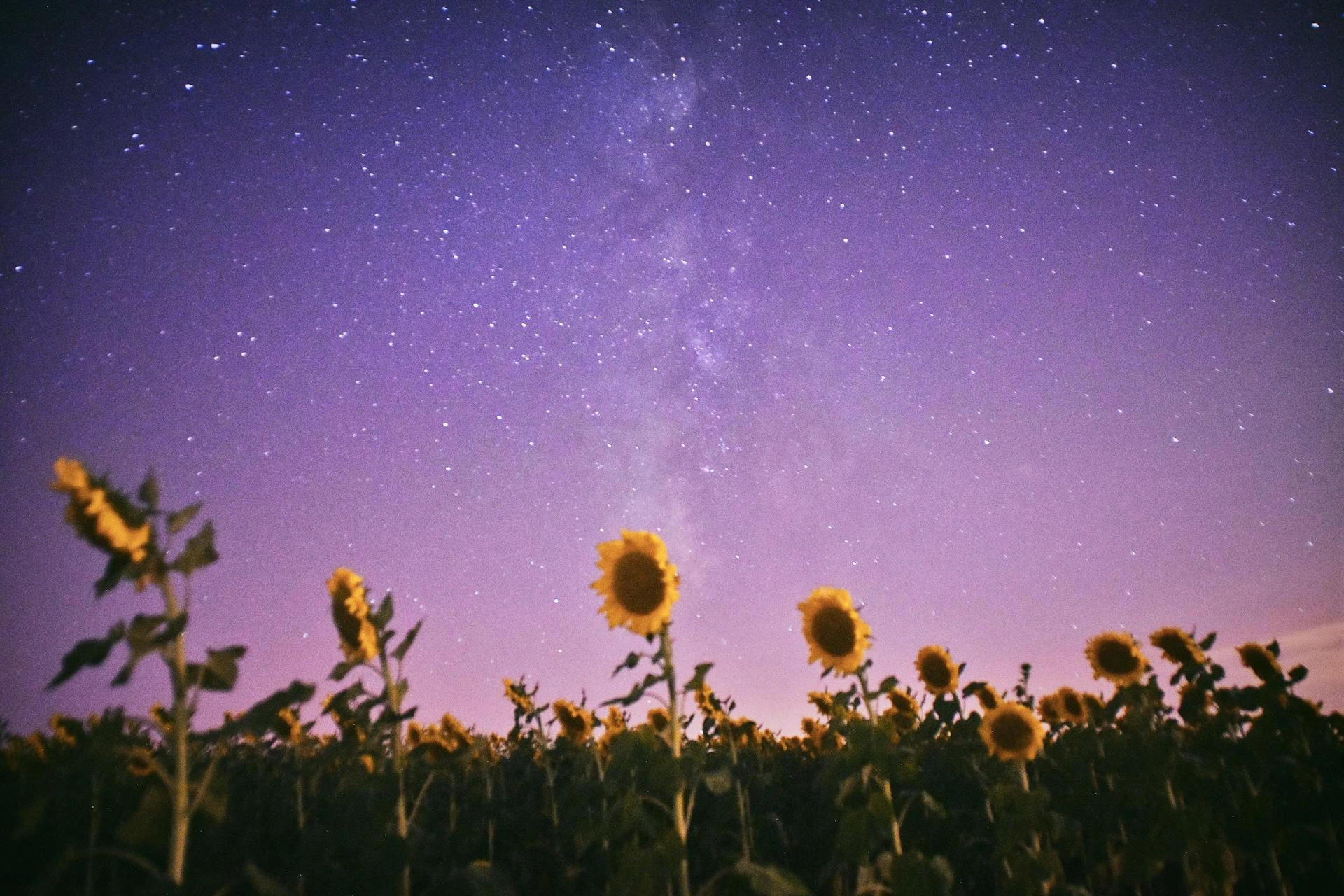
As summer approaches, the night sky becomes a dazzling stage for some of the year’s most striking celestial displays. Once again, we can use the Big Dipper as our starting point to explore the June skies and locate the distinctive Summer Triangle. This trio of stars shines brightly and widely across the heavens, resembling a giant sail guiding us through the cosmos.
From the Summer Triangle, we can trace our way towards the Milky Way’s enigmatic galactic centre – a super-dense region where a supermassive black hole, millions of times the mass of our Sun, exerts immense gravitational pull on the stars and gas around it.
Around the time of the Summer Solstice on 21 June, twilight lingers well into the night, making even the brightest stars harder to spot. To get the best views, seek out dark skies away from light pollution and plan your stargazing adventures after midnight.
Find Vega in Lyra
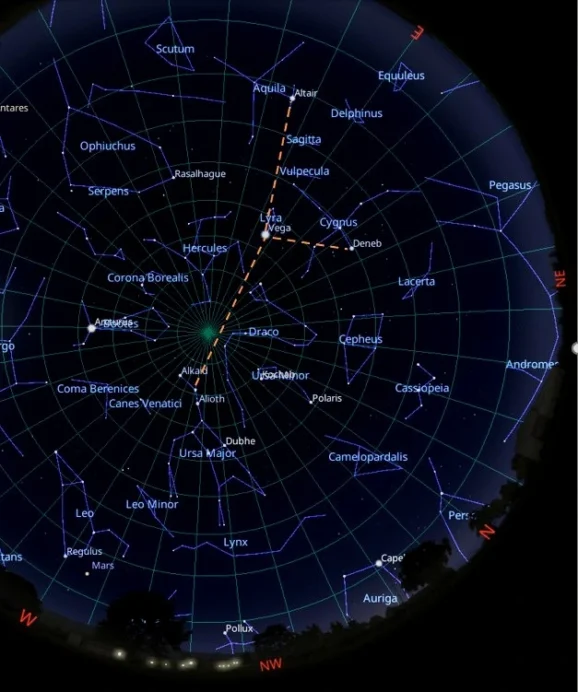
Begin with the Big Dipper, now hanging bowl-down in the north-western sky. Locate Mizar, the star at the bend of the Dipper’s handle, and draw an imaginary steep line upwards and towards the north-east. This will lead you to Vega, the radiant jewel of the Lyra constellation and one corner of the Summer Triangle.
Vega is a white main-sequence star, twice as massive and 40 times more luminous than our Sun. It is also relatively close, just 25 light-years away, and ranks as the fourth-brightest star in the night sky. Lyra itself forms a small rectangle and triangle joined at one point – a constellation said to represent Orpheus’ lyre in Greek mythology.
Find Altair in Aquila
To locate Altair, face north-west and use Vega as your guide. From Vega, extend an imaginary line upwards and eastwards at a gentle angle. Altair will appear above and to the right – another bright corner of the Summer Triangle.
Altair is a rapidly spinning white star, twice the mass of our Sun and ten times more luminous. At just 17 light-years away, it is one of the closest bright stars to us and ranks twelfth overall in brightness. Altair marks the head of Aquila, the Eagle – a constellation shaped like a bird in flight. In Greek myth, this was Zeus’s eagle, who punished Prometheus for giving fire to humanity.
Find Deneb in Cygnus
Return to Vega and trace a gently descending line towards the north-east to find Deneb, the third and faintest star of the Summer Triangle. It lies slightly below and to the right of Vega, anchoring the tail of the Northern Cross asterism within the Cygnus constellation.
Deneb is a luminous blue supergiant, around 20 times the Sun’s size and nearly 200,000 times as bright. Though it appears less bright than its triangle companions, it is far more distant – approximately 2,600 light-years away – making it one of the most far-flung first-magnitude stars visible to the naked eye.
In mythology, Cygnus is the swan – a symbol of loyalty and friendship. Deneb marks its tail, with wings stretching out across the cross. Cygnus is also home to Cygnus X-1, a fascinating double star system that includes a suspected black hole.
The Summer Triangle
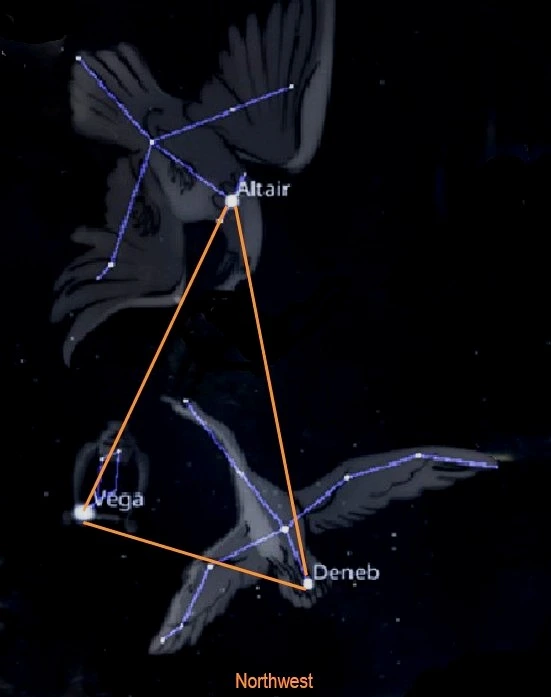
Together, Vega, Altair and Deneb form the iconic Summer Triangle – a brilliant asterism that dominates the summer night sky. Each star contributes its own distinctive glow: Vega shines with a piercing bluish-white hue, Altair radiates a crisp white light, and Deneb glows softly in pale blue-white. Their contrast of colours and brightness creates a truly memorable sight.
Find Antares in Scorpius
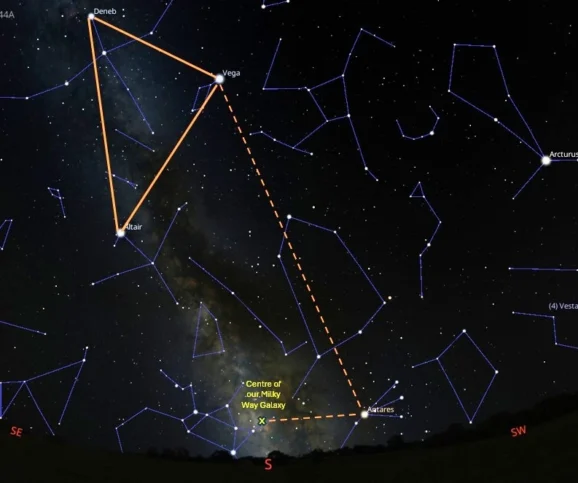
Facing south, start at Vega and draw a slightly steep line downwards and to the right towards the southern horizon. There you’ll find Antares, twinkling with a vivid orange-red hue.
Antares is a binary system comprising a red supergiant and a hot blue companion, 550 light-years away. One of the largest stars visible to the naked eye, it ranks fifteenth in overall brightness. Its name, Antares, means “rival of Mars,” due to its distinctive colouring.
In Greek mythology, Scorpius represents the scorpion sent to kill Orion. To prevent further conflict, Zeus placed the two on opposite sides of the sky.
Find Sagittarius and the Galactic Centre
From Antares, look slightly left to spot the teapot-shaped outline of the Sagittarius constellation. Off its spout lies the dense, shimmering heart of our Milky Way galaxy.
The galactic centre is filled with clusters, nebulae, and interstellar dust – a treasure trove of cosmic phenomena. While it may appear as a hazy band to the naked eye, binoculars reveal a chaotic, glowing core. From our position, we view it edge-on, 26,000 light-years away. At its core lies Sagittarius A*, a supermassive black hole whose gravitational pull influences the movement of stars and gas around it.
Sagittarius, the Archer, symbolises the centaur charged with protecting Hercules from Scorpius – a celestial pursuit that plays out endlessly across the heavens.
Main Night Sky Events in June
As we approach the summer solstice on June 21, now is the ideal time to look for noctilucent clouds. These high-altitude clouds are visible only during summer nights, appearing for about a month on either side of the solstice. The Sun illuminates the clouds as it remains hidden below the northern horizon, creating stunning iridescent patterns across the dark sky. If you are fortunate enough to see the unique display of electric-blue noctilucent clouds, your late-night skywatching efforts will be well worth it.
Additionally, this month offers many more unmissable events:
June 7 – Arietids Meteor Shower
Peaking on 7 June, this daylight meteor shower produces up to 60 meteors per hour, although visibility is limited due to the Sun’s proximity. Look northeast from 4 a.m., just to the left of bright Venus.
June 11 – Strawberry Moon
This full Moon, named by Native Americans for the strawberry harvest, rises low in the south-east and can be seen moving southward after 10:30 p.m.
June 17 – Mars near Regulus
After 10:30 p.m., look west to see Mars glowing near Regulus in the Leo constellation, their contrasting colours making for a striking view.
June 21 – Summer Solstice
The longest day and shortest night of the year. The Sun reaches its highest point, marking the official start of astronomical summer.
June 22 – Crescent Moon near Venus
From 3:30 a.m., look east to see the waning crescent Moon above Venus – a beautiful pairing enhanced by potential Arietids meteors to the left.
June 27 – Bootids Meteor Shower
Visible after midnight in the western sky, near the star Arcturus in Boötes. Known for their slow, bright trails and occasional fireballs.
June 30 – Moon near Mars
After 10:00 p.m., the waxing crescent Moon appears near Mars in the western sky – a serene finale to a month of skywatching.
With careful timing, a dark sky, and a little patience, the summer night sky offers endless rewards. For those following this seasonal series, the stars of spring have now given way to summer’s rich display – from brilliant constellations and mythological shapes to the hidden heart of our galaxy itself.
Missed the earlier instalments in this stargazing series?
You can read Omara Williams’ spring sky guide, Spot the Big Dipper — and unlock the secrets of the spring sky where she explains how to use the Big Dipper to find Ursa Major, Polaris, and the Spring Triangle.
Or start from the beginning with How to get more constellations than Orion under your belt, where she introduces the winter constellations, from Orion and Canis Major to Gemini, Taurus, and the majestic Winter Hexagon.

Omara Williams is a nuclear and software engineer whose multi-award-winning debut science-fiction novel, The Space Traveller’s Lover, shot to international bestseller status. Outside of her literary pursuits, she enjoys stargazing and chasing total solar eclipses.
Main photo: Emre Ayata/Pexels