AI-powered scams are becoming more sophisticated, more personal and harder to spot. Global bestselling author RR Haywood reflects on what happens when criminals start using your books, your reputation and even your name as tools of persuasion
I wrote DELIO Phase One and DELIO Phase Two, two bestselling novels about a self-aware artificial intelligence that gets into the entire global infrastructure, watches everything we do and then creates a masterplan to take over the world.
Why? Because that was always the big fear of AI: that it would become the apex entity and we’d end up as minions.
We might even reach that point. But first, as ever, criminals are exploiting the development of AI to target people. Not with killer robots or a dramatic global takeover, but with… emails.
As a multi-genre novelist with an extensive catalogue, I am very easy for readers to find. Not just my books but articles, information sites such as Wikipedia, Google searches and so on. That visibility is great to engage with readers, but that information is also being scraped by criminals, fed into AI language models and used to write strangely intimate scam emails which are then sent to me.
On any given day, I get several of them. They come from people claiming to be book club organisers, literary promoters, reviewers, influencers, marketing consultants, website specialists, social media strategists, data analysts, festival coordinators or some other vague professional category.
The old scam emails were easier to spot. They had spelling mistakes, terrible grammar or suspicious urgency. These new ones are different. They are well formatted. They use bold type and underlining. They have professional-looking signature strips. The language is formal and confident. They often mention one of my actual books by title.
The usual opening is something like:
“I recently read your book [insert title] and was deeply moved by your powerful exploration of [insert vague theme apparently lifted from the Amazon description]. We think it would be a great fit for our reading group.”
They don’t ask for money. Often, they don’t even include suspicious links. What they want is for the recipient to reply and engage. From there, they can start harvesting personal information with a view to stealing from you, or eventually ask for money in exchange for featuring or promoting your book.
The strangest one I received purported to be from the director of the Norwegian Literary Festival. It used the director’s real name. It had a smart-looking signature strip. It was beautifully written.
The email did not ask me for money. It did not ask me to click a link. In fact, it asked me for nothing at all. The aim was to get me to reply and start a conversation, which in itself would suggest I might be open to further engagement. As one passage read:
“There is a clear narrative intention in your writing, and a distinct voice that operates with confidence at scale. The control over pacing, stakes, and high-concept narrative architecture places your work above a large portion of submissions we encounter.
“Where the work is still developing is in the balance between conceptual momentum and thematic depth. At this stage, the dominance of large-scale plot progression slightly limits the exploration of the philosophical and human implications embedded within the central AI premise.
“From a programming perspective, this places your work in a category we would describe as highly effective at a commercial and narrative level, but not yet fully aligned with the depth typically required for live festival positioning.”
Curious, I contacted the real director of the Norwegian Literary Festival, who was kind enough to reply and confirm that the email was indeed a scam.
Thankfully, before I became a full-time writer, I was a police officer, and I’ve met a lot of what are called ‘white-collar criminals’. Not street thugs trying to snatch your phone from your hand. These are intelligent people with social skills, but without conscience. Since the dawn of time, these types have exploited every advance of technology to gain wealth.
Now they’re using AI to exploit our insecurities.
This is not just happening to authors, of course. It is happening everywhere: to small businesses, charities, elderly people, freelancers, artists, companies, job seekers, parents and students. Anyone with enough information online to be approached convincingly.
But authors make a good case study because we are already half-trained to respond to vague opportunities. We are used to emails from strangers. We are used to invitations, reviews, interviews, festivals, podcasts, promotions, events and strange little bits of literary admin arriving from nowhere.
More recently, the whole thing became even more surreal. Other writers started contacting me to say they had been approached by people offering services as editors, marketers or promoters while using my name as a reference, claiming I was a client.
I admit this is alarming. It is also, in a very bleak and stupid way, faintly flattering. There is something uniquely odd about discovering you are now credible enough to be used in someone else’s fraud.
It raises an awkward question: Where are the safeguards?
What protections are the creators and operators of AI language models putting in place to prevent this? I do not ask that lightly because the answer is not simple.
You could tell AI systems not to help anyone write scam emails. That sounds obvious. But then what happens when a novelist wants to write a scam email for a scene? Or a journalist wants to demonstrate how scams work? Or a police trainer wants examples for fraud awareness?
The problem is not only technical. It is moral, legal, cultural and commercial. We have created machines that can produce plausible human communication at enormous speed and released them into a world already full of people looking for angles.
That is what worries me most.
AI in fiction, as in DELIO, starts with a bang. It is a sudden, dramatic takeover of power and control. The reality is a slow, insidious erosion of trust.
If left unchecked, we may eventually reach a point where we no longer trust any email we receive. AI can already mimic and reproduce the language used by people closest to us. Similar scams already exist in the form of text messages sent to loved ones claiming they need urgent financial help.
The bizarre thing about all this is that we cannot fix it ourselves. The only realistic response may be to develop AI systems capable of detecting scams created by other AI systems — which, in turn, leaves us open to new forms of exploitation.
After all, we’ve been down this road before. Scammers release viruses and then sell anti-virus software.
Snake oil, anyone?
For now at least, the biggest tell is often the email address it comes from. Gmail is a frequent offender. But they’ll eventually find ways around that too.
The only real defence is what we humans are particularly good at when we put our flesh-and-blood minds to it: extreme vigilance.
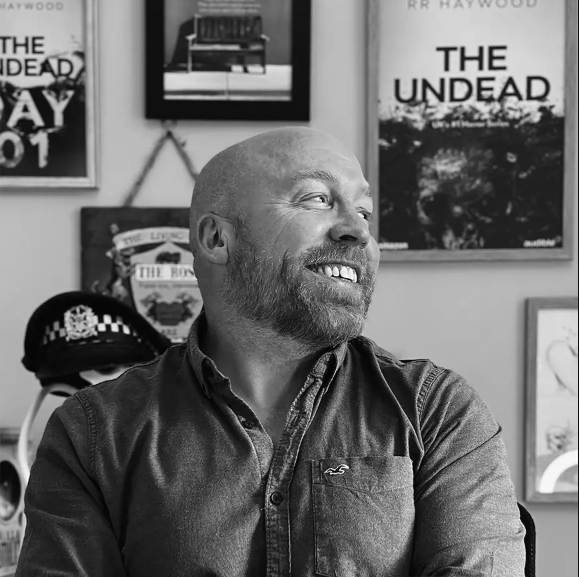
RR Haywood is one of the world’s bestselling fiction authors, known globally for his zombie and science-fiction series of books. His work, much of which was self-published, has sold millions of copies around the world, making him one of Britain’s most successful ever self-published novelists in these genres. As an Amazon “All-Star” author, RR Haywood’s books have consistently featured in the retailer’s top 100 sales chart since 2017. He has had 30 Kindle Bestsellers and is a Washington Post, Wall St Journal, Amazon & Audible bestselling author. His books Fiction Land and DELIO were nominated for the best audio book at The British Book Awards and won the Discover Sci-Fi Best New Book 2023 respectively. His latest novel, GASLIT, is a dark noir thriller about an ex-policeman manipulated into a murder plot.
READ MORE: ‘Shelf-made men: why publishing still favours the well-connected‘. Figures indicate that Britain’s publishing industry continues to draw heavily from privately educated and well-connected authors, while working-class writers progress more slowly and achieve fewer releases. Here, our Literature and Current Affairs correspondent, RR Haywood, reviews the evidence and considers how background and access continue to influence who gets published.
Do you have news to share or expertise to contribute? The European welcomes insights from business leaders and sector specialists. Get in touch with our editorial team to find out more.
Main Image: Alicia Christin Gerald/Pexels