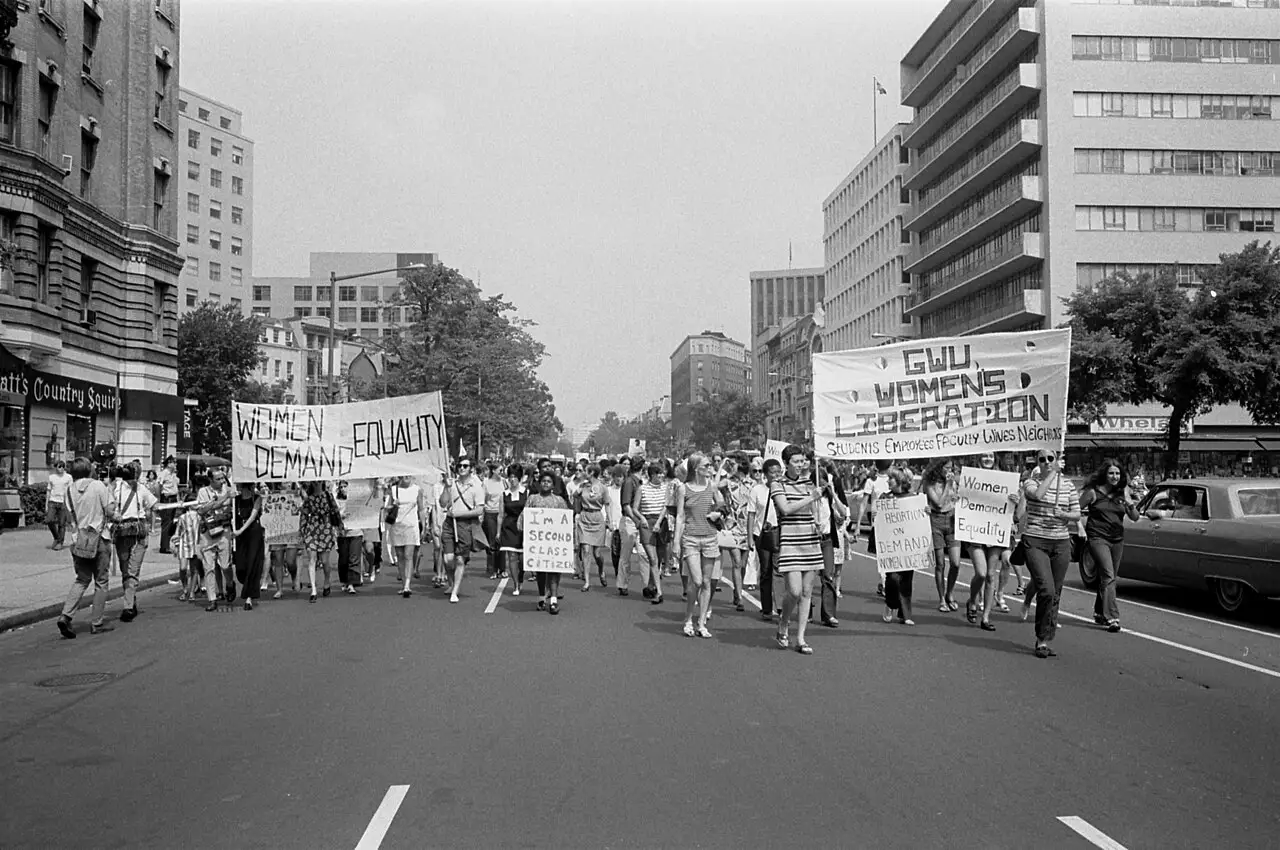
Women today enjoy freedoms won through generations of feminist political struggle, but many now encounter those gains without understanding how hard they were fought for, or how easily they can be weakened or lost. Elle Lorenzoni argues that feminism’s next challenge is to make that unfinished fight visible again
Feminism has won many of the freedoms that once defined its political struggle. Women can vote, own property, take out credit, build careers and businesses, and exercise far greater control over the direction of their lives. Yet the more ordinary those freedoms have become, the harder the movement that secured them can be to see.
Earlier generations of women organised, marched, litigated and lobbied for their freedoms. Many young women now, however, encounter feminism less as a movement than through the freedoms it helped create: sexual autonomy, career choice, entrepreneurship, wealth, beauty, consumption and the conversion of the self into a brand.
This is feminism’s ‘marketing problem’. Culture today is saturated with images of female empowerment but much less interested in the laws, institutions and collective action that made that empowerment possible. Over time, feminism as a political project has increasingly been represented as personal freedom, individual success and lifestyle.
Once rights become normal, it becomes easy to forget that somebody had to win them. The danger is that those rights begin to look unchangeable, which in turn creates a second problem: gains that are no longer understood are harder to defend. If younger generations inherit the outcome without understanding how it was won, they may also fail to recognise how those gains can subsequently be weakened or lost.
At its core, feminism asks a simple question: should being born female determine the boundaries of a person’s life? Its history is largely a history of structural change. The first wave of feminism fought for education, professional and property rights and the vote. The second pushed into workplace equality and reproductive autonomy. The third turned more towards individuality and identity.
The fourth wave, emerging around 2012, organised largely through digital platforms. Hashtags could organise millions of women at extraordinary speed, and the #MeToo movement demonstrated the collective power those platforms could generate. But the same media environment also elevated a very different image of empowerment: the influencer, the girlboss and the woman as brand.
Political feminism seeks changes to laws, rights and access to power but consumer culture can, instead, turn female empowerment into something that can be advertised and sold through fashion, lifestyle and personal branding. That makes the image of liberation easier to market to women than the actual political work that sustains it.
Popular culture has reflected that change. In 1970, The Mary Tyler Moore Show placed an unmarried professional woman at the centre of prime-time television. By 1988, Tess McGill in Working Girl wanted access to the rooms where decisions were made. In 1998, Carrie Bradshaw arrived in Sex and the City, where career, sex, money, marriage and desire formed a story of personal self-definition.
These characters made female independence visible but they also encouraged audiences to see liberation through individual success rather than the political changes that made that success possible in the first place.
And as female liberation became increasingly expressed through personal identity and consumption, it became easier for the market to package and sell. By 2014, Sophia Amoruso’s bestselling book #GIRLBOSS had given a name to an entrepreneurial model of female self-creation. The ‘girlboss’ did not need to overthrow the system – she wanted to run it.
Women succeeding inside existing systems is progress but it becomes misleading when exceptional success is treated as evidence that the structure itself has become equal. The success of women such as Oprah Winfrey, Beyoncé and Taylor Swift can make inequality look obsolete because highly visible individual achievement can create the impression that the door is now open to everyone.
A famous successful woman is easy to see but unequal patterns across millions of women are much harder to notice. Exceptional women can therefore become powerful symbols of progress without proving that opportunity and power are distributed equally.
USC Annenberg’s Inclusion Initiative found that 54 of 2024’s 100 top-grossing films had a girl or woman as lead or co-lead. We have, then, become much better at putting women at the centre of the picture but women remain much less well represented in positions of institutional power. As of January 1, 2026, IPU and UN Women data showed that only 28 countries were led by a woman head of state or government, while women led about 11 per cent of Fortune 500 companies.
In 2023, the blockbuster Barbie highlighted a different problem: women had gained new freedoms without losing many of the older expectations placed on them. Sociologist Arlie Hochschild described this as the ‘second shift’ – unpaid domestic labour following paid work.
The pressure of combining professional ambition with older domestic expectations helps explain the appeal of the trad-wife: beautifully dressed on a Tuesday afternoon, pasta made from scratch, presenting domesticity as an escape from the demands of modern female achievement. The girlboss ideal, by contrast, encourages women to pursue professional success without abandoning older expectations. The trad-wife offers an escape from that more demanding combination.
Don’t get me wrong, there’s nothing inherently anti-feminist about homemaking, motherhood or traditional marriage. Feminism has to include a woman’s right to choose those things. But the question is whether the choice survives changed circumstances. In other words, if a woman chooses the home, could she later leave it and remain economically viable? A choice that cannot survive reversal is not freedom.
Nostalgia presents a selective version of the past, and social media can do much the same with domestic life. Some women promoting economic dependence are themselves earning money from that content. In those cases, the traditional lifestyle being promoted is also the basis of a media business, so domesticity itself becomes a lifestyle marketed as a form of female freedom. Women were liberated from compulsory domesticity and professional achievement was then sold as liberation. Women then discovered that combining professional ambition with older domestic expectations could be exhausting, so now domesticity is being sold back to women as liberation. In both cases, a version of female freedom is being packaged and sold.

American attorney and conservative activist Phyllis Schlafly shows why the success or influence of individual women does not necessarily mean that women as a whole have secure legal equality. In the 1970s and early 1980s, she led STOP ERA, a political campaign opposing the proposed Equal Rights Amendment (ERA), which would have added a constitutional guarantee in America that legal rights could not be denied on the basis of sex. The amendment needed ratification by 38 states but had secured only 35 by the extended 1982 deadline, so it failed to become part of the U.S. Constitution. Schlafly argued that women did not need this constitutional protection while herself exercising considerable political influence thanks to the rights secured by earlier generations of feminists.
And for millions of women around the world, equality was never achieved in the first place. The World Bank’s Women, Business and the Law 2026 report found that 4 per cent of women worldwide live in economies approaching full legal equality.
Rights that have been secured can also be reversed. For nearly 50 years, *Roe v. Wade protected a federal right to abortion in the United States*. On June 24, 2022, Dobbs v. Jackson Women’s Health Organization overruled it and returned authority to regulate abortion to the people and their elected representatives.
You may disagree with abortion but that’s beside the point. Rights exist precisely because adults make different decisions according to their circumstances. The question is whether an adult woman is presumed competent to make consequential decisions about her own body or whether that competence is contingent on legislation, geography or judicial interpretation. The most efficient way to infantilise a class of adults is to reserve the right to overrule them.
Dobbs exposes the danger of treating rights as permanent simply because they have existed for a long time. Courts can reinterpret rights, legislatures can amend the laws that protect them and public attitudes can change over time. A legal or political settlement can be challenged again, even decades after it appeared settled. Rights therefore require continued political and institutional protection rather than being assumed to sustain themselves.
Feminism’s modern-day marketing problem could therefore threaten the rights of future generations of women. This can only be solved by reconnecting women who enjoy the fruits of hard-won freedoms with the long and difficult political struggle that secured them.
Women need to move beyond the image and the lifestyle. They must know who fought for their right to vote, work, own property or obtain credit in their own name. They must actively protect the gains that many women have come to take for granted. That means knowing which laws protect women and who is trying to change them, understanding how courts and institutions exercise power, voting in elections and teaching younger generations that their rights were won through political action and can be weakened or removed through political action too.
Elle Lorenzoni is an entrepreneur whose work spans media, law, and communications. She holds a BA in Rhetoric from the University of California, Berkeley, a Juris Doctor from Loyola University Chicago School of Law, and an LL.M. from the University of Fribourg in Switzerland. Her early career began at the William Morris Agency in Los Angeles, where she worked as a television literary assistant before going on to develop her own ventures, including Planning Pretty Picnics and The Spoken World. As Women, Work and Enterprise Correspondent for The European, she writes on female entrepreneurship, workplace culture, and leadership, with a focus on how power operates in professional environments and how it shapes women’s opportunities, decisions, and outcomes.
READ MORE: ‘Minority women are more visible in the creative industries but still underrepresented in ownership‘. Minority women are increasingly visible in Europe’s image economy, but their authority to commission, own and profit from those images still lags far behind. The European’s Women, Work and Enterprise correspondent Elle Lorenzoni speaks to Blursday founder Sheena James to find out what closing the gap looks like.
Do you have news to share or expertise to contribute? The European welcomes insights from business leaders and sector specialists. Get in touch with our editorial team to find out more.
Main Image: Women march for equality in Washington, DC, in August 1970. Credit: Warren K. Leffler / Library of Congress