Last month, Dr Stephen Whitehead wrote about Ajahn Jayasaro becoming the most senior foreign-born monk in Thai Buddhist history. In this exclusive follow-up interview, he talks to the British-born Buddhist teacher about masculinity in later life, from fathers, friendship and loneliness to desire and growing old
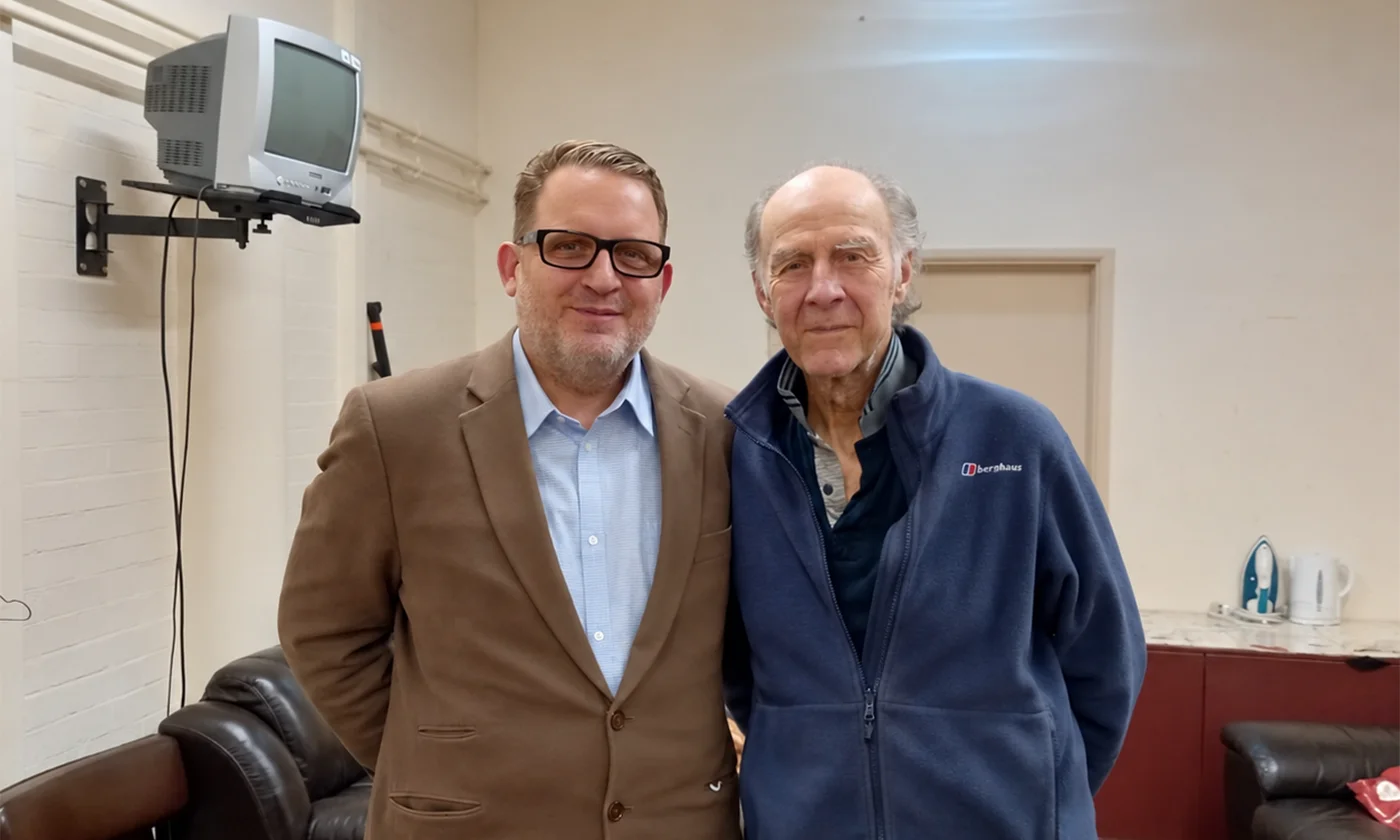
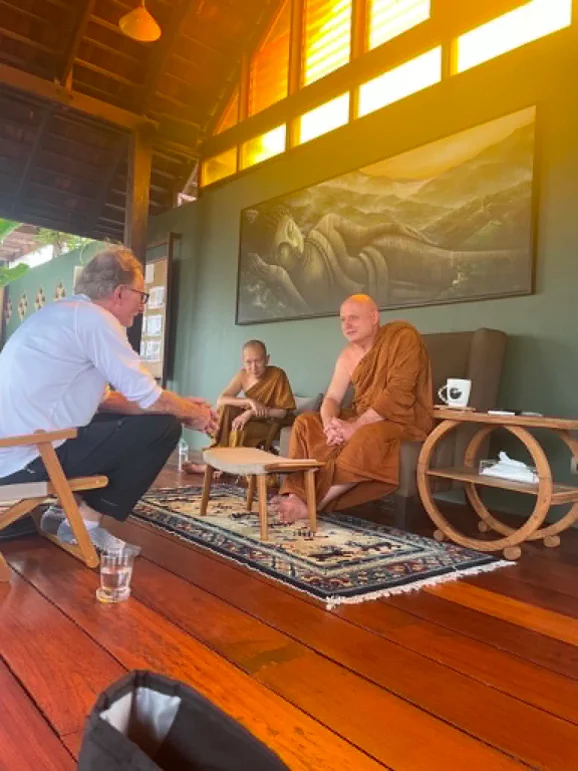
It’s a scene repeated a thousand times a week across Thailand. Two Englishmen of a certain age, decades into their expatriation, talking about the things such men talk about: the relationships, the friendships, the country they left and no longer quite recognise, the business of getting old somewhere warm and far away.
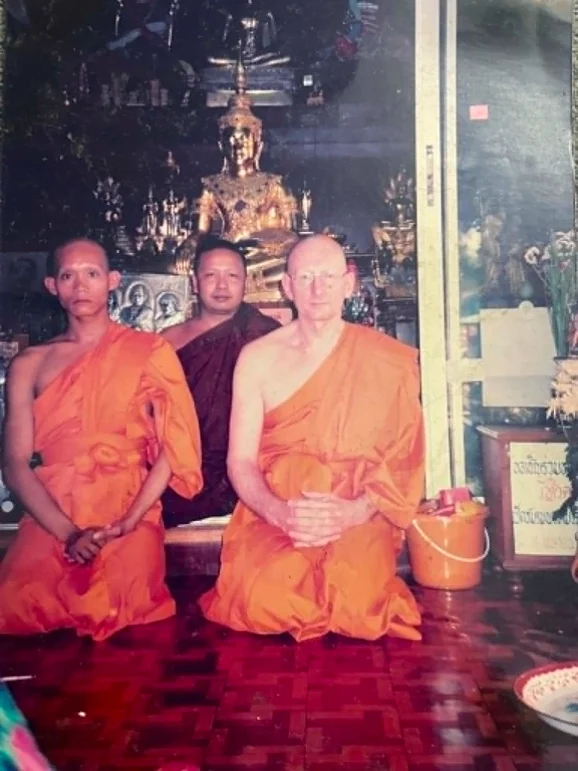
Except that one of us was wearing ochre robes, had taken his last meal before noon, and last month had been elevated by King Maha Vajiralongkorn to the second-highest rank in Thai Buddhism – Somdet Phra Ratchakhana – the first foreign-born monk in the country’s history to hold it. I recently discussed his promotion in my article What capitalism can learn from a British monk promoted at 68.
He was born Shaun Chiverton on the Isle of Wight in 1958 and grew up mostly in Newmarket. Severe asthma kept him out of school; he filled the empty days with reading and met Buddhism on the page long before he met a Buddhist. At 17 he left for India, travelled two years, hitchhiked home but could not settle. Then someone mentioned an Englishman who had become a forest monk in Thailand so he followed suit, aged 20, and stayed. The world knows him as Ajahn Jayasaro (a Pali monastic name: ‘Ajahn’ roughly means ‘teacher’, while ‘Jayasaro’ means roughly ‘essence of victory’). Thailand now knows him as Somdet Phra Maha Phatcharayanmuni – his title within the rank of Somdet Phra Ratchakhana.
I am the other sort of Englishman: Northern British, several marriages, five children on two continents, 25 years in Thailand. Not quite a layman, though. In April 2004 I ordained too – shaved head, ochre robes, alms at dawn – and lasted a fortnight. Jayasaro has managed 46 years. What survived in me was the practice: 22 years of daily meditation and counting. 35 years a sociologist studying men and masculinity, I now write about the far end of it – the last masculinity. Ajahn Jayasaro is one of 18 I am interviewing for my new book Old Men: The Last Masculinity, and the only one in robes.
I started by asking what his connections with England now amounted to. He did not soften it.
“Very loose, really,” he told me. “We have a number of monasteries in England, so over many years I’ve been going back to visit friends and colleagues, and of course my parents. But now both my parents have passed away. I have got a brother and sister there and we keep in touch, but my link with them is not strong enough to make me want to go halfway across the world.”
Any expatriate of our generation recognises the arithmetic. What holds you to a country is not landscape nor nostalgia but a small number of specific people, and when they die the tether goes with them. He had arrived at that point ahead of most of us, and stated it without the guilt an Englishman is supposed to perform.
What he remembered, in detail, was leaving. He was 17, at the railway station, taking the train down to London to begin the journey east.
“We get my bag out of the back and my father doesn’t say anything, you know, like meaningful. And then finally he says, ‘Don’t forget to write to your mother.’ That’s my dad. You probably can relate to that.”
I could. So, I suspect, can most men over 60 in Britain. Every one of the 18 men I am interviewing has a version of that platform, that silence, that substituted sentence. Those fathers were not so much cold as unequipped. What they had instead of a vocabulary was a practical instruction, offered at the last possible moment, which had to carry everything else.
Ajahn Jayasaro’s father, who left school young to support a poor family and took an aversion to religion from the Great Depression, eventually began reading Buddhist books – years after his son ordained. He never converted; a step too far, Ajahn Jayasaro said. And when people asked about the boy who went to Asia and stayed, the family had a settled answer: they had always known he would do something weird. They just hadn’t known what kind of weird.
I told him I had become celibate some years ago, after several marriages, and found it clarifying rather than depriving. My fortnight in robes aside, it took me most of a lifetime to reach a position he entered at 22. What, I asked, did he make of desire?
“I would say that Freud and his followers made too much out of sex. He made huge generalisations about human nature from the study of neurotic middle-class women in Vienna.”
A good line, and a serious one. Forty-six years inside the monastic life, hundreds of men observed, and he reported something our culture rarely allows to be said: libido is not a constant, not a reliable index of vitality and not the engine of the self.
“Sexual drive varies incredibly, and varies through life as well. Some people in their twenties, when you would think they would, actually don’t have a problem at all, and then they find it’s a problem in their thirties or forties. Some start off with very strong sexual desire and it wanes.”
For a generation raised to treat sexual capacity as the measure of manhood, and now ageing out of it, the observation reframed a widely felt loss as ordinary variance. Ajahn Jayasaro was unromantic about the alternative, noting approvingly that the Thai system was easy to leave. A man may say he would rather have a family and go, no shame attached, unlike traditions that treat disrobing as defeat and fill up with monks who do not want to be monks.
I read him the standard sociological inventory of traditional masculinity – stoic, competitive, insular, insecure, fearful, aggressive when threatened – and asked which of it he recognised in himself. He chose one term: stoic – the single item on the list which is a discipline rather than a pathology.
Ajahn Jayasaro then turned the interview round and asked whether I accepted the idea of a crisis of masculinity – the most disconcerting thing that can happen to a sociologist holding a schedule of 34 questions. I answered: “No, but with qualifications.”
Which brought us to what I had really come for. No wife, no children, no colleagues, alone in a forest hermitage near Khao Yai – on paper he ought to be among the loneliest men alive. However, he was not, and his explanation was not the one I expected.
“Negative mental states like loneliness, they’re based on certain unexamined ideas and assumptions about who you are and what life is about. So it’s not trying to change your mind and forcibly decide ‘No, I’m happy being alone.’ It’s seeing what are the roots.”
The West has spent a decade treating loneliness as arithmetic – too few people, a deficit of supply. The counting is now formidable: the WHO Commission on Social Connection reported in 2025 that one in six people worldwide is affected, with more than 871,000 deaths a year linked to loneliness. Ajahn Jayasaro was proposing something else: that loneliness is epistemic rather than arithmetic, an unexamined assumption about what people are for. Note what he ruled out – the forcible cheerfulness, the decision to be fine, which is precisely the move most lonely men make.
On friendship he was blunter still. I raised the figures – the Survey Center on American Life found the proportion of men with six or more close friends had fallen from 55 per cent in 1990 to 27 per cent, while those with none at all rose from 3 per cent to 15 per cent – and for the only time in the hour he interrupted me. “Oh, I’ve got so many.” He ordained alongside three others, three Englishmen and an Australian. Four decades on they are still in touch. Shared purpose, shared structure, uninterrupted proximity – the monastery preserves what the rest of us dismantled in our twenties, and never set out to.
He also cited, unprompted, the Harvard Study of Adult Development and its finding that satisfaction in relationships in midlife was the best predictor of a happy and healthy life at 80. He knew the conclusion but not the name. It was, he said, the one to look at.
At 68 he was stiffer than he used to be, and any small ailment took longer to clear. He had fallen asleep instantly all his life – “just turn off the switch” – but was waking repeatedly. Asked what he did then, he gave the shortest answer of the afternoon: “Meditate, then go back to sleep.”
Nor does rank bring rest: “Unlike laypeople, you get more work as you get older, not less. And I’m thinking I have to exercise a bit more, because I’ve got a lot on. It sounds a cliché but just take it day by day.”
Offered, near the end of the interview, the opportunity to provide a transcendent answer – the thing an interviewer hopes for – Ajahn Jayasaro declined it (“I wouldn’t articulate it in that way.”). What he described instead was the land around him: 50 acres of degraded cornfield when he arrived, painstakingly planted by him with thousands of trees which now form a forest, watched over by him from saplings to fruit. He was careful about using the word ‘mystical’. Rather, it was simply an environment that had grown up before his eyes.
Two old Englishmen, then, in a room in Bangkok, doing what such men do. One of us has a wife, five children, obligations across three continents and a body of work about masculinity. The other has 50 acres, four friends from 1980, an adopted daughter in the Himalayas and no plans to see England again.
For all the distance between those lives, on the questions which actually preoccupy men of our age – what desire is worth, what a father managed to say, who is left, what to do at three in the morning – he was not actually describing a distant country at all.
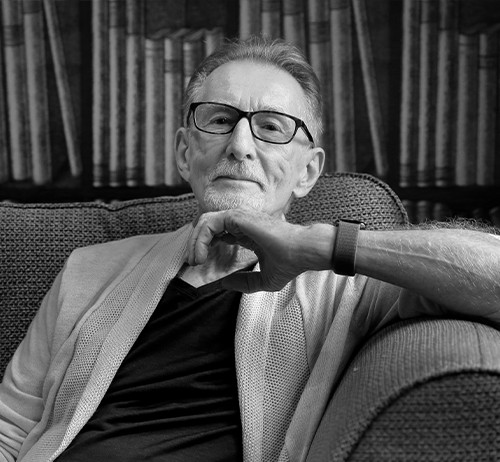
Dr Stephen Whitehead is a gender sociologist and author recognised for his work on gender, leadership and organisational culture. Formerly at Keele University, he has lived in Asia since 2009 and has written 20 books translated into 17 languages. He is based in Thailand and is co-founder of Cerafyna Technologies. His forthcoming book, Old Men: The Last Masculinity, will be published in 2027.
READ MORE: ‘What capitalism can learn from a British monk promoted at 68‘. A British monk and a retired Englishman were born the same year. One left for Thailand at 20 and has just become the most senior foreign-born monk in Thai Buddhist history. The other stayed closer to home and is living the retirement the rest of us are promised. Stephen Whitehead asks why one system pays a man for growing old, while the other simply stops paying attention to him.
Do you have news to share or expertise to contribute? The European welcomes insights from business leaders and sector specialists. Get in touch with our editorial team to find out more.
Main Image: Andrea Piacquadio / Pexels