Research involving more than six million international calling customers reveals how our telephone habits have changed, with conversations getting shorter, contact lists growing and voice calls surging during emergencies
People are speaking to almost twice as many contacts on the phone as they did a decade ago, according to new research examining the calling habits of more than six million people.
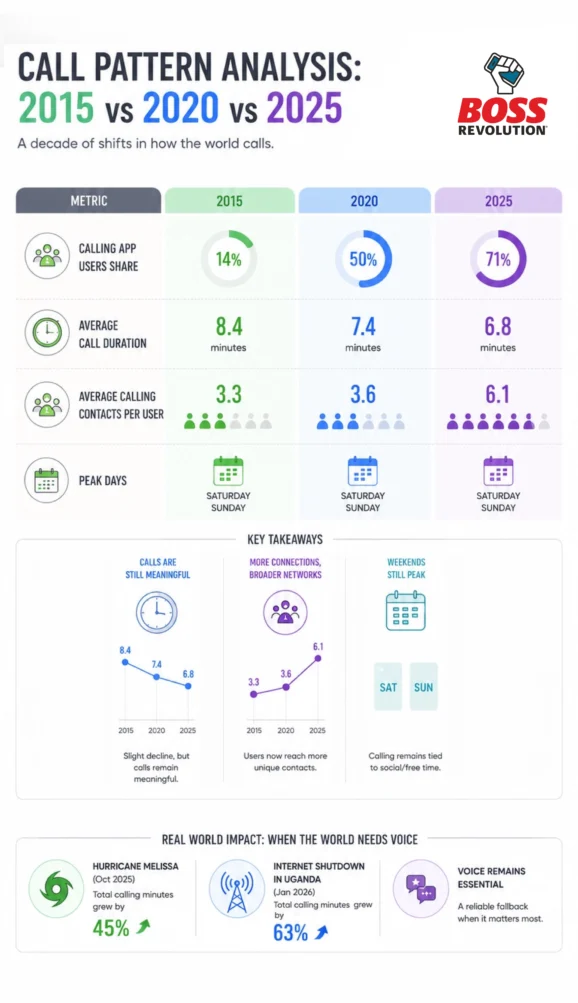
The average number of different people contacted by each user rose from 3.3 in 2015 to 6.1 in 2025, even as conversations became shorter and more people turned to smartphone apps to stay in touch.
The study, conducted by international communications provider BOSS Revolution, analysed customer calling records across more than 100 countries to examine how people communicate with friends and family overseas.
Researchers found that the average international call lasted 6.8 minutes in 2025, compared with 8.4 minutes a decade earlier. In 2020, the average was 7.4 minutes.
Saturday and Sunday remained the busiest days for calls throughout the decade, with evenings also among the most popular times for contacting relatives and friends.
The proportion of the company’s voice traffic carried through its mobile app increased from 14 per cent in 2015 to 50 per cent in 2020 and 71 per cent last year, as customers increasingly used smartphones for international calls.
A spokesperson for BOSS Revolution said: “Most of us now have lots of ways to keep in touch, from texting and messaging apps to video calls.
“But people are still spending several minutes on the phone when they do call, and they’re speaking to more people than they were ten years ago. “For anyone with friends or family living abroad, it’s now easier to stay in regular contact with a wider circle of people.”
The research, seen by The European, also found sharp increases in calling activity during major emergencies, when people sought to contact friends and family affected by disasters and disruptions.
During a nationwide internet shutdown in Uganda ahead of its elections earlier this year, for instance, total calling minutes among BOSS Revolution customers increased by 63 per cent.
A similar increase was recorded during Hurricane Melissa, which struck Jamaica, Cuba and the Bahamas in October 2025, when calling minutes rose by 45 per cent.
The figures suggest that people continue to rely on voice communication during emergencies, particularly when other methods of staying in touch were disrupted, the company said.
Its spokesperson added: “When something serious happens, people want to hear a familiar voice.
“Whether it’s a hurricane or an internet blackout, calling someone is often the first thing we think of doing to check they’re safe. Our research shows just how much more people use voice calls when they’re worried about friends and family.”
The research, conducted in May 2026 using anonymised customer data, examined international calling patterns between 2015 and 2025, alongside more recent examples of how major events affected telephone use.
BOSS Revolution’s data found particularly high levels of calling activity involving Central America, Mexico, Africa and the Caribbean.
Frequently contacted countries included Guatemala, Honduras, El Salvador, Nigeria, Ethiopia, Kenya, Eritrea, Ghana, Haiti, the Dominican Republic, Jamaica and Cuba.
The company’s list of countries with more than 100,000 active international callers included Guatemala, the U.S, the Dominican Republic, Nigeria, Ethiopia, Honduras, El Salvador, Haiti, Jamaica and Ghana.
Europe, Asia, Canada, Oceania and other North American destinations collectively accounted for approximately five per cent of the calling volume in the company’s geographical breakdown.
The study also examined the cost of international communication, particularly calls to remote locations and regions with limited telecommunications infrastructure.
BOSS Revolution listed charges of $5 per minute for calls to the Inmarsat, Iridium and Thuraya satellite networks, with calls to the Solomon Islands also costing $5 per minute.
Other expensive destinations included Saint Helena at $2.835 per minute, Tokelau at $2.50, Kiribati and Nauru at $1.50 each, and the Maldives, São Tomé and Príncipe and Antarctica at $1.
By comparison, the research listed calls to the United States and United Kingdom at less than 2 cents per minute on the same network.
Its research separately examined how AI is being incorporated into telephone services, including automated call handling, spam filtering, speech recognition and real-time translation.
According to BOSS Revolution, smartphone applications and AI-assisted services will play a growing role in international communications in the coming years.
“The way we make calls has changed enormously, but the reason we make them hasn’t,” it added.
“People still want to catch up with their families, share good news or check that someone is OK. Whether a call goes through a traditional phone network or an app on your smartphone, being able to talk to someone you care about is just as important as ever.”
READ MORE: Mobile operators warn of higher bills and slower 5G rollout after energy support exclusion. Britain’s biggest telecoms groups say their exclusion from the government’s electricity relief scheme leaves critical national infrastructure exposed to rising power costs linked to the conflict involving Iran, with possible consequences for prices, investment and jobs.
Do you have news to share or expertise to contribute? The European welcomes insights from business leaders and sector specialists. Get in touch with our editorial team to find out more.
Main image: International calling has become an increasingly important way for people to keep in touch with friends and family overseas, with new research showing that users are contacting almost twice as many people as they did a decade ago. Credit: SHVETS production via Pexels.