Recent breakthroughs by Tesat and Blue Origin, the space company owned by Amazon founder Jeff Bezos, have shown that laser communications are moving from promising tests towards operational use. But Jean-François Morizur, chief executive of optical communications company Cailabs, argues that the bigger challenge now lies in getting that data reliably back down to Earth at scale
In March of this year, Tesat set a record-breaking gigabit-per-second laser link between an aircraft and a geostationary satellite some 36,000km above the Earth.
Using a tightly focused laser beam, rather than a conventional radio signal, huge amounts of data were moved for the first time from a moving airborne platform to space in real time. In turn, that made it possible for information gathered by the satellite to be relayed far more quickly for processing and use on the ground.
Until recently, aircraft and drones have been able to gather vast quantities of information but getting it off the platform quickly enough has been far harder. In practice, much of that data often had to be stored onboard and brought back after the mission, by which point some of it was already less useful.
Tesat’s breakthrough is one of a growing number of signs that optical communication – or ‘lasercom’ – is moving beyond experimental promise and reaching operational maturity.
Blue Origin, the space company owned by Amazon founder Jeff Bezos, suggests that lasercom is moving beyond isolated demonstrations towards continuous operational networks. Its TeraWave network will reportedly use 5,408 optically interconnected satellites to provide continuous global connectivity for businesses, data centres and government users, with deployment due to begin in the fourth quarter of 2027.
For a long time, however, lasercom was seen widely as highly promising but fragile. The physics, for one thing, are demanding. Light can carry far more data than radio, but it is also far less forgiving. Relatively small disturbances can disrupt or break the connection. That made early optical systems difficult to deploy outside tightly controlled conditions.
Above the Earth’s atmosphere, there are different challenges than within it. There’s no turbulence, for instance, and no clouds – indeed, there’s no weather whatsoever. For this and other reasons, a laser beam can travel cleanly between platforms. It is why satellite-to-satellite optical communications technology has progressed so quickly, and why connections between satellites and high-altitude aircraft and drones are starting to reach maturity.
This is a step forward. Airborne platforms are now major producers of data. Modern ISR (Intelligence, Surveillance and Reconnaissance) systems generate vast amounts of information almost ceaselessly. It is now perfectly common for a single drone to produce data at rates of 2 to 2.6 gigabits per second – and the rate is increasing all the time.
Until recently, shifting that data in real time was a constraint. The data could be collected well enough but couldn’t be transmitted. That meant it needed to be stored, and brought back at the end of the mission, making it less and less relevant, useful and therefore valuable.
A high-capacity optical link connecting, say, a drone and a satellite changes that by removing one of the main ISR obstacles: getting data off the platform quickly enough for it still to be useful. But that solves only half the problem. However valuable it is to move multi-gigabit streams from aircraft to spacecraft, those streams still need to be brought back down to Earth. That is another challenge.
The shortfall, put simply, is this: coverage is sparse, capacity is uneven, and availability is still constrained by weather and geography. In effect, data is often throttled, delayed or lost at the final step between space and Earth.

As it stands, most satellite-to-ground communications rely on radio frequency (RF). RF is time-honoured, robust and well-understood. It is a workhorse technology whose enduring value is beyond doubt. But it does have weaknesses. Depending on spectrum availability, it can have limited bandwidth and was not made for a world in which dozens, then hundreds, of airborne platforms were producing gigabits of data at every moment. This is why, at scale, it starts to show strain.
Needless to say, a dedicated satellite for every drone is not a realistic solution. It is too expensive, for one thing, as well as being inefficient. What’s needed instead is shared infrastructure: networks that can collect, direct and distribute data dynamically, as needs require.
No single organisation will build this on its own. Governments will need to set requirements and anchor demand through defence and civil procurement; commercial operators will deploy, own and run stations; and common standards will be needed to ensure systems can work together.
If we’re to avoid a lopsided system, wherein the technology that gets data to the satellite is treated as distinct from that which gets the data back down to the Earth, then this system must be considered as a whole, and designed end-to-end. More concretely: we need to think about how data moves from the airborne platform to the satellite; from the satellite to other satellites; and from the final satellite to the ground station. Each link must be able to handle the same amount of data.
Are there signs that this is happening? Some. What’s most important is that the technology that enables the downlink, with all of the challenges that has historically involved, has been established, refined and commercialised. The chief obstacles – atmospheric turbulence, clouds, weather – have been surmounted thanks to the development of techniques capable of shaping and correcting the beam.
In short, it’s now possible to recover a stable, high-capacity link even in imperfect conditions. Thanks to these advanced optical techniques, optical ground stations can operate at scale.
And ‘scale’ is the operative word. Because one station is not enough. Only a broad and distributed set of optical ground stations will provide the resilience, coverage and capacity that modern ISR requires.
If conditions are poor in one location, data traffic can be redirected to another. This kind of architecture supports entire networks rather than standalone, point-to-point optical links. But it rests on our focusing not only on space, which has a certain glamour to it, but on the ground as well. Because – and it is a simple fact – data is valuable only insofar as it can be used.

Jean-François Morizur is CEO of Cailabs, a company founded in 2013 and recognised as a world leader in ground-to-satellite optical communications. Its optical ground station was recently named one of TIME magazine’s Best Inventions of 2025. He is also Vice-President and a Partner at Deeptech France.
READ MORE: UK backs satellite-AI projects to tackle climate and transport challenges. Backed by £1.5m from the UK Space Agency, six projects will apply satellite data and AI to green shipping, rail and finance, create tools for biodiversity and accessibility, and support net zero while opening new markets in a space sector that already employs 56,000 people.
Do you have news to share or expertise to contribute? The European welcomes insights from business leaders and sector specialists. Get in touch with our editorial team to find out more.
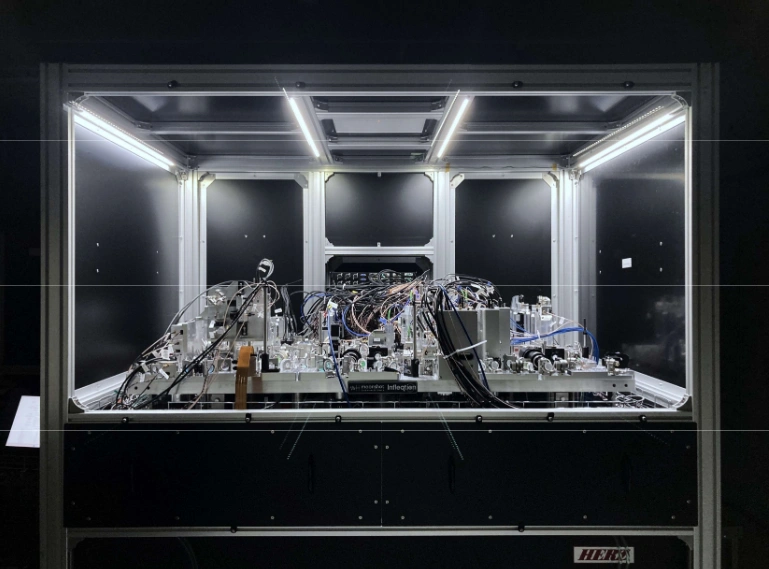
Main image: Cailabs’ optical ground station technology is designed to support high-capacity laser links between satellites and Earth, helping to move large volumes of data beyond the limits of conventional radio systems. Credit: Supplied