
In the fifth of her popular stargazing series, Omara Williams turns her gaze to the southern sky. This August, she guides readers to Fomalhaut, Hamal and other seasonal stars, while highlighting the month’s spectacular meteor showers, planetary pairings and lunar encounters
August is a spectacular month for stargazing, dominated by the dazzling Perseids, one of the most famous meteor showers of the year, and accompanied by six other showers that light up the summer sky. As darkness arrives earlier and the Milky Way stretches overhead in all its glory, the constellations of Capricornus, Cetus, Aries and Piscis Austrinus take centre stage.
In this fifth instalment of my stargazing series, we’ll build on July’s tour of the northeastern constellations, from Capella and Perseus to Cassiopeia and Andromeda, which you can revisit here to refresh your navigation skills before exploring August’s highlights. This time, we’ll focus on how to find some of the season’s brightest stars, including Fomalhaut and Hamal, and take a closer look at the month’s planetary alignments, lunar encounters and meteor activity.
How to Find Fomalhaut in Piscis Austrinus
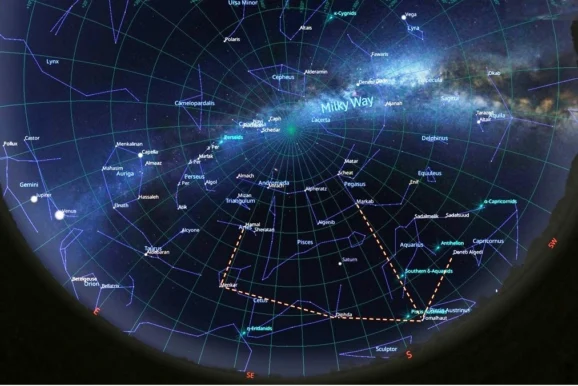
To find Fomalhaut, look south after midnight. It sits on its own in an otherwise empty stretch of sky, which is why it’s known as the Loneliest Star. If you can spot the large Square of Pegasus overhead — a big box of four bright stars — start from the bottom-right corner of that square. Trace an imaginary straight line down toward the horizon, and the first bright star you’ll see is Fomalhaut, twinkling near the horizon.
In August, Saturn shines just above and to the left of Fomalhaut, creating a beautiful pairing. Fomalhaut is a hot, white star, much more massive and luminous than our Sun, located around 25 light-years away. It has two smaller companion stars about one to two light-years distant and is surrounded by several rings of dust and gas, which astronomers study to learn about planet formation. The name Fomalhaut comes from Arabic and means Mouth of the Fish, marking its place in the Piscis Austrinus (Southern Fish) constellation.
How to Find Deneb Algedi in Capricornus
From Fomalhaut, look up and to the right (towards the southwest). You’ll see a faint V-shaped pattern of stars — this is Capricornus, the Sea Goat. The bright star at the left end of the V is Deneb Algedi, the tail of the goat.
Deneb Algedi is a multiple-star system about 40 light-years away, with two stars that eclipse each other as they orbit, causing its brightness to vary. Its name also comes from Arabic, meaning the tail of the goat.
How to Find Diphda and Menkar in Cetus
Go back to Fomalhaut and look up and to your left (towards the southeast). The bright orange star you’ll find there is Diphda, the brightest star in the sprawling constellation Cetus, which represents a sea monster in Greek mythology.
Diphda is an orange giant, more than 30 times larger than our Sun, and is located about 96 light-years away. Close to it — a few stars to the left — is Menkar, a red giant that’s much farther away at 250 light-years. Cetus is part of the legendary tale of Perseus and Andromeda, where Perseus fought the sea monster Cetus to save the princess.
How to Find Hamal in Aries
From Menkar, trace your gaze upwards until you spot three stars forming a small curve — this is Aries, the Ram. The brightest of the three is Hamal, which glows with a soft orange light.
Hamal is an orange giant, about 66 light-years away, and is ranked the 50th-brightest star in the night sky. Astronomers believe it may host an exoplanet nearly twice the mass of Jupiter. In Greek mythology, Aries was the golden-fleeced ram owned by Zeus, later placed among the stars near Pegasus.
What Else to Watch Out for This August
August is one of the busiest months for skywatchers, with meteor showers lighting up the heavens and planets making striking appearances alongside the Moon and bright stars. Here’s how to make the most of what’s coming.
Meteor Showers
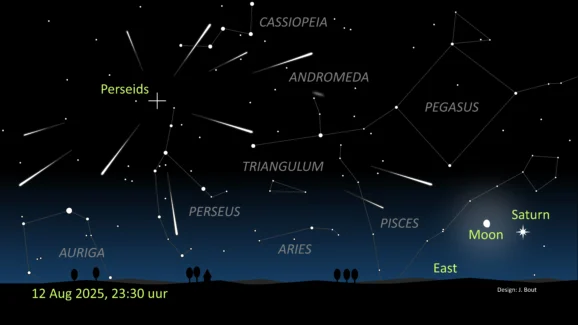
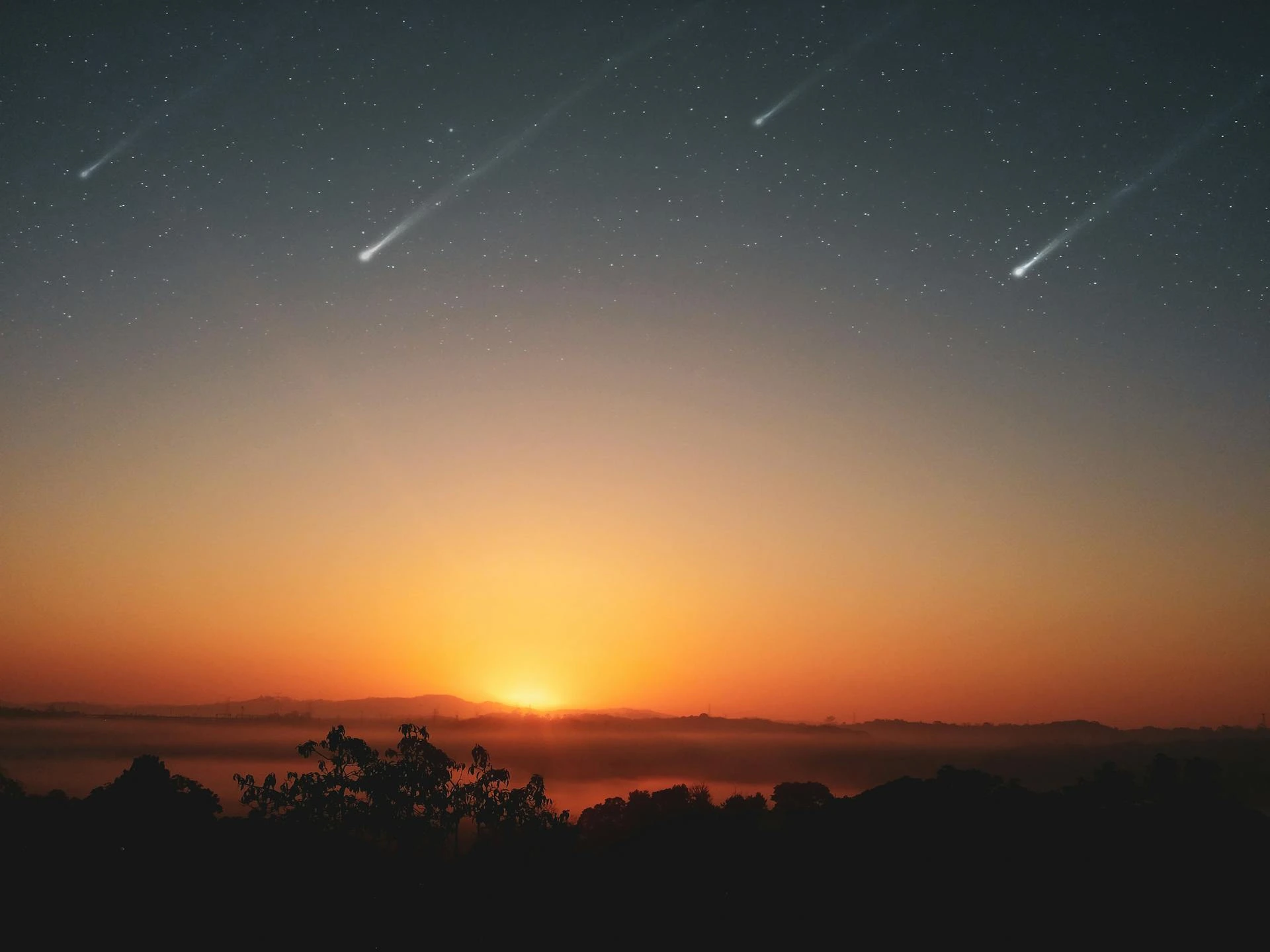
Meteor showers are truly one of the most enjoyable natural spectacles visible in the night sky. These captivating displays occur when Earth journeys through the remnants of comets or asteroids, leaving trails of sparkling debris in its wake. As this cosmic dust and fragments of rock enter our atmosphere at incredible speeds, they ignite in a brilliant flash, creating the awe-inspiring sight of shooting stars streaking across the heavens.
Most meteor showers are named after the constellation and star from which they appear to radiate. To maximise your chances of witnessing these brilliant fireballs, it’s important to prepare. After midnight, drive to a location far from city lights and choose a spot with an unobstructed view of the sky. A moonless night is ideal, but if that isn’t possible, try to shield your eyes from direct moonlight. Lie back in a comfortable chair that allows you to look up for extended periods. Be sure to allow your eyes to adjust to the darkness for at least 20 minutes as you wait in anticipation.
Here’s a clear breakdown of the meteor showers happening in August:
1. Perseids:
– Dates: July 17 – August 23
– Peak: August 12–13
– Rate: Up to 100 meteors/hour
– Notes: One of the brightest meteor showers of the year, but it will be impacted by moonlight. Look high in the eastern sky.
2. Eta Eridanids:
– Dates: July 12 – August 30
– Peak: August 7-8
– Rate: Up to 6 meteors/hour
– Notes: Swift meteors causing bright but brief streaks of light. Look low in the southeastern sky.
3. Southern Delta Aquariids:
– Dates: July 18 – August 21
– Peak: July 29–30
– Rate: Up to 25 meteors/hour
– Notes: Known to leave glowing trails lasting a few seconds after the meteor has passed. Look low in the southern sky.
4. Alpha Capricornids:
– Dates: July 12 – August 12
– Peak: July 29-30
– Rate: Up to 5 meteors/hour
– Notes: Known for bright fireballs. Look in the mid-southwestern sky.
5. Piscis Austrinids:
– Dates: July 15 – August 10
– Peak: July 28
– Rate: Up to 5 meteors/hour
– Notes: Faint shower but easy to locate near the bright star Fomalhaut. Look low in the southern sky.
6. Kappa Cygnids:
– Dates: August 3 – August 25
– Peak: August 17
– Rate: Up to 3 meteors/hour
– Notes: This sporadic shower sometimes peaks alongside the Perseids. Look high in the northwestern sky.
7. Antihelion
– Dates: January 1 – September 10
– Rate: Up to 4 meteors/hour
– Notes: On the direction opposite to that of the Sun in our sky. Look low in the southern sky.
Other Night Sky Events in August
While waiting for the meteors, there are plenty of other celestial sights to enjoy. Saturn gleams in the southeastern sky beneath the Square of Pegasus, while Venus and Jupiter rise together in the east during the early hours. Highlights this month include:
August 7 – Peak of the Eta Eridanids meteor shower.
Look in the southeastern sky below the orange star Menkar for this unpredictable meteor shower. Those who do see it, however, are rewarded with the sight of fast, flashing fireballs lasting a few seconds.
August 9 – Full Moon (Sturgeon Moon).
The full Moon rises from the southeast after 9:00 p.m. It follows a low arc toward the southwest, gliding between the Aquarius and Capricornus constellations and setting after 5:00 a.m. the next day. Unfortunately, this bright light will obscure the views of meteor showers occurring in that part of the sky. The name “Sturgeon Moon” is derived from the large population of giant lake sturgeon found in the Great Lakes during this time of year.
August 11 – Jupiter and Venus alignment.
Watch the bright planets Jupiter and Venus rising side by side in the northeastern sky in the early hours after 3:00 a.m. They will shine to the right of Castor and Pollux, the prominent stars of the Gemini constellation.
August 12 – Peak of the Perseids meteor shower.
With the Moon at 90% full, observing conditions will be challenging. However, since this shower produces very bright meteors, there’s still a chance to see a great display. Look for the radiant high in the eastern sky between the Perseus and Cassiopeia constellations.
August 16 – The Moon near the Pleiades star cluster.
After 11:00 p.m., watch the waning crescent Moon rise to the left of the bright Pleiades cluster and above the red giant star Aldebaran.
August 17 – Peak of the Kappa Cygnids meteor shower.
To observe this meteor shower, look high in the northwestern sky, to the right of the bright stars Vega and Deneb, which are part of the Summer Triangle. Known for its sporadic nature, this meteor shower surprises viewers with stunning shooting stars.
August 21 – The Moon near Jupiter, Venus and Mercury.
In the northeastern sky after 4:00 a.m., look for the thin, waning crescent Moon shining to the left of Jupiter and Venus, above Mercury and below the stars Castor and Pollux. This stunning arrangement of celestial objects will create a magnificent and unforgettable view.

Omara Williams is a nuclear and software engineer whose multi-award-winning debut science-fiction novel, The Space Traveller’s Lover, shot to international bestseller status. Outside of her literary pursuits, she enjoys stargazing and chasing total solar eclipses.
Main image, courtesy Felipe Helfstein/Pexels