President Trump’s plan to take over Gaza may seem shocking but it reflects America’s long-established conquest mentality and the country’s desire to put the ‘right people in charge’ at whatever cost, explains our U.S political analyst, Mike Bedenbaugh
President Trump’s recent comments about taking over Gaza, by buying it or otherwise, and relocating its population has been condemned across the globe, not just by Palestinian leaders and Arab nations such as Egypt and Saudi Arabia, but traditional US allies such as the UK, with fears that rather than bring peace it could further destabilise a volatile region.
But as outrageous as the proposal sounds, the rhetoric is almost as old as America itself, for the US has long carried the belief that the world could be made better if only the ‘right people’ were in charge.
This belief that it’s OK to displace indigenous populations can be traced back to the 19th century and Manifest Destiny, a notion that the United States was divinely permitted to expand across North America in the name of civilisation. Acted upon by its poster-child proponent, President Andrew Jackson, it led to the ruthless displacement of Native Americans under the Indian Removal Act.
Jackson’s idea that progress requires the removal of those who stand in the way has been immortalised not just in policy but also in symbolism – it’s no coincidence that his portrait hangs proudly in the Oval Office, a tribute to a shared philosophy of domination in the name of advancement.
Now, Trump speaks of taking over other countries with a similar conviction, as if these countries and regions are merely another frontier that needs a firm American hand to bring order. The rhetoric may be framed in terms of security and stability, but at its core, it follows the well-worn American tradition: identify the ‘never-do-wells’, push them aside, and reshape the land to suit the conqueror’s needs. This mindset is not a deviation; it is the very engine of American expansionism, whether in the western wilderness of the 19th century or the geopolitical battles of the 21st.
To British and European readers, this should come as no surprise. After all, America was founded by the people your ancestors kicked out. Your forefathers exiled the religious radicals, the criminals, the dissidents, the ones too brash, too independent-minded to conform. And what did they do? They built a country that did not seek merely to participate in the world order but to dominate it, growing into a superpower driven by boundless ambition and an insatiable appetite for economic success.
The post-World War II America that you may remember—the GIs handing out bubble-gum and candy to your grandparents in the wreckage of European cities—was only one side of the coin. The other side is a nation built on conquest and consumption. America does not simply engage with the world; it devours it. The economic boom of the late 20th century gave rise to a society where consumption is not just a habit but an identity. We buy, we consume, we entertain ourselves, and when that no longer satisfies, we seek out the next big drama to feed our addiction.
Enter Trump. He is not an anomaly; he is the embodiment of modern America’s true nature. A man who understands that in a country where attention is currency, trauma is the new entertainment. And he delivers it in spades, offering the American people a never-ending spectacle of conflict, controversy, and righteous fury. This is the America that no longer seeks access to the world’s resources by rebuilding it in an image of peace and prosperity but rather thrives on the perpetual churn of crisis and confrontation to outright conquer it.
Yet, there remains a glimmer of hope. The same economic and cultural success that propelled America into global dominance has also fostered a level of self-awareness that many Americans recognise when things go too far. Despite what Trump’s sycophants in Congress tell reporters, most people here are appalled at his off-the-cuff, ill-thought-out remarks. Many who voted for him knew he would be a bull in a china shop, but that was OK since it appears to be filled with nothing more than cheap knockoffs anyway…probably imported from China!. Even so, there are still those who understand that he must be contained – just as America, from its founding, built a system of checks and balances to rein in those who seek unchecked power.
Even within his own party, there were warnings. Niki Haley, one of the few Republicans who dared to tell the base that chaos follows Trump, assumed they would heed her call and turn to her as a saner alternative. They didn’t. The Republican electorate, far from recoiling at the destruction he leaves in his wake, seemed to revel in it. It was a stark demonstration of just how deeply the spectacle of disruption has taken root in the American psyche.
Many of us are deeply concerned that this system has been derailed, undermined by the megalomania of our own success and an atrocious lack of understanding of how our government is supposed to function. Yet, the seeds of self-correction remain. America has always been a nation of reinvention, and while we may flirt with disaster, history suggests that we have the capacity to pull back before the abyss. Whether that instinct prevails this time remains to be seen.
But for those of us who see this spectacle for what it is, there is also an opportunity. The chaos that Trump has unleashed can serve as a wake-up call, a moment for America to rediscover how its government is supposed to function. This nation was forged in disorder, but it was tempered by a small handful of men who, in a sweltering room in Philadelphia 238 years ago, designed a system meant to mitigate the excesses of megalomania. That system is now being tested like never before.
The American electorate must take this moment seriously. And to our European counterparts, you must understand this: those of us calling for less engagement in the world are not isolationists. We are realists who recognise that the very force that makes America the dominant, brash disruptor must also be contained. A wild bull is powerful, but it needs a strong corral.
We are who we are—we have always been this way. The challenge before us is whether we still have the will to gather the energy of containment that our founders fought so hard for, or whether the bull has finally broken loose beyond our control.
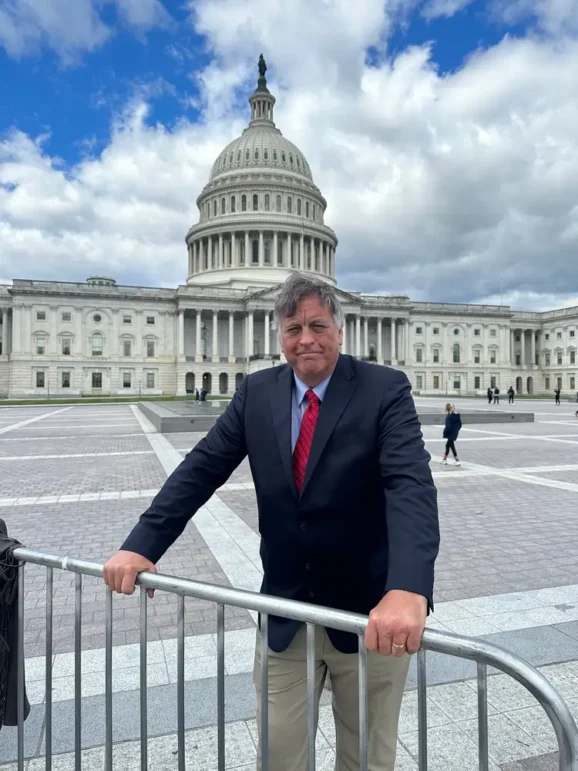
Author and political thinker Mike Bedenbaugh is a respected voice in constitutional principles and American governance. Based in South Carolina, he is deeply involved in his home state’s development while contributing to national discussions on governance and civic engagement, most recently as standing as an independent candidate for Congress. He is the author of Reviving Our Republic: 95 Theses for the Future of America and the host of Perspective with Mike Bedenbaugh.
Main image: Courtesy, DZackCulver/Pixabay