As AI transforms work, geopolitical instability grows and trust in institutions declines, the traditional image of the all-knowing male leader is no longer fit for purpose. Gender sociologist Dr Stephen Whitehead argues that healthier organisations will be built through leadership that is more reflective, relational and accountable
There is a particular quality to the anxiety of this moment that distinguishes it from the anxieties that have come before. It is not the anxiety of a single crisis with a beginning, middle and end – a war that will be won, a recession that will pass or a pandemic that will recede.
It is, rather, a chronic condition: AI systems rewriting the basic grammar of work faster than institutions can respond, geopolitical fault lines opening in places long assumed stable, and younger employees entering workplaces with a level of distrust in hierarchy that older leaders often mistake for entitlement, when it is in fact something closer to realism.
Sociologist Zygmunt Bauman called this condition ‘liquid modernity’ – a world in which the old solid structures of identity, career and institutional authority have melted, leaving individuals to navigate without the maps their parents relied upon. German sociologist Ulrich Beck named it the ‘risk society’, where the central organising anxiety shifts from material scarcity to the management of manufactured, often invisible, risk. And British sociologist Anthony Giddens described the resulting psychological terrain as one demanding constant reflexivity – an ongoing, effortful self-monitoring that never quite settles.
It is into this terrain that today’s leaders are required to lead. After more than three decades researching gender, organisations and the sociology of leadership, I have come to believe that the inherited model of what a leader is supposed to be is now actively contributing to the anxiety it claims to manage rather than alleviating it.
The leadership template many organisations still carry in their heads, even when they believe they have moved beyond it, was built for a different world. It prizes certainty over honesty, decisiveness over deliberation, stoic composure over visible emotion and a single commanding voice over distributed sense-making. In sociological terms, this reflects what Australian sociologist Raewyn Connell termed ‘hegemonic masculinity’: a culturally dominant configuration of traits – control, invulnerability, competitive individualism and emotional restraint – that has, for generations, defined not simply how men are expected to behave but how leadership itself has been understood. Women who reached senior positions were for decades required to perform this same template in order to be recognised as credible. The masculine norm became, in effect, gender-neutral by default because it had saturated our collective understanding of what authority looks and sounds like.
The difficulty is that this model has always been a performance of strength rather than an actual practice of it. In conditions of chronic uncertainty, that performance becomes increasingly difficult to sustain. A leader who must always appear certain in a world where nobody can honestly promise to know what happens next is either deceiving others or deceiving themselves – and followers, particularly younger followers raised on a diet of institutional disappointment, are extraordinarily good at detecting both. Anxiety does not disappear under this model. It is merely displaced, resurfacing as burnout, disengagement, quiet quitting and declining trust between employees and senior leadership.
This is where feminist poststructuralism becomes unexpectedly practical. Drawing on thinkers including Chris Weedon, Judith Butler and Michel Foucault, it argues that leadership identity is not a fixed property residing within an individual but something shaped by language, behaviour and organisational practice. We are not naturally decisive or naturally nurturing. We learn, through repeated cultural rehearsal, which characteristics become coded as leadership and which become coded as weakness. Those assumptions have changed throughout history and across cultures, which means they can be changed again.
The command-and-control model is therefore not an immutable law of effective leadership but a historically specific mode among many possible alternatives. If leadership is socially and discursively produced rather than biologically fixed, organisations can also construct different models of authority – ones in which acknowledging uncertainty is recognised as transparent competence rather than weakness, and where power is understood as relational rather than simply hierarchical.
For male leaders, this opens the possibility of what I describe as ‘progressive masculinity’. This is often misunderstood as passivity, but it is nothing of the sort. Progressive masculinity retains courage, agency and decisiveness while abandoning the compulsion to dominate or to suppress emotion. The old model required men to project certainty they did not necessarily feel because vulnerability was treated as failure. Progressive masculinity relocates strength from performance to substance. A leader who can say, “I do not yet know the answer, but here is how we are going to find it together,” often demonstrates far greater confidence than one who feels obliged to maintain an illusion of omniscience.
Across organisations I have studied in Europe and Southeast Asia, the male leaders whose teams report the highest levels of trust are rarely those who dominate the room. Instead, they are those who have done the harder internal work of separating their sense of authority from their need to appear invulnerable. In anxious organisations, that distinction frequently determines whether leaders contain fear or unintentionally amplify it.
Women have long faced a different but equally restrictive expectation. Leadership has often appeared to require a choice between adopting the hegemonic masculine template in order to be taken seriously or remaining within the culturally sanctioned role of the nurturing, relationship-smoothing presence who is valued but rarely promoted into positions of greatest consequence.
I argue instead for ‘independent femininity’. This neither borrows its legitimacy from masculine performance nor defines itself simply in reaction to it. It is a self-authored form of authority that answers to itself. Leaders operating from this position can combine empathy with decisiveness, establish clear boundaries without apology and exercise authority without performing either masculine toughness or expected feminine softness. In organisations experiencing sustained uncertainty, this kind of grounded presence often provides exactly the stability anxious teams need.
What, then, does healthy leadership actually look like? It is not leadership without pressure, nor leadership that avoids difficult decisions. It is leadership that does not require people to suppress who they are, conceal what they do not know or perform confidence they do not genuinely feel in order to be trusted. It is, first, reflective, questioning itself rather than defending fixed assumptions. Second, it is confident because authority rests on substance rather than performance. Third, it is relational, recognising that leadership emerges between people rather than simply flowing down hierarchies. Finally, it is ethical, remaining accountable for the human consequences of organisational decisions. None of these qualities belongs to one gender, generation or culture. They are available to any leader prepared to separate authority from performance.
Theory earns its keep only if it changes behaviour. In practice, healthy leadership means pushing decision-making closer to where problems actually arise rather than concentrating everything at the top of increasingly overloaded hierarchies. It means senior men modelling appropriate openness about uncertainty, giving others permission to do the same. It means senior women leading without feeling obliged either to out-masculine the room or apologise for qualities such as empathy. It also means designing meetings, promotion systems and performance measures that reward genuine contribution across different communication styles rather than confidence theatre.
We are not trapped by the leadership models we inherited. They were constructed and they can be reconstructed.
Nor will healthier leadership eliminate the uncertainty of our age. No organisation can remove the realities of technological disruption, geopolitical instability or economic volatility. What leaders can do is create environments in which uncertainty is held collectively rather than borne silently by individuals.
The leaders our anxious era will remember will not be those who looked most certain but the ones who were most genuinely, accountably present – and who built organisations capable of being that way long after they themselves had left the room.
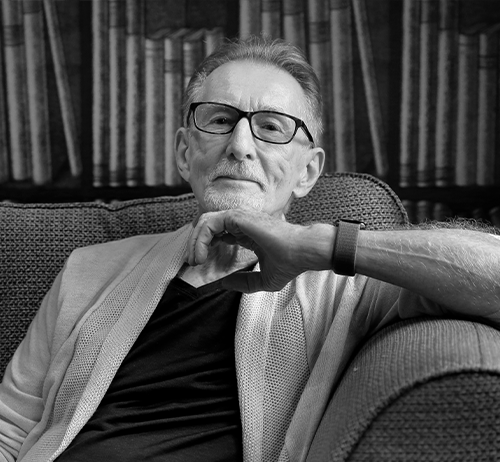
Dr Stephen Whitehead is a gender sociologist and author recognised for his work on gender, leadership and organisational culture. Formerly at Keele University, he has lived in Asia since 2009 and has written 20 books translated into 17 languages. He is based in Thailand and is co-founder of Cerafyna Technologies. His forthcoming book, co-authored with Constanza Fernández Arce, is Where Have All the Good Men Gone?
READ MORE: ‘Harrow School’s new approach to boys and toxic masculinity offers a lesson for us all‘. One of Britain’s most prestigious boys’ schools has introduced teaching on toxic masculinity and online misogyny. Gender sociologist Dr Stephen Whitehead argues that Harrow’s decision reflects a challenge every school will eventually have to confront: the growing influence of the manosphere on young men.
Do you have news to share or expertise to contribute? The European welcomes insights from business leaders and sector specialists. Get in touch with our editorial team to find out more.
Main Image: Osviel Rodriguez Valdés/Pexels