European Space Agency uses satellites flying 150 metres apart to forecast the Sun’s corona ahead of total eclipse over parts of Europe
The European Space Agency has created an artificial solar eclipse in space to predict what scientists will see during tomorrow’s real one.
The agency’s Proba-3 mission uses two satellites flying 150 metres apart, with one blocking the Sun and casting a shadow over the other so it can photograph the normally hidden solar corona.
Unlike a natural total eclipse, which lasts only minutes, the system can keep the Sun blocked for hours, giving scientists much longer to study its outer atmosphere.
The latest artificial eclipse was staged about two weeks before the August 12 event because the Sun takes roughly that long to rotate halfway around its axis.
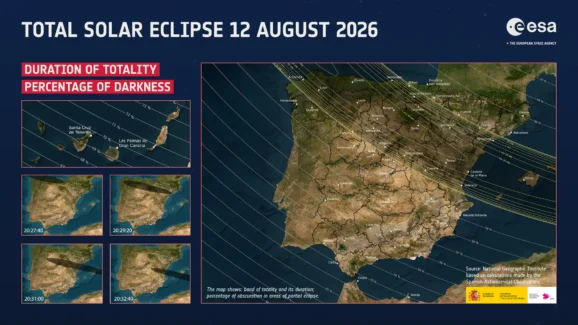
By reversing the resulting image, scientists can forecast the large-scale structure of the corona that should be visible when a total eclipse crosses parts of Greenland, Iceland, Spain and Portugal tomorrow.
The test has wider implications because the corona is where space weather originates, including solar wind and coronal mass ejections capable of disrupting satellites, communications and electricity networks.
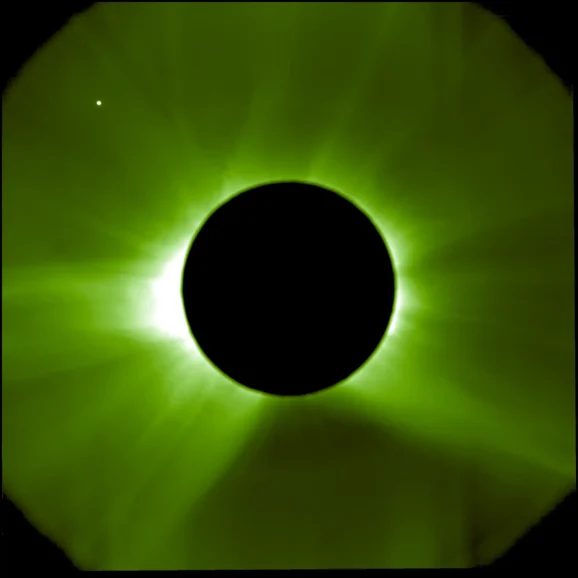
Andrei Zhukov, principal investigator for Proba-3’s ASPIICS instrument at the Royal Observatory of Belgium, said: “This is the 62nd eclipse of Proba-3’s nominal operations – a part of the mission during which we acquire coronal images.
“What makes this one unique is that it was taken about two weeks before the upcoming natural eclipse on 12 August.
“It takes the Sun two weeks to rotate halfway around its axis, so if we mirror the image horizontally, we get a prediction of what the corona will look like during the natural eclipse seen from Earth two days from now.
“The overall large-scale coronal structure usually doesn’t change much during that time.”
ESA is combining the Proba-3 observations with data from its Solar Orbiter spacecraft and computer modelling to improve the prediction.
Solar Orbiter is currently viewing the side of the Sun that will soon rotate into Earth’s view, allowing scientists to identify changes that could affect the corona before the eclipse begins.
Its instruments have already detected a newly emerging active region which is likely to alter what observers see.
The real eclipse will then provide scientists with a rare opportunity to compare their forecasts directly with observations.
Jorge Amaya, ESA space weather modelling coordinator, said: “A total solar eclipse lets us verify that our models are correct by comparing forecasts with actual observations.”
He added: “Observing the Sun from multiple viewpoints allows us to determine their orientation in three dimensions. That is the key to dramatically improving forecasts of how solar activity will affect our technology.”
The research could help improve forecasts of space weather and forms part of work ahead of ESA’s Vigil mission, planned for launch in 2031.
ESA will broadcast the eclipse live from 7.30pm to 8.45pm CEST tomorrow.
The agency warned that ordinary sunglasses are not safe for viewing an eclipse. Certified eclipse glasses should be worn during the partial phases and removed only during totality, when the Moon completely covers the Sun.
READ MORE: Stellar Tips for the Next Total Solar Eclipses. Last week, the Moon blotted out most of the Sun across the Pacific Ocean in an annular ‘ring of fire’ eclipse. But as impressive as it was, nothing on Earth beats a total solar eclipse for excitement and sheer spectacle, writes the sci-fi author and stargazer, Omara Williams.
Do you have news to share or expertise to contribute? The European welcomes insights from business leaders and sector specialists. Get in touch with our editorial team to find out more.
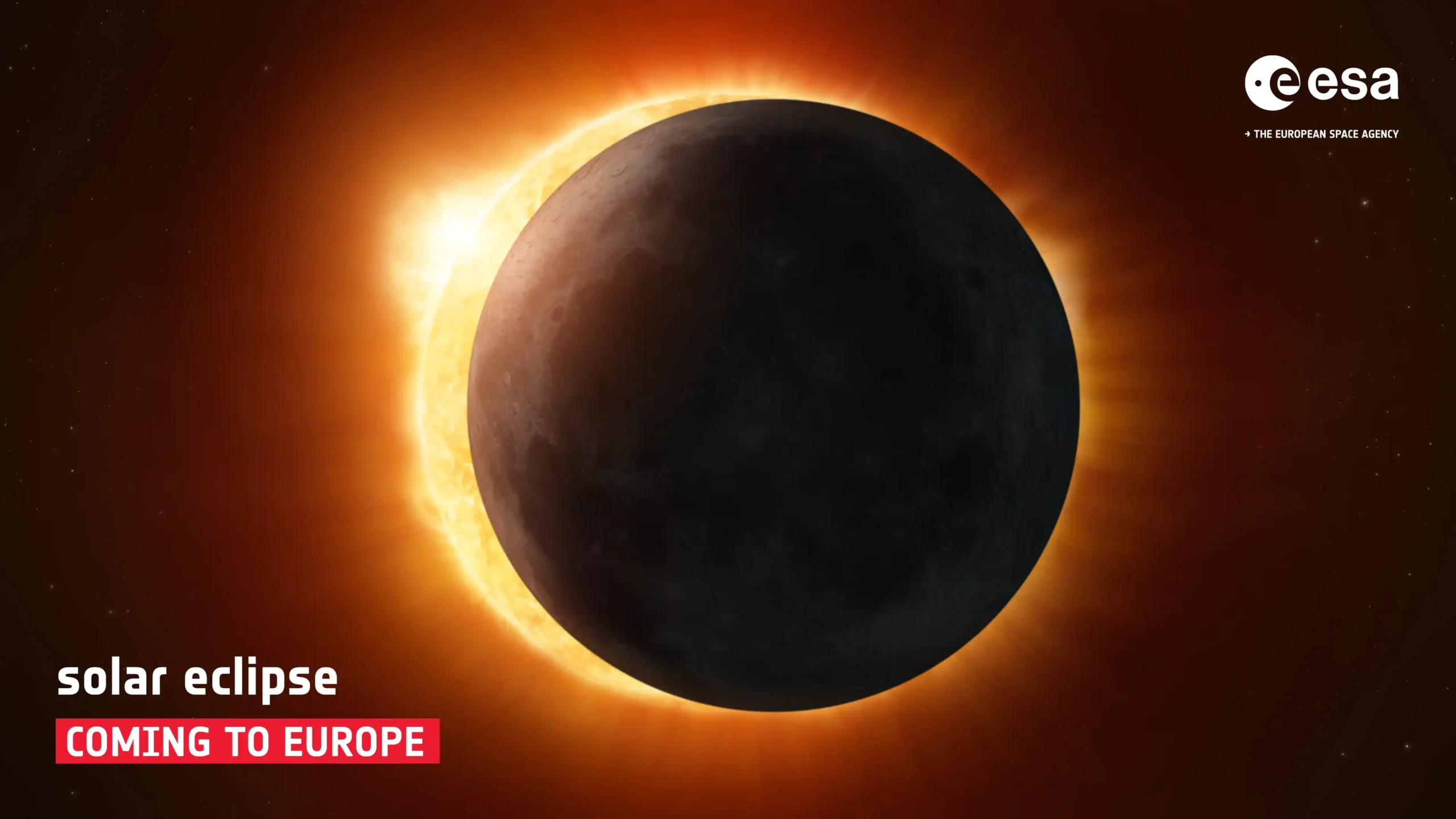
Main image: On a dark background, the Moon nearly covers the Sun, leaving only a bright crescent visible on the left-hand side. The Sun’s surface looks active, with bright yellow glowing loops sticking out from it. The Sun emits a yellow-orange glow that extends around the dark Moon, and faintly lights up the Moon’s left side. Craters are faintly visible on the Moon’s surface. Credit: ESA/ATG Europe. Sun image based on data from ESA & NASA/Solar Orbiter/EUI Team/CC BY-SA 3.0 IGO