On a frozen archipelago at the top of the world, ten British students with additional needs proved that true adventure belongs to everyone. Braving deep snow, glacial caves and sub-zero temperatures, these young pioneers defied expectations and left their labels behind. As veteran polar guide Mark Wood writes, not every explorer fits the mould
A snowball whizzed by my head as I watched in stunned disbelief. On the edge of the Arctic Circle, a free-for-all was breaking out. In a lifetime of polar exploration, I’d never seen this.
Within sight of a glacier — near the outskirts of one of the northernmost towns on the planet — a snowball fight was on. On the fringes of the battle, teachers rallied teams and cinematographers dodged powdery knockout blows. In the middle of the fray, a remarkable sight began to unfold. One of the students, Kian Furlong, had been watching from the sidelines as his classmates laughed in the snow. Furlong’s wheelchair was unable to roll through the deep snow onto the battlefield, and it was evident from his expression that he wanted to get in on the action.
Seeing this, Furlong’s teachers took it upon themselves to carry him into the thick of the fold. As a flurry of snowballs pelted him on the ground from his friends, his contagious smile seemed to light up the entire town of Longyearbyen.
Credit: Liz Hooper / Joe Sills
That smile is what we came to the Arctic for. This scene is what it was all about.
A decade ago, I started working with Sherbourne Fields Special School in Coventry, England, serving pupils with a broad range of needs that might not be met in traditional classrooms. Some have physical disabilities or learning difficulties; others have medical conditions that require close supervision and one-to-one support. These challenges have a tendency to produce labels outside of their world, but by giving these young people opportunities to defy those labels, the team gives them a chance to redefine themselves.
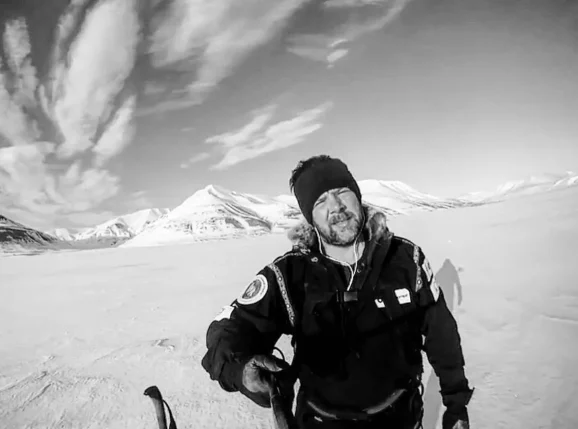
My relationship with the school began in 2012 after I reached both the Geographic North and South Poles alone. When I returned to the UK, I set up an educational day at the Coventry Rugby Club for schools all over the city. With the support of local companies, I arranged activities based around understanding the true worth of our planet. This initial contact with the school quickly evolved into one of the most meaningful relationships of my life.
In the ten years I’ve been working with the school, I’ve helped some of their students climb to the top of the highest peaks in Ireland and the UK. Together, we’ve summited Snowdon, Ben Nevis, Scafell Pike, Carrauntoohil, Slieve Donard and the Three Yorkshire Peaks.
On each of those expeditions, I gained so much more than I gave. I’ve seen labels disappear on those peaks in real time. I’ve seen moments of camaraderie, poetry and pain as these remarkable children gain a greater perspective on the world around them.
Credit: Liz Hooper / Joe Sills
This year, I had an opportunity to up the ante and rewrite the metaphorical record books by bringing ten of those students with me into my workspace — into the Arctic.
For some, this trip to Svalbard was their first time on an aeroplane and their first overnight trip away from home. A tall task by some measures. But my first forays into the field with these exceptional children taught me not to doubt them. Though the world often places labels on kids like these, the daily challenges they face make them uniquely capable in challenging environments.
Credit: Liz Hooper / Joe Sills
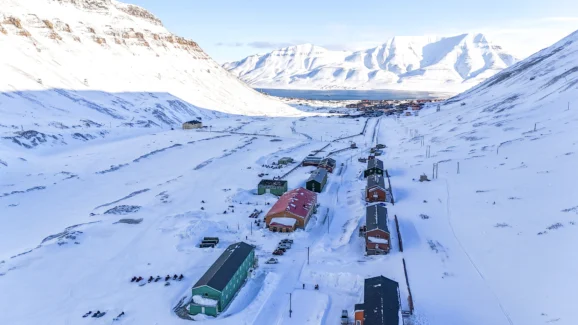
From our base camp in Longyearbyen, the snow-capped peaks of the Svalbard archipelago form a gateway into one of the world’s harshest environments. It’s a location that polar explorers regularly visit to train for expeditions to the North Pole. And while a few adventure outfitters pepper the unnamed streets of this mining town, Svalbard is not a hotspot for tourism. Only around 30,000 visitors journey to Svalbard each year. Most of them visit during the summer — not now. Not during the waning days of winter, when the island chain is still blanketed in deep snow and ice. That’s the world I wanted these incredible students to see, a world that changed the course of my own life decades ago.
Credit: Liz Hooper / Joe Sills
Venturing to the Arctic means exposure to extreme cold, whiteouts and polar bears. But it also means a chance to excel in an environment that very few people in Coventry ever get a chance to see. What better way to tear away a label than that?
Though our location would be extreme, our plan was modest: three full days of activities plus two travel days on the frozen precipice of northern Europe. Ten students would require a complete team of 22 for support. A handful of bold teachers geared up to venture forth on the field trip of a lifetime with their students. The people most familiar with each student’s needs would form the backbone of our expedition. In Svalbard, teachers needed to become more than instructors and caregivers — they’d have to become snowmobile drivers, ice cave spelunkers and dogsled mushers.
Credit: Liz Hooper / Joe Sills
To help share the load, I tapped into colleagues at The Explorers Club to bring expedition veterans into the fold. Norwegian member Hilde Fålun Strøm became our lead resource on the ground. The Svalbard local, polar ambassador and citizen scientist took a break from Arctic advocacy to facilitate activities and lodging in Longyearbyen. Irish maritime explorer Rory Golden, Australian world record runner Hamish McGoffin, and American multidisciplinary journalist Joe Sills joined in from the Great Britain & Ireland Chapter.
To help maximise the reach of this story, I also tapped into the creativity of British filmmakers Dom Sant and Tom Holland at Common Story and American expedition photographer Liz Hooper. My ace in the hole, Himalayan trekking guide, former SAS medic and longtime expedition partner Paul Vicary provided essential expertise in group leadership in the Arctic to round out the crew.
Credit: Liz Hooper / Joe Sills
In February, I ventured to Svalbard to scout the facilities our students would be using on the trip, paying special attention to obstacles that might pose unforeseen problems for wheelchairs or clumsy feet. A gear list was assembled: base layers, mid-layers, down jackets, wool socks, winter boots, crampons, gloves and duffel bags.
Credit: Liz Hooper / Joe Sills
It was essential that no family be responsible for footing the bill for this expedition. And yet, gear adds up. Lodging — even on the edge of the inhabited world — costs money. Flights alone totalled £17,000. All told, we would need around £50,000 to make the trip a reality.
Mercifully, our trip was blessed with a multitude of sponsors who all stepped up in a massive way to help these children experience the world beyond their classrooms.
In fact, the expedition owed its existence to Ramble Worldwide Trust, a charity organisation dedicated to encouraging people to spend time outdoors, that initially convinced me the trip was possible. Their organisation contributed £22,000 to the cause.
Others, too, pulled massive weight. Longtime sponsor Farm Foods supported the flights. Outdoor brands Go Outdoors and Sprayway contributed clothing, and thermal technology pioneers Alfa Laval stepped in to help cover the cost of lodging — a major contribution that helped make the entire expedition viable. I’m incredibly grateful to them and to all the sponsors who made this journey possible. It’s thanks to their support and generosity that these young explorers were able to step into a world few ever get to see.

Credit: Liz Hooper / Joe Sills
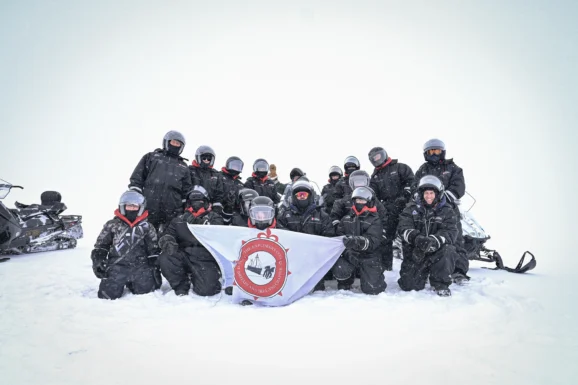
On 5 April 2025, our team of 12 adults and ten students rendezvoused on a Longyearbyen city bus. Not far from the Global Seed Vault, the flurries of a snowstorm whipped past the windows while the students caught their first sight of the Arctic’s might.
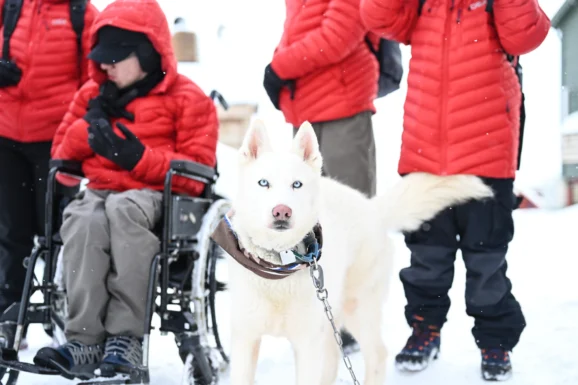
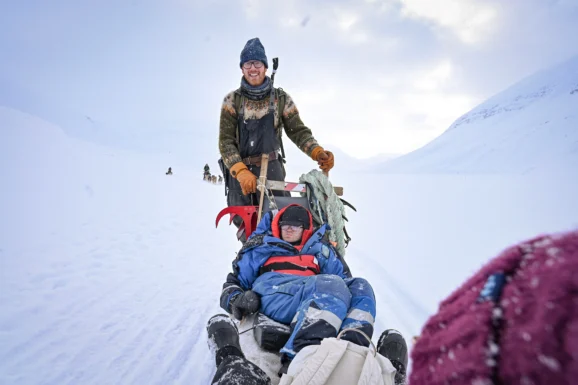
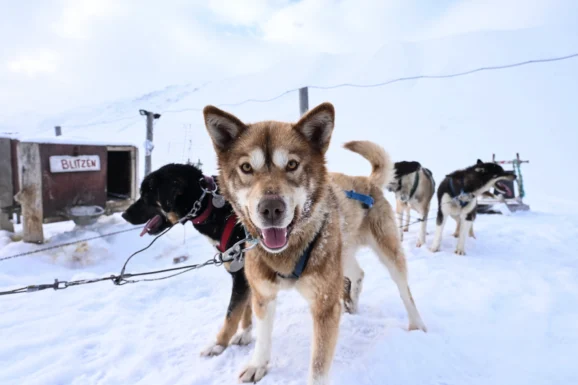
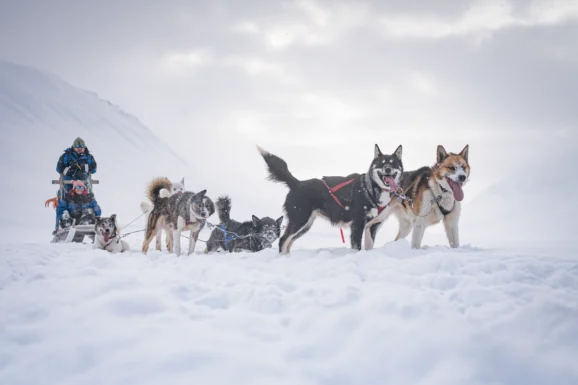
During our five days on the ground, the children experienced dogsledding through breathtaking snow-filled valleys (Furlong may have become the first wheelchair user to dogsled in the Arctic). They rode snowcats through herds of Svalbard reindeer. They scrambled through the heart of a glacier in ice caves glimmering under their head torches. They snowmobiled through an Arctic whiteout, stopping for tea in temperatures reaching –30°.
They warmed themselves by the fireplace of a Norwegian ice hut; attended lectures on icebergs, shipwrecks and polar bears. They were named honorary members of the Great Britain & Ireland Chapter of The Explorers Club. And, of course, they had one remarkable snowball fight.
Despite the itinerary brimming with polar adventure activities, that moment is what sticks with me the most. I’m not sure I’ll ever forget that unplanned battle royal in the Longyearbyen snow — or the smile on Furlong’s face when he felt the chill of fresh, polar powder on his coat.
Credit: Liz Hooper / Joe Sills
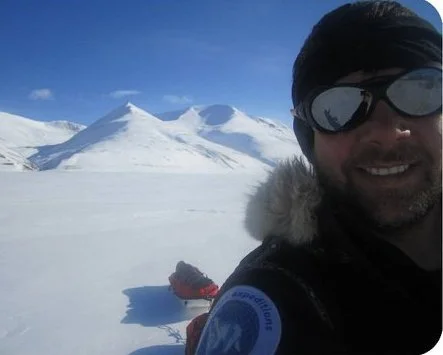
Mark Wood is a Polar explorer with over 30 major expeditions to his name, including solo crossings to both the Geographic North and South Poles. Over the past 20 years, he has led polar and mountain expeditions in the Arctic Circle, Antarctica, and the Himalayas, while also supporting film crews for documentaries. Mark’s accomplishments include completing a 200-mile solo trek to the North Pole, which was featured in a Channel 5 documentary, and a Mount Everest expedition where he engaged with over 10,000 students globally via Skype. In 2012, his education programs, which focus on climate change, have reached 1.2 million students.
Mark’s work extends beyond the cold regions, as he has cycled across New Zealand, trekked across Iceland, and crossed America. He has also filmed anti-poaching efforts in Africa and dog teams in Alaska. He is a Fellow of the Royal Geographical Society and was Chairman of The Great Britain and Ireland chapter of the American-based, Explorers Club where he is also affiliated with the Norwegian chapter. He continues to work with broadcasters like the BBC to promote climate awareness and education, and is an in-demand corporate speaker who connects his unique perspective on resilience and leadership to navigating teams in sometimes stressful, hostile conditions.
Mark’s latest project, SOLO 100, marks the final stage of a five-year journey addressing the urgent need for modern exploration and environmental awareness.
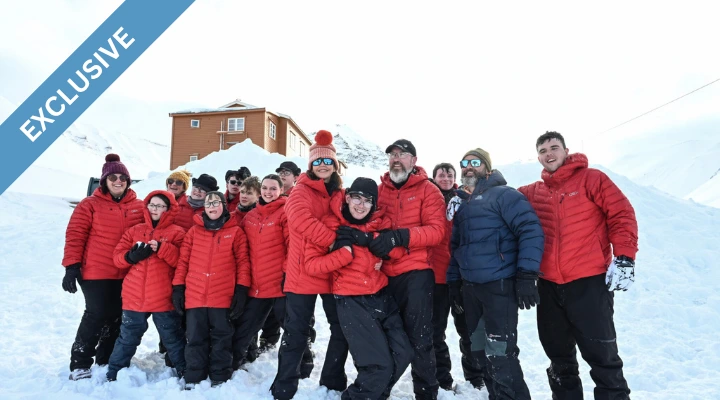
Featured image: The full expedition team pictured in Longyearbyen, Svalbard — ten students with additional needs alongside their support staff, teachers and guides.
Credit: Liz Hooper / Joe Sills