On paper, President Trump stands for conservatism. In practice, he seemingly does what he likes. But that’s only been made possible because political language has lost its meaning, allowing personality to become the centre of power in a confused nation, writes political analyst Mike Bedenbaugh
He may lead the Republican Party, but Donald Trump is not a traditional conservative. He’s been described as many things, but an autocrat is, perhaps, not far off the mark.
But why has someone like this, who clearly does not align with our understanding of traditional political terms such as ‘conservative’ or ‘liberal,’ been able to take charge of the world’s largest superpower?
It’s only been made possible because the meaning of American political language itself has collapsed.
The terms that once anchored our national debate — ‘conservative,’ ‘liberal,’ ‘Right,’ ‘Left’ — have been hollowed out and drained of substance. Once meaningful labels with deep philosophical roots, they now serve as mere slogans, not ideologies.
This collapse of political meaning hasn’t just confused the American public and U.S. allies — it has opened the door to a new kind of politics where the personality of the leader outweighs political ideology, and spectacle substitutes for structure.
In this vacuum, principle no longer matters. Only performance does. And if ‘conservative’ can mean anything, it can mean Trump.
And so now, to many, it does.
As someone who cares deeply about the future of my country, I often struggle to explain our political dysfunction — not because it’s complex, but because it’s so fundamentally incoherent.
From a distance, the United States still appears to be locked in a straightforward ideological contest between Left and Right, Democrats and Republicans, just as in the past. But beneath the surface, we’re in the midst of a linguistic and philosophical crisis.
Once, liberalism and conservatism were noble, if competing, traditions. Classical liberalism emphasized individual dignity, natural rights, limited government, and the rule of law. Conservatism, in turn, respected cultural inheritance, restraint, and scepticism toward change. These weren’t just policy preferences — they were intellectual foundations that guided governance for generations.
But today, these concepts have been tactically and decisively emptied of meaning.
‘Conservative’ has come to signify little more than ‘not left-wing,’ and ‘liberal’ merely ‘not conservative.’ In this new context, political identity is no deeper than the team colours of sports teams — disconnected from any vision of liberty, justice, or governance.
Importantly, the rot didn’t begin with Trump, though he’s exploited it better than anyone. It stretches back to the Reagan era, when a fusion of libertarian rhetoric and centralized federal power laid the groundwork for contradiction.
Under Reagan, the Right began saying one thing and doing another — championing small government while expanding the military-industrial complex.
But the Left is not without blame. Liberal Democrats also helped pave the road to this confusion. Over time, they traded the language of individual liberty and equal protection for one of bureaucratic management and abstract identity categories. In redefining terms like ‘justice’, ‘equality’, and even ‘democracy’, they made those words feel alien to many working-class Americans who once embraced them. This erosion of trust and clarity helped create the very backlash that Trumpism now harnesses.
In both cases, political traditions were diluted into marketable brands. Strategy overtook substance. Ideological coherence gave way to whatever language could win elections. And so, the once-principled divide between liberalism and conservatism collapsed into an empty contest of symbols and styles.
Trump and his cohorts thrive in this land of confusion. With no stable meaning behind political terms, voters became more receptive to personality than to program. Trump has offered no coherent worldview — only dominance, disruption, and loyalty.
And because our political language is so untethered from meaning, he hasn’t had to define conservatism. He only needs to embody it.
The result? A culturally conservative base that now embraces centralized power — so long as that power enforces their values. But that’s not constitutional conservatism. It’s right-wing liberalism: a belief in big government as long as it’s run by the ‘right’ people.
This is a crucial but underappreciated point. Many Americans who call themselves “conservative” today are socially or culturally conservative but not politically conservative in the classical sense. They may uphold traditional values, but they support using the state to impose them, abandoning the restraint that conservatism once demanded.
True conservatism would resist that temptation. It would champion constitutional order, local institutions, and the limitations of power. It would uphold the principle that government should be restrained even when its goals appear righteous.
Trumpism offers the opposite. Consider the symbolic gestures — like suggesting America purchase Greenland or absorb Canada. They may seem eccentric, but they reflect a worldview driven by performance over policy, by dominance over diplomacy.
More seriously, Trump’s use of trade tariffs marks a sharp break from their historical purpose. Traditionally, tariffs in America were a stable source of federal revenue and a tool to support domestic industry. They also served as political theatre — sparking fierce debate between North and South over whose economy they served. But even then, they were grounded in national development and long-term strategy.
Today, that internal debate has turned outward. Tariffs are now used to punish others with the added benefit of building the American economy. What was once political theatre within a nation has become spectacle directed at the world. Trump believes these punitive actions will restore domestic prosperity — but many of us believe they will do the opposite. When the goal is to punish, not partner, who, or what, does it truly strengthen?
The emerging Right no longer seeks to conserve — it seeks to conquer. Disruption has become its principle, not its tactic. This is not a course correction; it is a reactionary lurch into something much darker — politics fuelled by resentment, not renewal.
Meanwhile, allies across the Atlantic must grapple with a new reality: the post-war image of America — a nation committed to global leadership, democratic institutions, and constitutional continuity — has given way to something more volatile, more personal, and far less coherent.
Trump’s presidency has shown how quickly language can be repurposed and how easily principles can be abandoned once the meaning of political terms becomes fuzzy.
And yet, I remain hopeful.
All across this country, Americans are quietly rebuilding what was lost — teaching the Constitution, defending local institutions, choosing duty over rage. They’re not on television. They’re not trending. But they’re there. I know — because I’m one of them.
If America is to remain a republic, we must move beyond the slogans, beyond the hollowed-out labels, and return to the principles that once made us a light to the world.
The republic is still here. But only if we are willing to conserve it.
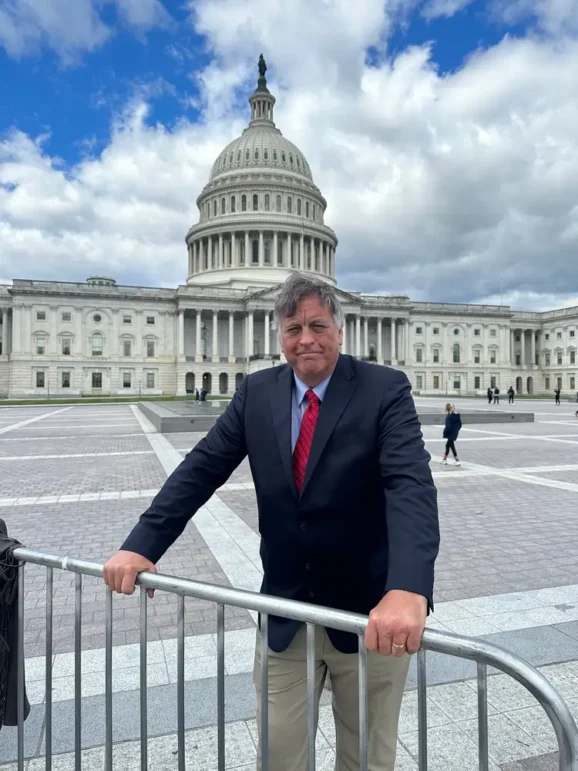
Author and political thinker Michael Bedenbaugh is a respected voice in constitutional principles and American governance. Based in South Carolina, he is deeply involved in his home state’s development while contributing to national discussions on governance and civic engagement, most recently as standing as an independent candidate for Congress. He is the author of Reviving Our Republic: 95 Theses for the Future of America and the host of Perspective with Mike Bedenbaugh.
Main image: Courtesy, The White House