AI-generated influencers are attracting millions of followers and becoming increasingly difficult to distinguish from real people. Here, deepfake detection expert Julia Jakimenko explains how to recognise the warning signs – and why your instincts are no longer enough
Scroll through Lil Miquela’s Instagram and, at first glance, you might assume she’s just another influencer. Her feed is a mix of Coachella selfies beneath its infamous Ferris wheel, high-fashion campaign shoots with luxury brands, mirror selfies and candid photos with her best friend, Blawko. https://www.instagram.com/lilmiquela/?hl=en
The 19-year-old Brazilian-American lives in Los Angeles. She has a soft brown fringe, freckles across her nose, opinions about the news, argues with fans in the comments and even released a pop single that racked up millions of streams.
The only thing is, Lil Miquela doesn’t actually exist. She was reportedly created using CGI, not flesh and blood, and behind her social media platforms, which have a combined following of more than 2.6 million, is a small team of people.
Miquela is part of a growing number of AI-generated personalities capitalising on social media’s creator economy. As the technology has become increasingly lifelike, virtual influencers have begun attracting real audiences and paying subscribers.
One high-profile example was Jessica Foster, presented as a patriotic, pro-Trump Army veteran. She amassed more than a million followers before people realised she wasn’t a real person at all, and that the account had been reportedly funnelling admirers towards a paid adult content page.
Last month, The Guardian revealed that brands had jumped on the bandwagon too, using AI-generated customers in advertising campaigns and presenting synthetic people as authentic consumers without making the deception clear. These weren’t obviously stylised avatars like Lil Miquela. They were designed to pass as genuine testimonials – the kind of ‘real person, real results’ content that shapes what people buy. Some of the creators behind these campaigns are reportedly bound by non-disclosure agreements, preventing them from revealing the truth even after the fact.
“The problem is that fiction has stopped announcing itself as fiction and learned to wear the clothes of documentary truth.”
I’ve spent years trying to answer one question: is this person real?
Before founding my company, I worked in compliance and identity fraud at one of the Netherlands’ largest banks, where I watched criminals become faster and more convincing every year at pretending to be someone they weren’t. I have degrees in both law and computer science, which is a strange combination until you realise that synthetic identity is as much a legal problem as a technical one. Today, my team builds technology designed to detect AI-generated deception, work that means staring at faces and gestures for a living, hunting for the tiny inconsistencies that give a fake away.
But here’s something I’ll confess. Even I can’t always trust my own eyes anymore. Some days, a video crosses my desk and I genuinely can’t tell. Not at a glance. Not without pulling it apart, frame by frame.
If someone whose job is spotting synthetic media can still hesitate, what chance does the average person have while scrolling social media half-asleep at 11pm, their thumb moving faster than their judgement?
According to research by Which?, 70 per cent of people couldn’t reliably distinguish a genuine video from a deepfake. That’s an overwhelming majority of us, most of the time, consuming content specifically designed to be watched quickly and believed instantly.
The problem isn’t that people are following fictional characters. We’ve been doing that for decades, whether it was a soap opera villain or a cartoon. Nobody was harmed by believing in Tony the Tiger. The problem is that fiction has stopped announcing itself as fiction and learned to wear the clothes of documentary truth.
Social media was built on the idea that we were seeing snippets of real people’s lives. Maybe filtered and carefully curated, a highlight reel rather than the whole picture, but fundamentally real. That assumption no longer holds, and most platforms haven’t caught up with that fact in the way they label content.
Today, an account can build trust, influence purchasing decisions, shape political opinions and earn thousands each month without there ever being a real person behind the screen. Most of us won’t realise it until someone else points it out – if we ever find out at all.
So how do you separate a real person from a convincing fake? There is no single tell and no foolproof test, but there are still patterns worth watching for. The good news is that you do not need specialist software or a degree in computer science to spot them. A few warning signs and simple habits can make you far harder to fool. Here are my tips for identifying AI-generated content before it catches you out.
How to detect a deepfake
1. Don’t trust your first reaction
AI is exceptionally good at manufacturing content designed to make you stop scrolling. A tearful confession. A heartwarming reunion. A flawless proposal. A stranger’s act of unexpected kindness caught perfectly on camera. The stronger your emotional response, the less likely you are to question what you’re seeing. If a post immediately makes you feel outrage, sympathy or amazement, that’s the moment to slow down rather than share it.
2. Listen as carefully as you watch
Most people instinctively focus on a person’s face, particularly their eyes and mouth. But increasingly, the audio tells a different story. Does the voice sound detached from the environment? Is there no natural background noise? Does the speech feel unnaturally flat or as though it has been recorded in a completely different room and laid over the video? Deepfakes often get the face right before they get the atmosphere right.
3. Train your eye to spot the almost-perfect face
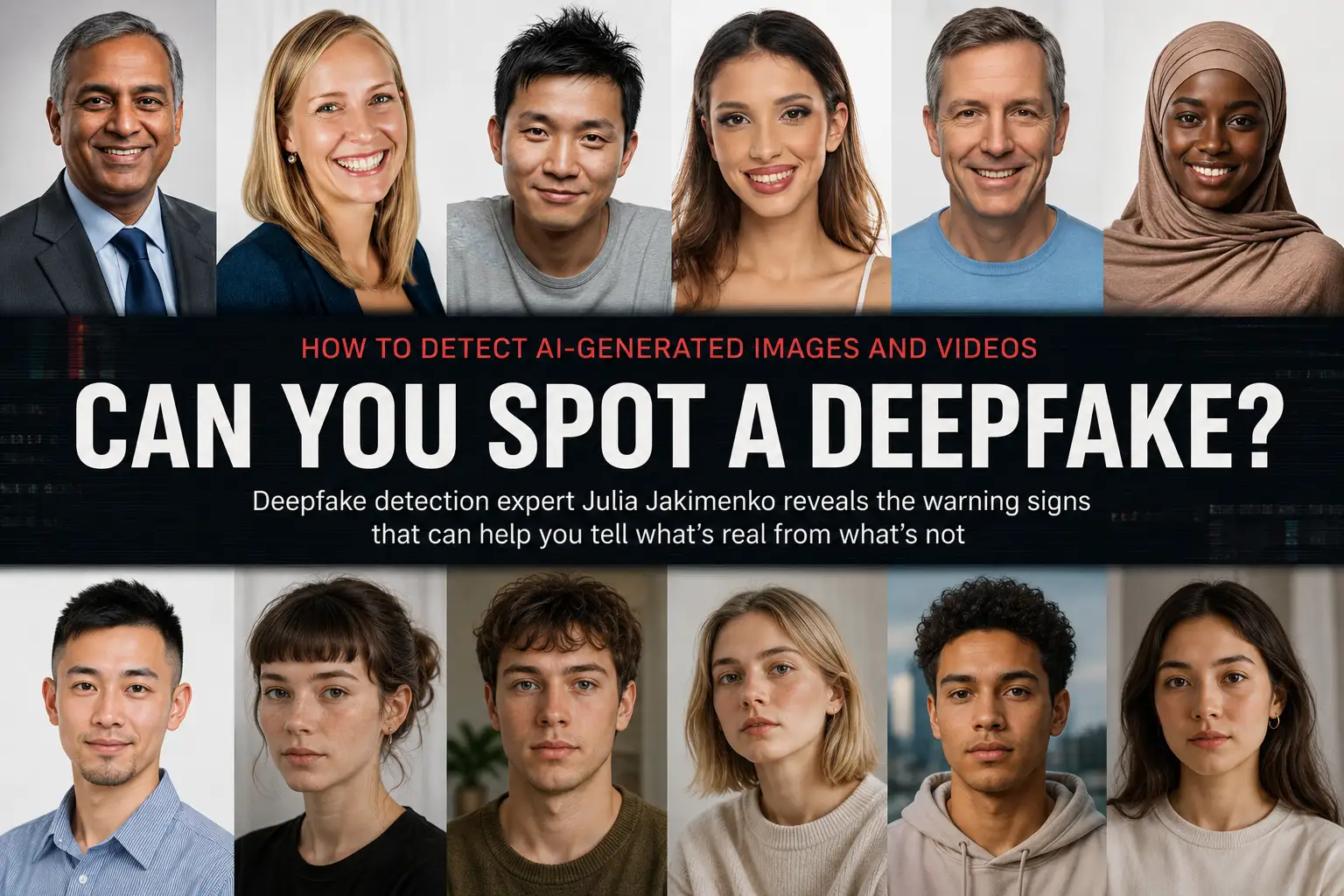
Take the eight portraits below. Some are photographs of real people; others were generated entirely by AI.





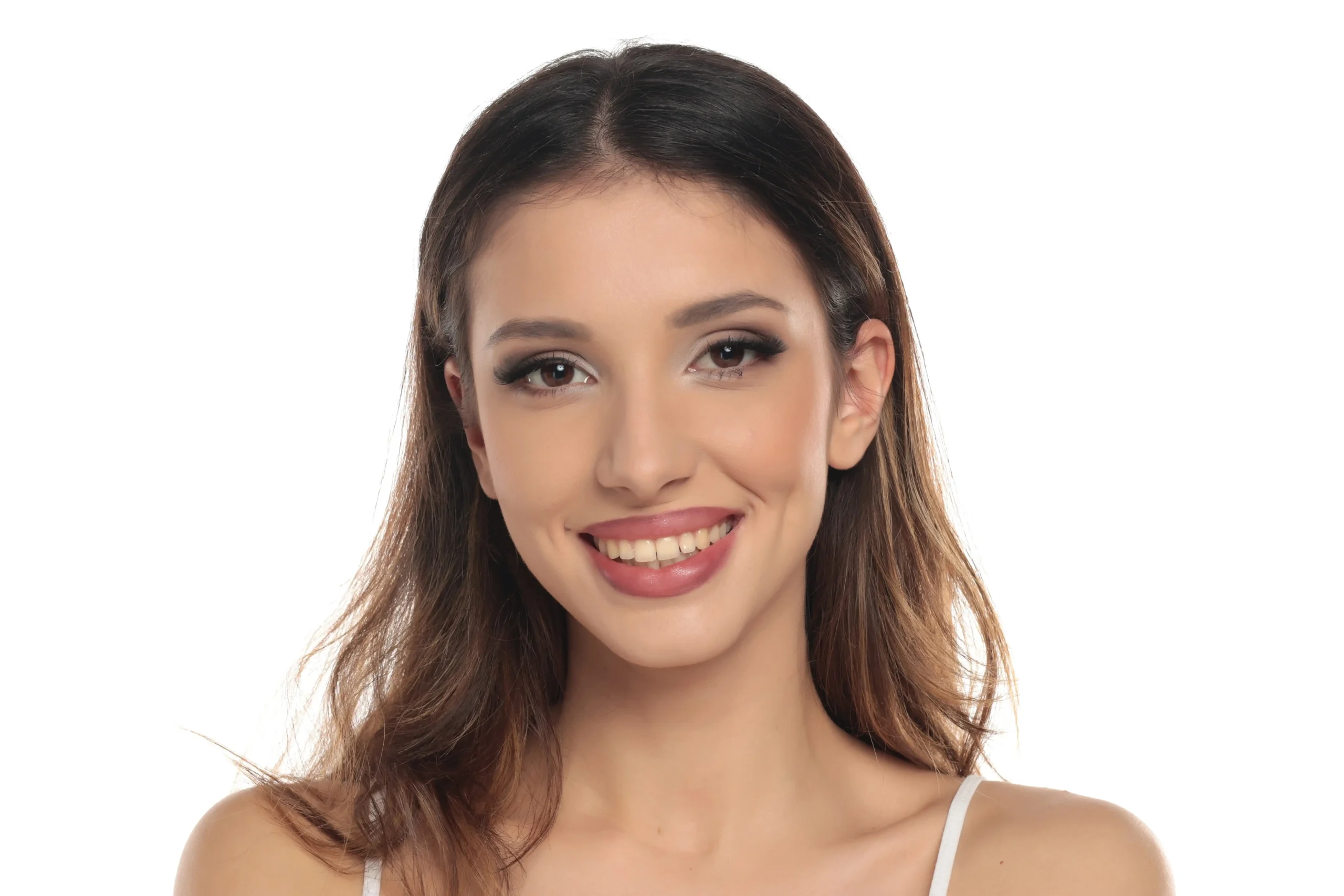
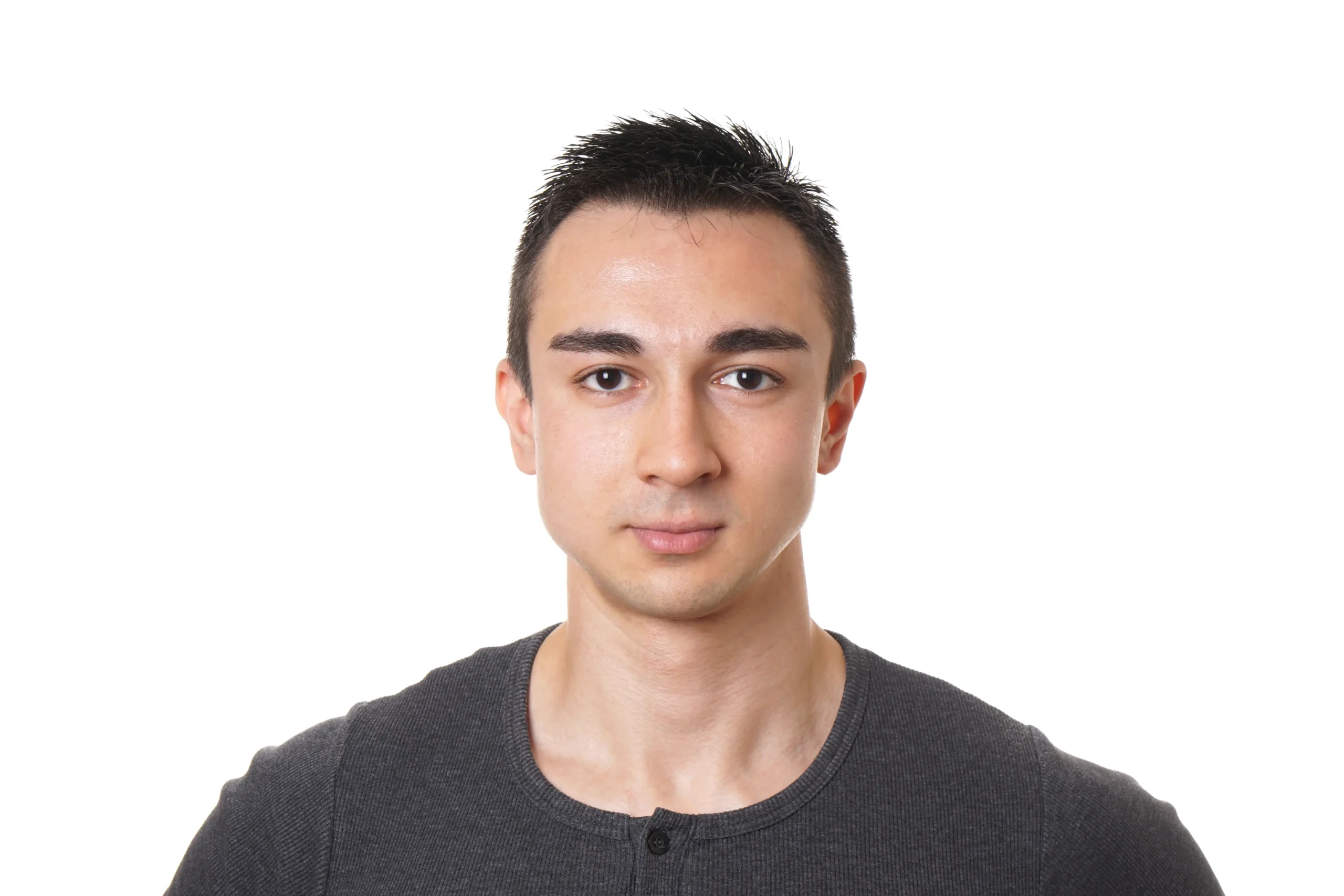



At first glance, all eight appear convincing. Each has the familiar ingredients of a professional headshot: even lighting, a plain background, direct eye contact and a carefully composed expression. That is precisely why this kind of comparison is useful. Modern AI images rarely announce themselves through obvious distortions. The clues are often subtler and become more noticeable only when several faces are viewed together.
Before scrolling any further, decide which portraits you believe are real and which are AI-generated. The answers are revealed at the end of the article.
When you study the faces, don’t look for one obvious mistake. The most convincing AI-generated portraits don’t usually have six fingers, mismatched earrings or distorted features anymore. Instead, look at the overall impression the face gives you.
Does it seem just a little too perfect? AI has a tendency to create unusually balanced faces. The eyes often sit at almost identical heights, the eyebrows follow smooth, even curves and the smile appears carefully centred. Skin texture is usually present, but it can look remarkably consistent, with very little of the natural variation you would expect around the eyes, nose and mouth.
Then widen your focus. Look at the hair, clothing and background as well as the face itself. AI-generated portraits often have an unusual photographic neatness. Hair sits almost perfectly, clothing appears immaculate and backgrounds are clean and uncluttered. None of those details proves an image is synthetic, but together they can create a portrait that feels a little too polished.
Real faces are generally less uniform. One eye may open slightly wider than the other. A smile may pull more to one side. Skin tone changes subtly across different parts of the face, while hair, clothing and lighting tend to contain the small inconsistencies that naturally occur in real photographs.
Above all, don’t rely on a single clue. Modern AI can reproduce pores, wrinkles, freckles and even slight asymmetry. It’s the overall pattern that matters. If everything about a portrait seems just a little too balanced, too clean and too flawless, your instincts may be telling you something important.
4. Look beyond a single post
A convincing Instagram feed proves very little. Real people leave a trail across the wider internet: tagged photographs from friends, event appearances captured by other people’s cameras, interviews, older content and years of interactions that build naturally over time.
AI-generated influencers often have carefully curated feeds but remarkably little existence beyond them. Nobody else was there because there was nobody there to begin with.
5. Be wary of faces that all seem strangely familiar
AI doesn’t just generate attractive people – it tends to generate average ones. Many synthetic faces share the same broadly appealing proportions and lack the distinctive features that make someone memorable in real life. If you’ve finished scrolling and struggle to remember what made a particular face unique, your brain may already be picking up on something artificial.
6. Accept that there isn’t a single giveaway
Unfortunately, there isn’t a foolproof test anymore. AI is improving too quickly for any single checklist to stay useful for long. No individual clue proves something is fake, just as the absence of one doesn’t prove it’s real. The safest approach is to build a habit of looking for several small inconsistencies rather than one dramatic mistake.
7. Practise
The encouraging news is that spotting deepfakes is a skill that improves with experience. Researchers at the University of Aberdeen found that after being shown a series of genuine and AI-generated faces and told which was which, people became noticeably better at telling the difference in under an hour.
Quiz answers (from top left): Images 1, 6, 7, 8 and 9 are of real people. The others are deepfakes. Look at them again now that you know the answers. The differences may seem more obvious the second time because your eye has begun to recognise a pattern rather than searching for one dramatic flaw.

Julia Jakimenko is the founder and CEO of Cyberette, an Amsterdam-based media forensics company that detects deepfake images, video, and audio and helps security, fraud, and investigative teams act on the findings. Before founding Cyberette, she worked in compliance and identity fraud at a major Dutch bank. She holds degrees in both law and computer science, and Cyberette is backed by Rabobank and NVIDIA Inception.
READ MORE: Spain urges EU rules as Chinese factories move in. Spanish regions are competing for investment from Chinese car and battery manufacturers while pressing Brussels to impose common safeguards for European jobs, technology and strategic industries.
Do you have news to share or expertise to contribute? The European welcomes insights from business leaders and sector specialists. Get in touch with our editorial team to find out more.
Main image: AI-generated faces are becoming increasingly difficult to distinguish from real people, raising new questions about trust, identity and authenticity online. Credit: Belters News/The European. Profiles and deepfakes: Supplied.