Spring has finally sprung, and with the warmer nights and cloudless skies, now’s the perfect time to start stargazing. In this ongoing series for The European, keen amateur astronomer and bestselling author Omara Williams takes you on a tour of the night sky, starting with Orion and its neighbours
With spring here and warmer nights inviting us outdoors, it’s the ideal time to learn a few simple tricks to spot astronomical wonders and earn yourself a gold star from friends and family. While there are many helpful stargazing apps like Sky Tonight, Night Sky, and Stellarium available to help you pinpoint constellations, with a few visual cues, it’s easy to navigate the night sky by yourself.
Even without a telescope or binoculars, you’ll be surprised by just how many stars you can see with the naked eye.
Depending on which direction you look, you’ll see different constellations. These also change depending on the time of the year.
To get the best view at any time of year, head away from city lights. A rural spot or any open area free from light pollution will do. Wait until twilight ends and try to choose a night when the moon is dim or absent. Let your eyes adjust to the dark for 15–20 minutes and then begin.
In this first article, we’re focusing on the constellations that are visible in early spring in the southwestern sky around Orion.
How to spot Orion
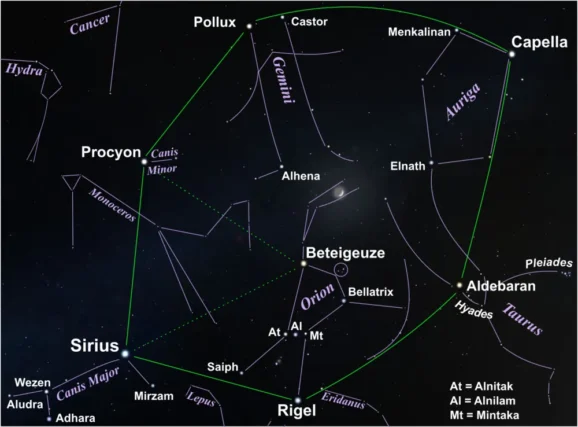
Orion the Hunter can be found high in the southwestern sky after sunset. The constellation is named after the legendary figure famed in Greek myth for his hunting skills and strength. According to legend, he was placed among the stars by Zeus upon his death.
The constellation is shaped like a stick figure with a raised arm. At the bottom right of Orion’s hourglass shape, marking the hunter’s foot, is Rigel, the brightest star in the Orion constellation and the seventh brightest star in the night sky. Rigel is a luminous blue supergiant and part of a multiple-star system that includes a close binary pair of smaller stars.
In the middle of the hourglass shape are three bright stars in a straight line – that’s Orion’s famous Belt, wrapped around the hunter’s waist and sparkling like diamonds against the darkened sky. If you look just above the left-hand star of the belt, you’ll see Betelgeuse – a red supergiant star with a warm, reddish-orange hue, similar to glowing coal. It marks Orion’s upper left shoulder and is noticeably redder and more prominent than nearby stars.
How to spot Canis Major
From Betelgeuse, draw an imaginary line diagonally down and left, roughly the width of three to four fingers held at arm’s length, and you’ll reach Sirius, the brightest star in the night sky. Siriusisactually a binary star system, comprising a main-sequence primary star and its white dwarf companion, is part of the constellation Canis Major (the Greater Dog), which represents the large dog following Orion the Hunter.
How to spot Canis Minor & the Winter Triangle
Above Sirius, and slightly to the left – about two finger widths up – lies the constellation Canis Minor (the Lesser Dog). This constellation represents the second of Orion’s two mythical hunting dogs and contains Procyon, which is the eighth brightest star in the night sky and one of the Sun’s closest stellar neighbours.
Together with Betelgeuse and Sirius, these stars form the Winter Triangle – a bright, striking asterism (a recognisable pattern of stars that isn’t a full constellation) that helps orient you in the night sky.
How to spot Gemini
From Procyon, look directly upward and slightly west. About three fingers’ width apart, you’ll find Gemini (the Twins). This is a medium-sized constellation marked by the bright stars Castor and Pollux, which represent the mythological twin sons of Zeus, celebrated for their brotherly love and bravery.
Pollux, glowing with a subtle golden tint, is a yellow-orange giant, while Castor, shining a little dimmer and cooler white, may look like one star to the naked eye but is actually a fascinating multiple-star system composed of three binary pairs, including a mix of main-sequence stars and red dwarfs.
How to spot Auriga
Now, trace a shallow arc down and to the right (towards the northwest) about the length of a clenched fist at arm’s length. This brings you to Capella, the sixth brightest star in the night sky, shining prominently in the Auriga constellation (the Charioteer). Capella is the closest first-magnitude (very bright) star to the North Celestial Pole (the point in the sky that lines up with Earth’s North Pole) and served as a navigational star for ancient sailors. It is also a multiple-star system, consisting of two binary pairs – two yellow giants that closely orbit each other and two red dwarf stars.
How to spot Taurus
From Capella, draw a gentle line down and to the left (about four fingers’ width) to reach Aldebaran in Taurus (the Bull). Taurus is one of the oldest recognised constellations, with a V-shaped group of stars, the Hyades open cluster, forming the face of the sacred bull and its long horns extending out. Aldebaran is unmistakable – an orange-red supergiant known as the Bull’s Eye. It has a coppery glow and stands out clearly from the stars around it.
Just to its right, you’ll spot a tight, sparkling cluster of stars called The Pleiades (also known as the Seven Sisters), which resemble a tiny dipper or miniature saucepan of blue-white lights. Usually, six or seven stars can be seen with the naked eye, and they are said to represent seven sisters being pursued by Orion the Hunter.
How to spot the Winter Hexagon
Finally, trace a diagonal line downward and left from Aldebaran to return to Rigel in Orion. This loop of six bright stars – Rigel, Sirius, Procyon, Pollux, Capella, and Aldebaran – is what’s known as the Winter Hexagon, a giant, sky-spanning asterism made up of some of the brightest stars visible from Earth.
Five quick tips to help you get more constellations under your belt:
- Get away from lights – Find a dark location for the clearest skies.
- Use an app (if you want to) –Apps like Sky Tonight, Night Sky, or Stellarium can help you identify stars in real time.
- Start with Orion – It’s one of the easiest constellations to find and a perfect launch point.
- Be patient – Let your eyes adjust to the dark for 15–20 minutes.
- Make it social – Share what you learn with others; it makes the experience more fun and memorable.

Omara Williams is a nuclear and software engineer whose multi-award-winning debut science-fiction novel, The Space Traveller’s Lover, shot to international bestseller status. Outside of her literary pursuits, she enjoys stargazing and chasing total solar eclipses.
Main image, courtesy Lucas Pezeta/Pexels