Satellite images reveal possible warning signs weeks before 132 million cubic metres of rock and ice crashed into a Himalayan valley, unleashing a catastrophic flood that left thousands missing. The European’s Editor-at-Large Stanley Johnson has visited the disaster zone as scientists investigate whether global warming contributed to the collapse
A Himalayan mountainside moved by as much as 40 centimetres in the weeks before a catastrophic avalanche that killed more than 1,400 people in Nepal, according to a new scientific investigation into the disaster.
Satellite observations revealed signs of instability before an estimated 132 million cubic metres of rock and glacier ice broke away from the Langtang Lirung massif on 26 August, sending a devastating torrent of mud, water and debris through communities along the Nepal–China border.
The collapse left at least 1,451 people dead and another 5,745 missing in Nepal, according to figures published by the International Centre for Integrated Mountain Development (ICIMOD) this month. Chinese authorities reported a further 43 deaths and 519 people missing.
Scientists have yet to establish the exact cause, but believe weaknesses in the rock, changes to glaciers and possibly rising temperatures may have played a part.
The report also suggests that an earthquake, initially suspected as a possible cause, was unlikely to have triggered the avalanche.
The findings are contained in a 36-page report by ICIMOD, which examines satellite observations, seismic records, drone imagery and field investigations to establish what happened, why the mountainside failed and whether similar disasters could be anticipated.
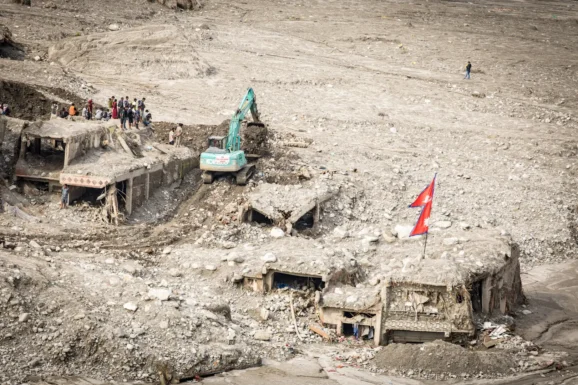
The European’s Editor-at-Large, Stanley Johnson, visited the affected area on 5 October with ICIMOD researchers Pradeep Man Dangol and Prasana Dangol, as part of a visit to Nepal at the invitation of the organisation’s director-general, DrPema Gyamtsho.
Johnson, who also visited Tibet while researching his forthcoming book The Third Pole, said the devastation was almost impossible to comprehend.
He said: “The sheer scale of the devastation is almost impossible to comprehend. An entire section of a Himalayan mountain simply gave way, unleashing an enormous mass of rock and ice that swept through the valley below.
“Standing there and seeing the aftermath for myself, I was struck by the terrifying force of what had happened and the dreadful human cost. It is a sobering reminder of just how vulnerable communities living in the shadow of these great mountains can be.”
According to the ICIMOD investigation, the collapse began at approximately 8.37am local time on 26 August, when a vast section of bedrock broke away from the northern side of Langtang Lirung at an altitude of around 5,200 metres, taking part of a glacier with it.
The enormous mass plunged almost vertically for approximately 1,200 metres into the Lhende Khola Valley, breaking apart and transforming into a fast-moving torrent of rock, sediment, ice and water.
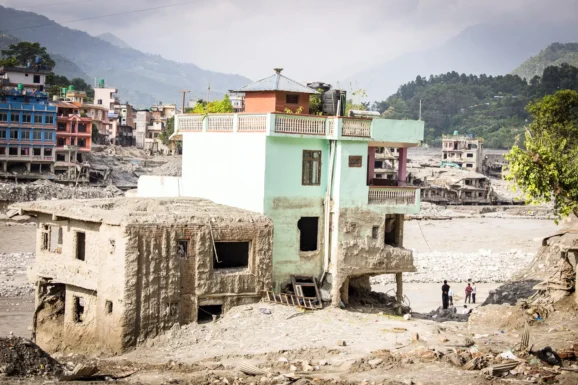
Scientists estimate that the collapse involved 115 million cubic metres of rock and 17 million cubic metres of glacial ice, although the figures require further verification.
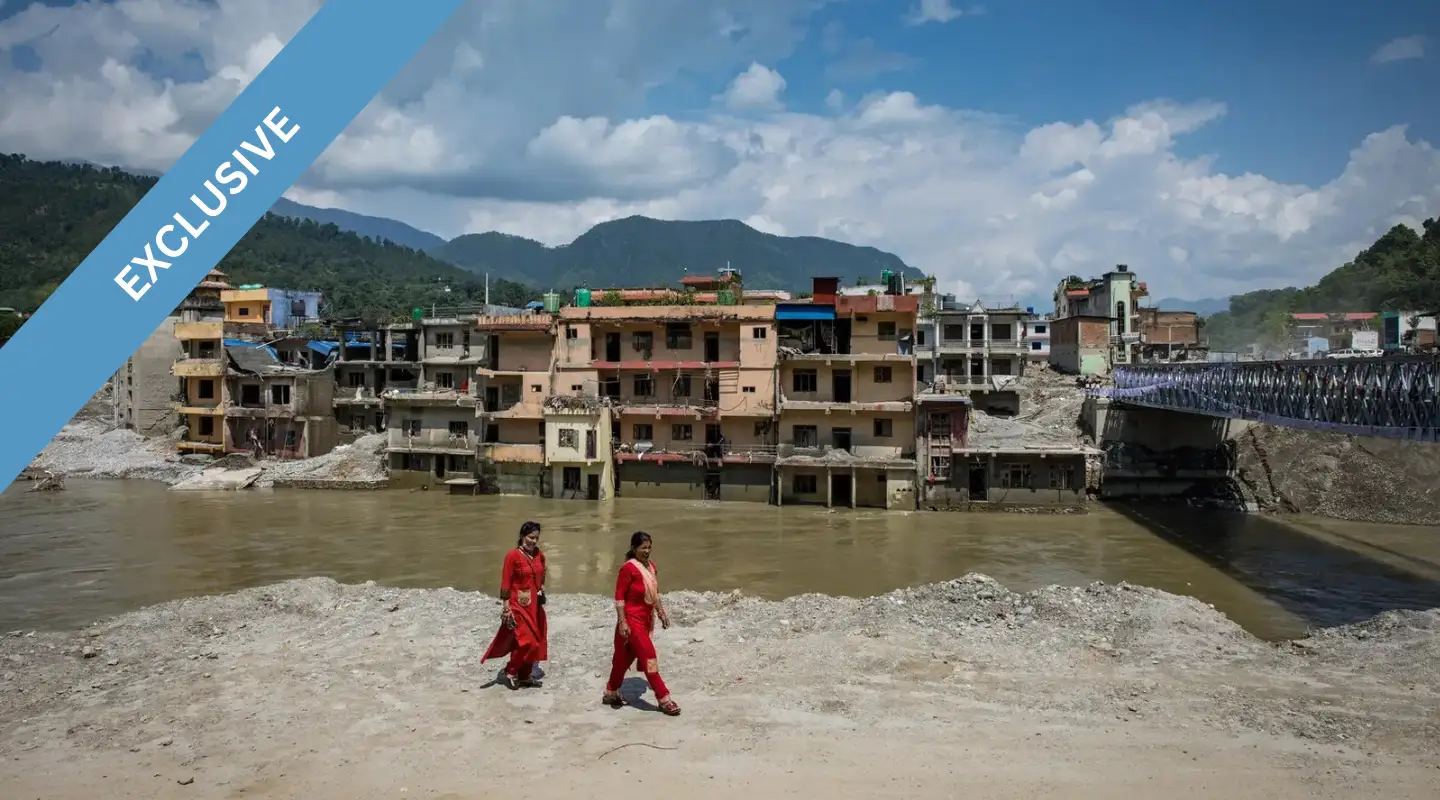
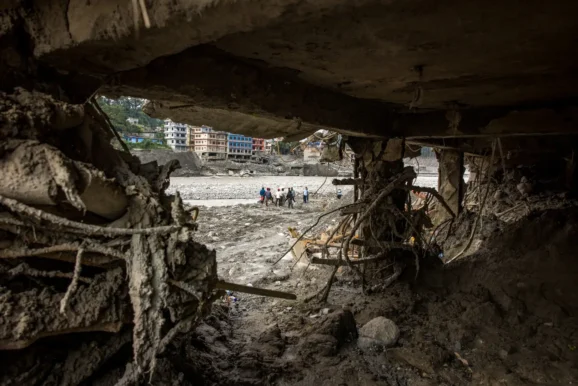
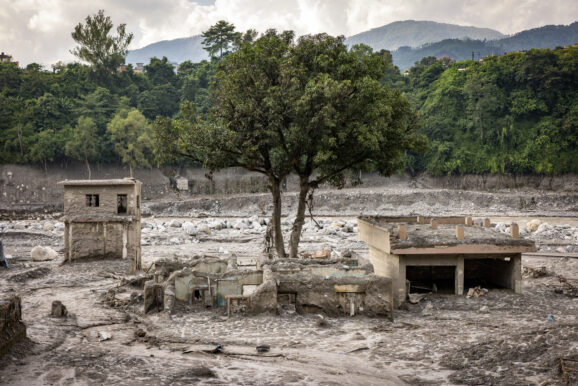
The material swept through the Gyirong–Rasuwagadhi border corridor, travelling down the Bhotekoshi and Trishuli river systems and destroying buildings, infrastructure and sections of the river valley.
Satellite observations have since revealed that the mountainside may have been showing signs of instability for several weeks before the disaster.
Researchers examining images taken between 7 July and 24 August identified apparent movement of up to 40 centimetres in the area that subsequently collapsed. A separate analysis covering 26 July to 19 August recorded displacement of up to 30 centimetres.
The measurements suggest that the rock-and-ice system may have been gradually deforming, although researchers say further investigation is needed to determine precisely what they represent and whether similar observations could provide reliable warnings of future collapses.
Scientists have also examined seismic records to establish whether an earthquake triggered the avalanche, as initially suspected.
The collapse generated seismic waves detected around the world, with instruments recording signals equivalent to a magnitude 5.2 earthquake.
Analysis indicates that the major seismic disturbance was caused by the mountainside itself falling, making an earthquake an unlikely immediate trigger.
With the sequence of events established, the investigation has focused on why such an enormous section of rock and ice became unstable.
One possible explanation involves geological weaknesses that may have existed for years. Satellite images taken in December 2017 and January 2026 showed features in the mountainside that scientists believe could represent long-standing fractures in the rock.
Researchers have also considered whether the devastating 2015 Nepal earthquake weakened the mountain. The earthquake caused a catastrophic failure on another side of Langtang Lirung, burying Langtang village, although any connection with the August 2026 collapse remains unproven.
Changes to the glacier attached to the mountainside may also have contributed. Evidence suggests that its thickness had altered over previous years, potentially adding weight to an already unstable rock face.
The report additionally examines the possible effects of accumulated snow and ice and repeated freezing and thawing, which can weaken fractured rock over time.
Scientists are particularly interested in whether rising temperatures contributed to these processes, amid growing concern about the effects of global warming throughout the Hindu Kush Himalayan region.
ICIMOD reports that the rate of glacier mass loss across the region has nearly doubled since 2000, with the 2024–25 monitoring year recording the greatest losses in the series examined.
As glaciers retreat, they can expose mountainsides previously supported by ice, leaving fractured rock more vulnerable to instability. Changes in the weight and thickness of glaciers can also alter the forces acting on surrounding slopes.
Rising temperatures can contribute to another potential source of instability – the degradation of permafrost, or ground that ordinarily remains frozen and can help hold fractured rock together.
Researchers found that the disaster area lay within a zone where permafrost may have existed, although they could not establish whether thawing had occurred at the precise location of the collapse.
Unusually warm conditions in 2026 are also being examined as scientists investigate whether higher temperatures, changes to glacier ice and weakening permafrost may have combined with existing geological fractures to destabilise the mountainside.
However, the report explicitly states that there is no direct evidence linking rapid glacier melting to the August disaster. Scientists have not established whether global warming contributed to the collapse or identified any single factor as its dominant cause.
The catastrophe caused extensive damage to Nepal’s infrastructure, destroying or damaging 13 operational and under-construction hydropower projects, affecting infrastructure equivalent to approximately one-tenth of the country’s installed electricity-generating capacity.
Hydropower accounted for approximately 44 per cent of the physical damage assessed across the affected sectors, with losses estimated at nearly 120 billion Nepalese rupees.
The flood also devastated the Gyirong border port, where a powerful wave of debris travelled approximately three kilometres upstream. Two temporary lakes formed following the collapse and subsequently drained without causing another major disaster.
The speed of the avalanche left communities closest to the mountainside with little opportunity to escape. The debris surge reached the border corridor within approximately seven minutes of the initial collapse.
Nepal’s Department of Hydrology and Meteorology reportedly sent text-message alerts to approximately 679,000 people in downstream districts at around 9.15am, after the first communities along the border corridor had already been struck.
The disaster has exposed limitations in existing warning systems, which are designed primarily to detect heavy rainfall and rising river levels rather than sudden rock-and-ice avalanches high in the mountains.
The Gyirong–Rasuwagadhi corridor had already suffered a major flood in July 2025 when a lake on Tibet’s Purepu Glacier suddenly released its water, destroying the Friendship Bridge linking Nepal and China.
Scientists are also examining another recent rock-and-ice avalanche in Nepal’s Budhi Gandaki basin, where satellite imagery has confirmed a separate mountain collapse and glacier failure.
The two latest disasters, occurring within seven weeks of each other, have intensified concern about the dangers facing Himalayan communities and the difficulties of identifying unstable mountainsides before catastrophic failures occur.
ICIMOD has called for improved satellite monitoring of vulnerable slopes, better seismic detection, coordinated early-warning arrangements and faster communication between countries sharing mountain river systems.
Researchers believe identifying dangerous mountainsides before they collapse could help authorities assess risks and improve emergency preparations, even where scientists cannot predict precisely when a failure will occur.
During his visit to Nepal, Johnson also spoke to David Silsen, the World Bank’s Country Director for Nepal, who warned that the consequences of warming in the Himalayan region could extend far beyond the countries immediately affected.
“The effect of global warming in the Hindu-Kush Himalayan region may be as important to the world’s future as the destruction of the Amazon rainforest,” Silsen told Johnson.
The Hindu Kush Himalaya supplies water to major Asian river networks, making the condition of its glaciers, snow cover and mountain environments important to millions of people throughout the continent.
Johnson said the scientific investigation could have profound implications for the future of the region if a connection between the disaster and rising temperatures is established.
“If scientists establish that global warming played a part in this disaster, the implications could be deeply troubling,” he said.
“It would raise serious questions about what the future holds for the Himalayas and the millions of people who depend on them.
“We must be careful not to jump to conclusions about the cause, but if rising temperatures are making these mountains more unstable, it would underline just how urgently the world needs to tackle climate change.”
ICIMOD works across eight countries – Afghanistan, Bangladesh, Bhutan, China, India, Myanmar, Nepal and Pakistan – to research environmental change and strengthen regional cooperation.
Dr Pema Gyamtsho, its director general, said: “The speed and force of the flood, carrying large volumes of water, sediment, and boulders through the Bhote Koshi and Trishuli river systems, are deeply concerning.
“The potential for impacts further downstream is a reminder of how quickly a hazard in the mountains can become a wider regional concern. It also reinforces the importance of timely information, early warnings, preparedness, and coordinated action.”
He added: “On behalf of ICIMOD, I extend our solidarity to the people and the Governments of Nepal and China at this difficult time. We stand ready to support the ongoing response and recovery efforts, drawing on the knowledge, science, data, and expertise available to us.
“My heart also goes out to the families and loved ones of those who have lost their lives and to all those enduring the consequences of this tragedy.”
READ MORE: New Hindu Kush Himalaya glacier reports warn of deepening risk to Asia’s water security. New reports published today lay bare the accelerating loss of ice across the Hindu Kush Himalaya, where glaciers are retreating at increasing speed in a region critical to the water security of nearly two billion people. Here, our editor-at-large Stanley Johnson, drawing on his long career as an environmentalist and ahead of the 30 March re-release of his book In the Footsteps of Marco Polo, reflects on changes to a mountain system whose fate matters far beyond the high Pamirs.
Do you have news to share or expertise to contribute? The European welcomes insights from business leaders and sector specialists. Get in touch with our editorial team to find out more.
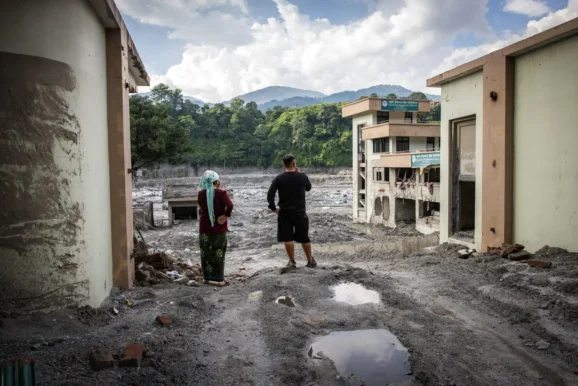
Main image: Two women walk along a riverbank overlooking buildings damaged by the disaster. The avalanche sent huge volumes of rock, ice and sediment into the river system, causing extensive destruction to settlements and infrastructure downstream. Credit: Jitendra Raj Bajracharya/ICIMOD