Ancient civilisations may be long gone, but the cities and monuments they have left behind provide a foundation for countless science fiction stories, writes international bestselling author, Omara Williams
Across the world – from Africa to the Americas, Asia to Indonesia – the ruins of ancient civilisations continue to amaze. Even with our state-of-the-art technology, we still cannot fully explain their sophisticated infrastructures or replicate their architectural feats.
These enduring mysteries, speaking of advanced knowledge and achievements lost to time, have been a major inspiration to me in writing The Space Traveller’s Lover, and they continue to fascinate me as I work on its sequel. But this shouldn’t be surprising, for ancient civilisations have inspired countless works of science fiction over the decades.
In Bolivia, we find the ancient city of Tiahuanaco, known for its impressive stone monuments. This site was once the centre of a civilisation – the Tiwanaku Empire – and boasted more than 40,000 inhabitants at its height, from around 500 AD to 1000 AD. As part of this remarkable complex is the temple of Puma Punku, which contains some of the largest and most precisely cut megalithic stones found anywhere in the world. Puma Punku is situated at an elevation above the natural tree line, which rules out using trees to transport the massive stones.
This mysterious city inspired the ancient alien theories found in Erich von Däniken’s Chariots of the Gods? (1968), in which he proposed that such impressive and advanced ancient structures may have been built with the help of alien visitors to Earth. This later influenced Hollywood, with sci-fi films such as 1994’s Stargate and its long-running TV spin-off, where ancient structures serve as gateways to the universe.
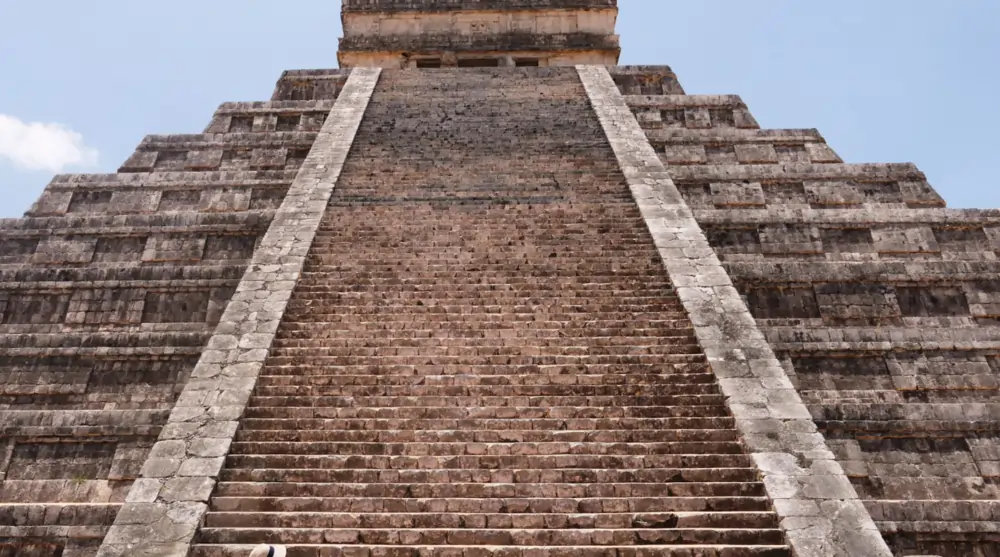
Around the same period (800-1200 AD), a bustling city with more than 30,000 inhabitants existed to the north in the Yucatán Peninsula: Chichén Itzá. This impressive Mayan city features elaborate temples that are precisely aligned with Venus, the Sun, the Moon, and the Earth’s seasons, showcasing an advanced level of mathematical accuracy and architectural prowess.
The Mayan civilisation’s astronomical knowledge and their mysterious disappearance inspired sci-fi icon Arthur C. Clarke’s acclaimed Rendezvous with Rama (1973), in which an abandoned alien spacecraft with a distinctly Mayan-like design drifts into our solar system. Nearly 40 years later, in 2009, filmmaker Roland Emmerich drew upon the Mayan calendar for the apocalypse-themed blockbuster 2012.
Going back 4,500 years and nearly 8,000 miles across the Atlantic Ocean, we find the Great Pyramid of Giza in Egypt. Standing 147 metres high, the most recognisable pyramid in the world is oriented towards the cardinal points with remarkable accuracy, while the ratio of its edges, base, and height encodes geometrical principles and mathematical constants. Additionally, the main four shafts within the pyramid are each precisely aligned with a star, demonstrating the Egyptians’ exceptional knowledge of astronomy.
Unsurprisingly, the Great Pyramid and Egyptian mythology have significantly influenced sci-fi literature and cinema. H.P. Lovecraft’s At the Mountains of Madness (1936) explores an ancient alien race that left structures resembling pyramids in Antarctica. Similarly, Alien director Ridley Scott’s Prometheus (2012) builds on the concept of pyramid-like structures serving as ancient repositories of extraterrestrial knowledge that have shaped human evolution.
Another 6,000 miles to the southeast, across the Indian Ocean, lie the remains of arguably the oldest giant pyramid constructed by an advanced ancient civilisation: Gunung Padang in West Java, Indonesia. This site, located atop a dormant volcano, features thousands of volcanic stones that form a series of four successively smaller terraces connected by steps and upright columns. The dating of its construction varies widely, ranging from 45 BC to 22 AD, with some estimates even suggesting it could date back as far as 27,000 years ago.
Gunung Padang and other lost cities heavily inspired the hidden civilisations in early sci-fi author H. Rider Haggard’s She (1887), where a British explorer stumbles upon an ancient, technologically advanced society that has continued to thrive away from the world’s attention for millennia.
To the north, near ancient Mesopotamia and what we now know as Turkey, is Göbekli Tepe, which is among the world’s oldest megalithic constructions, dating from 7,000 to 9,500 BC. It boasts large circular structures surrounding massive stone pillars carefully decorated with abstract pictograms and depictions of wild animals. Some of these pictograms correspond with solar calendars and other astronomical features, such as meteor showers and constellations, revealing that thousands of years before the Egyptians built the pyramids, the inhabitants of Göbekli Tepe were keen observers of the sky.
This remarkably well-preserved site has inspired many sci-fi stories, not least through its intriguing, undeciphered pictograms. You only need to watch a film such as Arrival (2016), where a team of investigators try to crack an ancient alien language, to see its fingerprints.

Omara Williams is a nuclear and software engineer whose multi-award-winning debut science-fiction novel, The Space Traveller’s Lover, shot to international bestseller status. Outside of her literary pursuits, she enjoys stargazing and chasing total solar eclipses.