Long-range patient transfers often look effortless on screen, yet in reality they depend on precise coordination between medical teams, aviation operators and regulators across multiple jurisdictions. Adam Mikulski, General Manager at Medical Air Service — which provides global medical evacuation and repatriation by private medical jet or with medical escorts on commercial flights — explains how modern “wing-to-wing” operations function in practice and why continuity of care matters as much as speed
When most people imagine private medical flights, the picture in their minds comes straight from the cinema: a sleek jet gliding onto the tarmac, a team of medics stepping out with practised urgency, and a patient whisked aboard for rapid evacuation to first-class treatment. What the films leave out is the intricate logistical machinery that enables those scenes to unfold in real life.
Behind every successful medical transport is a chain of coordination that extends far beyond the aircraft itself. This plays a key role in the concept specialists refer to as “wing-to-wing” transport, where the patient’s treatment must be continuous before and after reaching the destination, regardless of the number of systems or aircraft interfaced.
When it comes to international patient transport, which involves long distances, the key to success is not how fast the process is but how the entire process is organised, whether in aviation, health, or regulatory matters. This is becoming an essential concept in the evacuation of long-distance patients, as it may not be feasible for the plane, crew, and infrastructure to handle the entire process.
A good example of the above is an operation we recently handled, in which a patient in a persistent vegetative state was transported from Germany to the Philippines. This specific mission called for a carefully designed mix of regular commercial airline transport accompanied by medical escort services, and, finally, a private medical flight for the final-stage delivery in a regional area.
The coordination for each stage changeover includes the relevant aviation authorities, ground handlers, medical staff, and the ground transport service. The success of the entire operation does not lie in a single aircraft.
This kind of mission is becoming more frequent. Global mobility, remote locations, and varying access to quality medical infrastructure mean patients must be transported across the continent. The challenge is not simply distance but continuity of care during that distance.


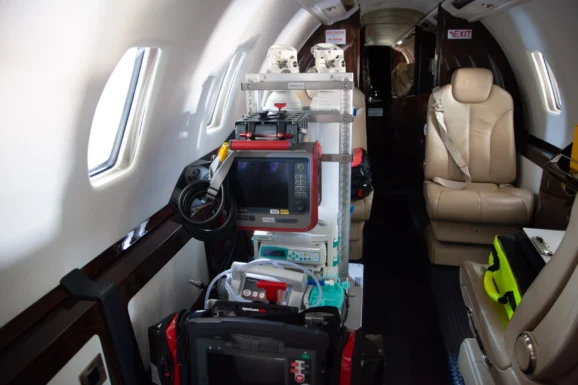
Long-haul medical flights are hardly ever straightforward affairs. The patient’s medical condition, the availability of an aircraft, and the constraints of the regulatory framework would all significantly impact the plan of action for such an evacuation. Another recent medical evacuation involved flying a patient from Europe to the São Paulo region, with the need for transport arising at very short notice. Given the tight deadline and crew rest requirements, a wing-to-wing transfer offered the most practical solution. Operating a larger aircraft with a replacement crew would have added unnecessary cost.
In essence, then, what makes wing-to-wing operations so challenging is that many systems must work concurrently. There must be integration among medical readiness, aviation compliance, and logistical issues. Whereas commercial air transportation is a relatively organised way to travel from point A to point B, medical air transport is far more dynamic and unpredictable.
Obtaining medical clearance may often be the first challenge. Determining whether a passenger is fit to fly is not easy, and this requires coordination among primary physicians, flying physicians, and medical coordinators. This is a time-sensitive task.
Aircraft selection is the next step, which is almost as important as patient transportation itself. The factors to be considered go beyond availability; they include aircraft layout, power sources for any equipment, and enough room for medics to be comfortably accommodated.
And then, of course, governmental regulations must be taken into account. Flight rights, landing rights, and customs clearance need to be well synchronised. Each country has its regulations, and any error could result in the complete grounding of the operation.
At last, comes ground coordination. Ambulances must be there on time. Teams in hospitals must be ready to receive a patient. Communication among all must be continuous. Each handover poses hazards if managed improperly.
Properly managed wing-to-wing operations must therefore take a holistic view, seeing systems as entities in and of themselves rather than through the lens of separate air operations. The planning stage begins long before any aircraft is assigned to fly. The medical teams analyse cases, and operations specialists examine possible sources of potential logistics-related risk.
Instead of dealing with difficulties after the fact, emphasis is instead placed on anticipating constraints. Weather patterns, airport congestion, aircraft availability, and regulatory delays are considered upfront. Contingency plans are developed alongside the primary routes so that alternatives can be implemented if needed.
Such a philosophy is even more crucial in intercontinental transfers where a ripple effect might occur. It becomes easier to maintain a continuum of patient care if one knows the areas that might pose challenges.

Then there is the human factor. Patients who require overseas medical transport will likely be in a precarious physical and psychological position. Their loved ones may also be dealing with a high degree of worry and unfamiliarity. Communication is as central as implementation.
The mention of transparency in wing-to-wing operations underscores the need for families to receive accurate information on timelines, delays, and care processes. Medical personnel should receive appropriate information and data. Trust lies in consistency and clarity, and this is especially crucial in unforeseen circumstances.
This human aspect is also present in the professionals involved. It is important for the medical teams, pilots, dispatchers, and coordinators to be a single unit despite their activities occurring in different time zones and locations. This requires mutual understanding and respect.
In a sense, medical air transport is often full of misconceptions and myths, but one of the most prevalent is the idea that faster is always better for healthcare transport by air. Rushing a flight without fully accounting for medical readiness or regulatory compliance can introduce unnecessary risk.

Wing-to-wing coordination prioritises continuity of care while balancing time sensitivity and cost considerations. It ensures that the patient receives support from the moment of care until the completion of the process, even when the process involves switching planes or staff.
Finally, when the patient is safely delivered to the destination hospital, the complexities involved are no longer apparent. The calls, clearances, planning, and contingency preparations are things that do not usually attract attention but are the very things that determine success.
READ MORE: ‘Cornwall project to open new UK test airspace for drones and autonomous aircraft‘. A new collaboration at Cornwall Airport Newquay aims to unlock segregated airspace for long-range and high-speed uncrewed aircraft, as the UK seeks to expand domestic testing capacity for autonomous and defence systems.
Do you have news to share or expertise to contribute? The European welcomes insights from business leaders and sector specialists. Get in touch with our editorial team to find out more.