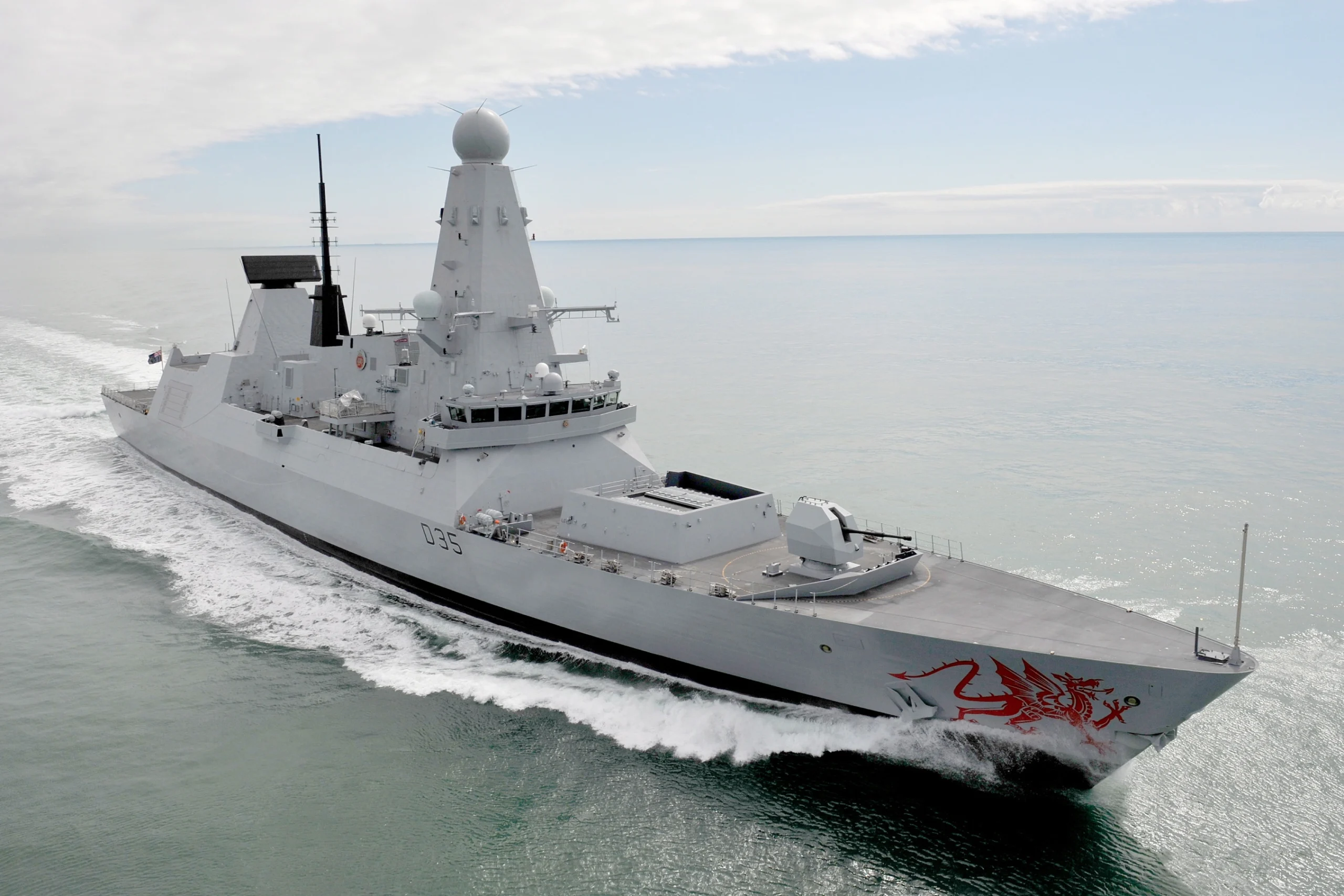
With questions mounting over whether Britain is prepared to support the U.S in the Gulf and defend its own regional interests, Dr Linda Parker argues that the delay in sending HMS Dragon to Cyprus has revealed how far the Royal Navy has drifted from its long tradition of rapid global response
The Royal Navy has a long and storied tradition of being able to respond rapidly to world events. The first element of the task force sent to the Falkland Islands in 1982 sailed within just three days of the invasion. The aircraft carrier HMS Hermes, which at the time was covered in scaffolding, was readied almost over a weekend, sailing with HMS Invincible on 5 April 1982.
Nor was this ability to act quickly confined to one theatre. In 1940, 299 British POWs were rescued from the German vessel Altmark in a Norwegian fjord. The POWs were alerted to their rescue by cries of “The Navy’s here!” This episode has become part of the history of the Royal Navy.
The navy has also had an enviable record of surging to evacuate or protect UK citizens and other nationals from danger zones, and of delivering urgent humanitarian help around the world in rapid response. HMS Albion, for example, supported an evacuation from Sierra Leone. HMS York and several other UK ships in rotation performed one of the largest British evacuations since the Second World War off Lebanon in 2006. In 2019 HMS Argyll assisted in humanitarian support after Hurricane Dorian hit the Bahamas.
That tradition mattered particularly in the Gulf, where Britain long maintained a visible maritime presence in defence of its interests and wider regional security. The war between Iran and Iraq, starting in 1980, posed a serious threat to important oil supplies passing through the waters of the Gulf. The UK government decided to send defensive patrols to the region, named the Armilla Patrol.
Starting on 7 October 1980, the destroyer HMS Coventry, supported by two frigates, HMS Naiad and HMS Alacrity, was on station, and the Armilla Patrol continued its presence in the Gulf throughout the 1980s and 1990s.
In November 1990, the presence of the Armilla Patrol in the Gulf was marked in a speech by Vice Admiral Jock Slater, in which he mentioned that 106 ships had taken part in the patrol and that 26 shipping companies had ships escorted through the Strait of Hormuz. During the First Gulf War, the Royal Navy played an important part in escort duties, troop transport and mine detection.
In more recent years, the Armilla Patrol has been replaced by Operation Kipion, which had a destroyer, a frigate and a supply ship on rotation in the Gulf. However, the Royal Navy no longer has enough frigates or destroyers to keep a permanent presence there. HMS Lancaster, a Type 23 frigate which had been based permanently in Bahrain, was decommissioned in December 2025, and the last minehunter in the Middle East, HMS Middleton, has been towed back to the UK.
It is against that background that the delays in the deployment of HMS Dragon to Cyprus have caused such concern. Despite controversy about the wisdom of the UK becoming involved in the present situation in the Gulf, and the extent to which the UK government will aid the U.S, the delays in the sailing of HMS Dragon have shown up the inability of the Royal Navy to surge and deploy assets quickly to defend its global interests. HMS Dragon, a Type 45 destroyer equipped for the air defence of the UK base at Akrotiri, became a test of whether the navy could still do what it once did routinely.
At this time HMS Dragon is the only Type 45 available, as the other five are either in refit or committed overseas. Dragon was due to go into maintenance in April and was undergoing software updates and engineering work. Sailors and engineering staff worked day and night to ready the ship for sailing, but the delays have drawn criticism of the UK’s military preparedness.
The immediate problem was not simply the delay itself, but the condition of the fleet behind it. Dragon needed six days to be ready for sea, while wider maintenance pressures and delayed refits had left the Royal Navy with little room for manoeuvre.
Former First Sea Lord Lord West has weighed into the debate, arguing both that the government “has no understanding of the importance of maritime power” and that “there isn’t a single warship between Singapore and Gibraltar”. He has also said: “We have got too few ships and the ships that we have have not been properly maintained.”
Defence budgets under successive governments have been cut, squeezing maintenance budgets and delaying refits. Type 45s have been undergoing a PIP (Power Improvement Project) refit, and delays to refit projects have meant that several destroyers are in refit at the same time. When the navy only has six of this type, delays to maintenance scheduling have a clear effect.
Serving naval officers do not comment on current events, but The Times has reported “sources in the navy” as being furious that the government did not act on advice to act sooner, after being told a month ago that the U.S build-up in the Gulf indicated a looming conflict. The navy source was quoted as saying: “The signal was that America said we are now calling for a second aircraft carrier. When America empties out the Indo Pacific of its carriers you know something is going to happen.”
Questions in the House of Commons revealed that the Navy claimed to have had a contingency plan to send a Type 45 destroyer to Cyprus and had advised the government on this, but for some reason that recommendation was not passed to the Chief of the Defence Staff until Tuesday 3 March at 9.30am – two days after a drone had hit RAF Akrotiri. The government acted on the recommendation the same day, but delay had already set in. Whether the delay was administrative or political, the result was the same: HMS Dragon did not leave until Monday 10 March.
There has been much speculation in the UK press about the long- and short-term reasons why the Royal Navy was struggling to send a rapid response to the crisis, while Italy, Spain and the Netherlands had already sent naval assets to the Mediterranean and France had sent a carrier group.
Notwithstanding the arguments about the advisability of, or the ability to aid, the U.S in its actions in the Gulf, the bottom line remains that the Royal Navy has a duty to protect UK interests, forces and citizens.
It can only be hoped that defence cuts and slow decision-making do not undermine the Royal Navy’s proven ability to look after British interests and contribute to international security in an age of global volatility.

Dr. Linda Parker is widely considered to be one of Britain’s leading polar and military historians. She is the author of six acclaimed books, an in-demand public speaker, the co-founder of the British Modern Military History Society, and the editor of Front Line Naval Chaplains’ magazine, Pennant, which examines naval chaplaincy’s historical and contemporary role.
READ MORE: ‘The Arctic’s unfinished cold war‘. As Arctic militarisation gathers pace amid renewed geopolitical rivalry, the environmental scars of the Cold War remain embedded in ice, soil and seabed. Dr Linda Parker argues that without sustained cooperation and meaningful Indigenous consultation, the region risks compounding an already hazardous legacy.
Do you have news to share or expertise to contribute? The European welcomes insights from business leaders and sector specialists. Get in touch with our editorial team to find out more.
Main Image: Nicky Wilson/MOD (OGL)