As Arctic militarisation gathers pace amid renewed geopolitical rivalry, the environmental scars of the Cold War remain embedded in ice, soil and seabed. Dr Linda Parker argues that without sustained cooperation and meaningful Indigenous consultation, the region risks compounding an already hazardous legacy
Buried less than 55 metres beneath the Greenland ice sheet lies a network of tunnels the length of small streets, once powered by a portable nuclear reactor and stocked with diesel fuel, sewage and radioactive waste. It was abandoned in 1967, sealed by snow and silence. What was left behind — including an estimated 180,000 litres of liquid radioactive material mixed with chemical waste — remains entombed in ice that is now thinning.
As Arctic temperatures rise and the ice shifts, that Cold War relic may not remain buried. And it is only one of dozens of military installations across the circumpolar north whose environmental legacy has never been fully addressed.
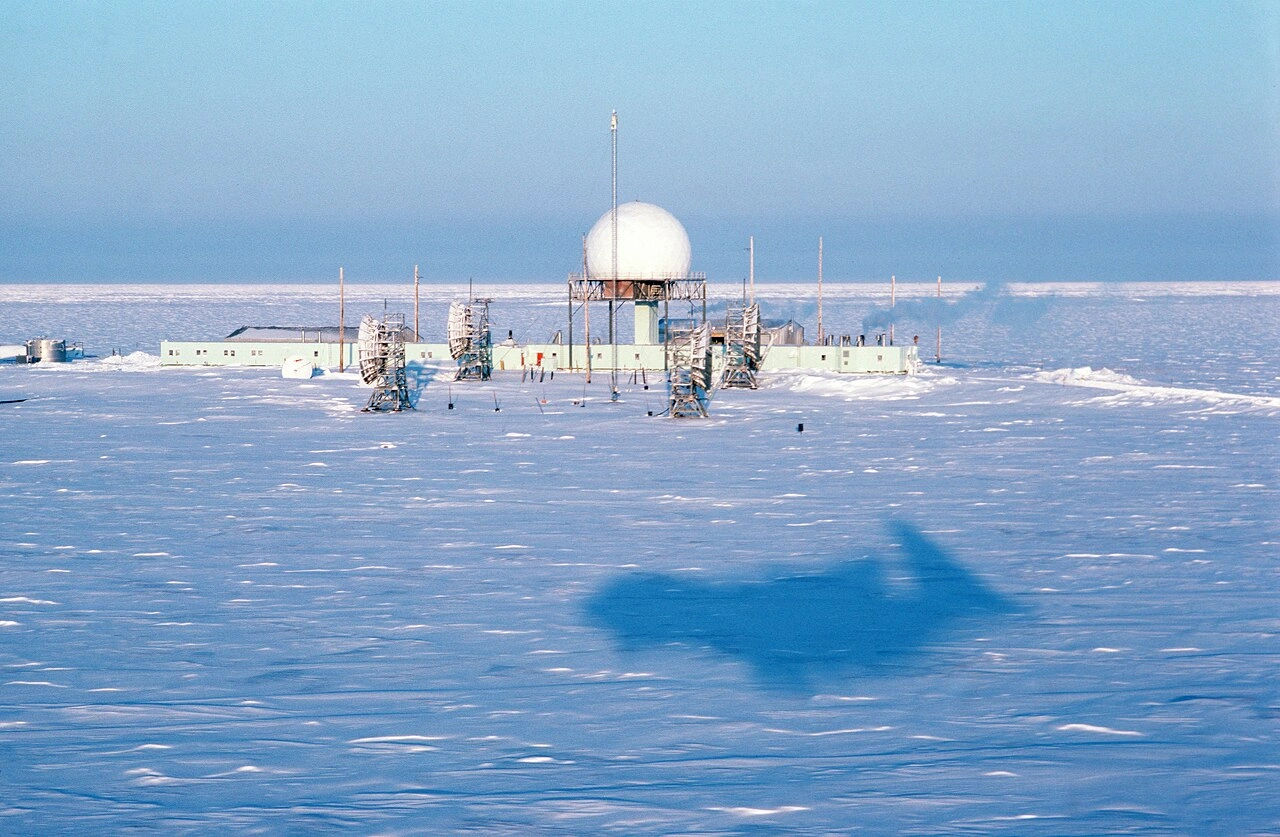
During the Cold War, dominance of the air and sea in the Arctic was central to both Washington and Moscow. The polar region offered the shortest route for intercontinental missiles and long-range bombers. In Alaska and Greenland, the United States constructed air bases and Distant Early Warning radar stations. Along the vast Russian Arctic coastline, the Soviet Union developed airfields, radar sites and naval bases. Nuclear-armed submarines patrolled beneath the ice, carrying missiles and conducting surveillance in waters that were both shield and launchpad.
The environmental consequences of that military build-up persist. Infrastructure brought oil spills, chemical dumping and poorly managed waste. Soil was contaminated, permafrost disturbed and coastal waters polluted. Many sites were abandoned hastily, with hazardous materials left in place under the assumption that ice and remoteness would contain them indefinitely.
Across Alaska, Canada and Greenland, Inuit communities saw radar stations erected on their land, at times on traditional burial sites and ice cellars. In 1953, during construction of Thule Air Base — now Pituffik — residents were forcibly removed and their settlement destroyed to prevent return. Military imperatives overrode local consent. For Sami communities in northern Scandinavia, radioactive fallout from nuclear testing in the 1950s and 1960s, including at Novaya Zemlya, contaminated reindeer grazing grounds that sustained both livelihoods and culture.
Accidents compounded the burden. The crash of a B-52 bomber carrying nuclear weapons near Thule in 1968 spread radioactive material across sea ice and into surrounding waters. At least two Soviet nuclear submarines, K-278 Komsomolets and K-159, lie on the Arctic seabed, their reactors and warheads a continuing source of concern. Soviet radioactive waste was also dumped in Arctic waters, alongside abandoned bases and corroding infrastructure concentrated in the Russian north.
After the Cold War, there was a brief period in which Arctic states attempted to place environmental repair above strategic rivalry. In a 1987 speech in Murmansk, Mikhail Gorbachev called for the Arctic to become a “zone of peace”. The Arctic Environmental Protection Strategy followed in 1991, and in 1996 the Arctic Council was established, including representation from Indigenous organisations. Cooperation extended to oil-spill response, pollution monitoring and search-and-rescue coordination. The idea of “Arctic exceptionalism” took hold: the belief that geography and vulnerability would sustain collaboration even when relations elsewhere deteriorated.
That framework has weakened sharply since Russia’s invasion of Ukraine in 2022. Diplomatic engagement has stalled, joint projects have been suspended and environmental remediation has slowed. Russia’s state nuclear corporation Rosatom announced in 2023 that aspects of its Arctic clean-up programme were ending. Efforts to retrieve hazardous fuel rods and address submarine wrecks have been curtailed. The legacy of Cold War contamination remains, with fewer mechanisms in place to manage it.
At the same time, the strategic logic that once filled the Arctic with bases and submarines is re-emerging. Melting sea ice is opening shipping routes and easing access to hydrocarbons and minerals. Coast guards, navies and icebreakers are increasing their presence. Governments are investing in new infrastructure across northern territories. The last remaining arms control treaty between the United States and Russia is due to expire in 2026, raising concern that nuclear testing and weapons deployment could once again extend into polar regions.
Indigenous communities have responded with renewed insistence that defence and security policy must account for cultural survival and environmental protection. In Canada, the government’s defence policy “Our North, Strong and Free” has prompted debate over the extent to which Indigenous groups were consulted about land use, pollution risk and long-term stewardship. Inuit organisations have emphasised that sovereignty and security cannot be separated from environmental integrity.
The Arctic in the twenty-first century remains marked by decisions taken in the twentieth. Radioactive waste lies beneath ice that is melting faster than expected. Submarine reactors corrode in deep water. Contaminated soils endure along remote coastlines. If militarisation accelerates in response to geopolitical rivalry, the danger is cumulative. Pollution from increased naval traffic and new bases would layer upon an existing burden that has yet to be resolved.
The risk is repetition on a larger scale: strategic competition proceeding faster than environmental repair, cooperation faltering as military budgets rise, and communities whose lives depend on clean seas and viable grazing grounds once again placed at the edge of decisions taken far away. The Cold War never entirely left the Arctic. The question is whether the region’s future will be shaped by its unfinished past.

Dr. Linda Parker is widely considered to be one of Britain’s leading polar and military historians. She is the author of six acclaimed books, an in-demand public speaker, the co-founder of the British Modern Military History Society, and the editor of Front Line Naval Chaplains’ magazine, Pennant, which examines naval chaplaincy’s historical and contemporary role.
READ MORE: ‘The fight for Greenland begins…again’. Greenland became a strategic prize during the Second World War, when the United States occupied the island to block Nazi advances, shield Atlantic convoys and gather the meteorological intelligence that helped time D-Day. It later formed the backbone of NATO’s Arctic early-warning system during the Cold War. Trump’s latest claim that America “has to have” Greenland has revived that history, alarmed Denmark and unsettled the alliance. Yet Greenland’s future remains a matter for Greenlanders, not Washington, writes historian Dr Linda Parker.
Do you have news to share or expertise to contribute? The European welcomes insights from business leaders and sector specialists. Get in touch with our editorial team to find out more.
Main image: US Air Force/Wikimedia Commons