NATO’s refusal to back U.S. action on Iran shows that European allies will not automatically follow Washington into conflict. Ravi Balgobin Maharaj argues that the United States must now win support for each decision instead of expecting it as a given
There’s a certain melodrama in the way observers have reacted to NATO’s refusal to join the United States in its war with Iran. The tone of commentary in some corners suggests a sudden rupture, as though the alliance has fractured overnight under pressure, but that interpretation says more about expectations than reality.
What NATO has done is not shocking, nor is it unprecedented, and its leaders will argue it has simply acted in accordance with its original design. The alliance was never intended to serve as an automatic extension of American military policy across the globe. It is, at its core, a defensive pact, built to respond collectively when one of its members is attacked and this conflict, regardless of how it is framed in Washington, does not trigger that obligation. Seen in that light, NATO’s decision is not a betrayal or a collapse, but a reaffirmation of its foundational purpose.
Still, reducing the situation to procedural correctness alone would miss the broader dynamics at play. The refusal is not only about legal frameworks or treaty language; it is also shaped by practical constraints and strategic realities within Europe. Many European militaries are operating under significant limitations after years of underinvestment, ongoing regional commitments, and economic pressures that have tightened defence budgets. Opening another front, particularly one as complex and potentially protracted as a conflict in the Gulf, is not a decision that can be taken lightly. Leaders must weigh not only military feasibility but also the long-term sustainability of such an engagement and in this sense, NATO’s hesitation reflects capacity as much as principle.
Even more influential, however, is the political climate within European countries themselves. Public appetite in the U.S for another Middle Eastern war is, at best, limited, according to recent research. Memories of past interventions linger, and scepticism runs deep about the costs and outcomes of such conflicts. Compounding this is the widespread perception, fair or not, that the war is entangled with broader regional dynamics, including Israeli strategic interests, which makes it even more difficult for European governments to justify visible military support. Domestic politics impose real constraints, and for many leaders, participation is not just a strategic calculation but a question of political survival. This reluctance is not rooted in hostility toward the U.S, but in the necessity of responding to internal pressures that cannot be ignored.
It is in this space, between alliance structure and political reality, that newer or less formal coalitions begin to take on greater relevance. Frameworks like the Board of Peace, with their emphasis on de-escalation, diplomacy, and multilateral restraint, help explain Europe’s instinct to step back rather than surge forward. They reflect a growing preference in some capitals for conflict management over escalation, even when that position creates friction with Washington. On the other end of the spectrum, looser alignments such as the Shield of the Americas, represent a different model entirely, one oriented toward flexibility, regional security cooperation, and a greater willingness to align with U.S. strategic priorities when interests converge.
In that sense, NATO’s hesitation may also function, intentionally or not, as a kind of stress test for these emerging arrangements. If traditional alliance structures are unwilling or unable to act, the question becomes whether alternative coalitions can step into the gap in a meaningful way. Can the Shield of the Americas coalition provide operational support, legitimacy, or logistical depth? Can diplomatic groupings like the Board of Peace shape the political environment in ways that constrain escalation or open off-ramps? These are not hypothetical questions, and they go to the heart of how power and cooperation are being reorganised in real time. What NATO withholds, others may be asked to supply, and how effectively they do so will determine their long-term strategic value.
At the same time, it is important to address a more sensitive and often overstated claim, which is that NATO’s reluctance is driven by antisemitic sentiment within Europe. While it would be naïve to deny that antisemitism exists in varying degrees across different societies, as it does globally, reducing the alliance’s position to such motivations is both analytically weak and politically misleading. European governments are responding primarily to strategic constraints, public opinion, and risk calculations, not to ideological hostility toward Jewish people or Israel. In fact, many of these same governments maintain strong diplomatic, economic, and security relationships with Israel. The discomfort surrounding the conflict is better understood as a reaction to the prospect of another prolonged regional war, rather than as an expression of prejudice.
That distinction matters, because misdiagnosing the cause of NATO’s hesitation leads to flawed conclusions about how to address it. If the issue were rooted in bias, the remedy would lie in confronting that bias. But if, as evidence suggests, it is rooted in political caution, limited capacity, and divergent strategic priorities, then the solution lies in diplomacy, burden-sharing, and clearer alignment of objectives. Conflating the two risks deepening divisions at a moment when clarity is needed.
As a result, NATO’s position is best understood not as opposition, but as hesitation, a deliberate step back rather than a break away. For the U.S, this moment serves as a kind of strategic clarification. It underscores a reality that has been gradually emerging over the past decade, which is that NATO is no longer an instrument that automatically amplifies American power on demand. Instead, it is a coalition of sovereign states that increasingly prioritise their own national interests and political constraints when deciding whether to align with U.S. actions. This shift may be unsettling to those accustomed to a more unified Western posture, but it does not necessarily signal decline. Rather, it reflects an evolution in how alliances function in a more multipolar and politically complex world.
From a purely military perspective, NATO’s absence does not fundamentally weaken the United States’ ability to conduct operations in the Gulf. American forces retain unmatched capabilities in power projection, logistics, and sustained combat operations. The notion that the campaign’s success hinges on additional European participation is often overstated. While allied contributions would undoubtedly enhance capacity and share the burden, their absence does not cripple the mission. The United States remains fully capable of acting independently when necessary, as it has demonstrated in numerous past conflicts.
Where NATO’s decision does have a tangible impact is in the realm of perception. The lack of visible alliance support complicates the narrative of unified Western resolve, creating space for adversaries like Iran to frame the conflict as a unilateral American venture rather than a collective international response. In modern warfare, perception is not a secondary concern, but it is a strategic factor in its own right. The optics of division can influence diplomatic alignments, affect global opinion, and embolden opposition. While this does not alter the military balance, it does shape the broader context in which the conflict unfolds.
Yet even this challenge is not insurmountable and in many ways, it forces the U.S to return to a familiar strength, its adaptability. When traditional alliances fall short of consensus, Washington has historically demonstrated an ability to assemble alternative coalitions tailored to specific objectives. These may lack the institutional weight and prestige of NATO, but they often provide greater flexibility and willingness among participants. Regional partnerships and emerging frameworks, however loosely defined, offer avenues for cooperation that are more responsive to the immediate strategic environment. They are not replacements for NATO, nor do they need to be. Instead, they represent a different model of coalition-building, one that prioritises practicality over uniformity.
This shift points to a broader lesson about the nature of leadership in the current era. The expectation of automatic alignment from allies is becoming increasingly outdated. In its place is a more complex landscape in which support must be negotiated, cultivated, and sometimes improvised on a case-by-case basis. This approach is undeniably more complicated and often less predictable, but it is not inherently weaker. In fact, it may produce more resilient forms of cooperation, grounded in genuine alignment of interests rather than institutional obligation.
Ultimately, NATO’s refusal does not mark the end of the alliance, nor does it represent a fundamental crisis in transatlantic relations. What it does signal is the presence of clearer limits and boundaries around when and how European states are willing to engage militarily, particularly outside their immediate region. This reflects a broader movement toward strategic autonomy within Europe, one that has been developing steadily and is now becoming more visible in moments like this.
For the U.S, the implications are both sobering and instructive. The burden of action may be heavier, and the diplomatic terrain more fragmented, but the underlying capacity to act remains intact. The war will proceed, shaped by the same core dynamics regardless of NATO’s involvement. Iran will continue to test for weaknesses and exploit divisions where possible, while the U.S will adapt its strategy to the realities of a less unified coalition.
In stripping away assumptions about automatic support, this moment offers a clearer view of the current global order. NATO is not a blank check, and Europe is not uniformly aligned in every strategic endeavour. American power, while still formidable, operates in an environment where alliances are conditional and consensus is no longer guaranteed. That reality does not diminish strength, but rather, it redefines how it must be exercised.

Ravi Balgobin Maharaj is a geopolitical commentator and international affairs analyst with a focus on security strategy, alliance systems, and emerging global power structures. His work explores the intersection of military capability, political sentiment, and diplomatic alignment in an increasingly multipolar world. Drawing on a global perspective, he provides analysis on shifting coalition dynamics, regional security frameworks, and the evolving role of Western institutions in contemporary conflict.
READ MORE: ‘Why Europe still needs America‘. As Washington and Beijing intensify their parallel courtships of European capitals, Ravi Balgobin Maharaj argues that beneath the flurry of trade deals and diplomatic visits lies a harder truth about power, security and trust, and why, despite the allure of Chinese investment and the turbulence of American politics, Europe’s long-term stability still rests on the transatlantic alliance.
Do you have news to share or expertise to contribute? The European welcomes insights from business leaders and sector specialists. Get in touch with our editorial team to find out more.
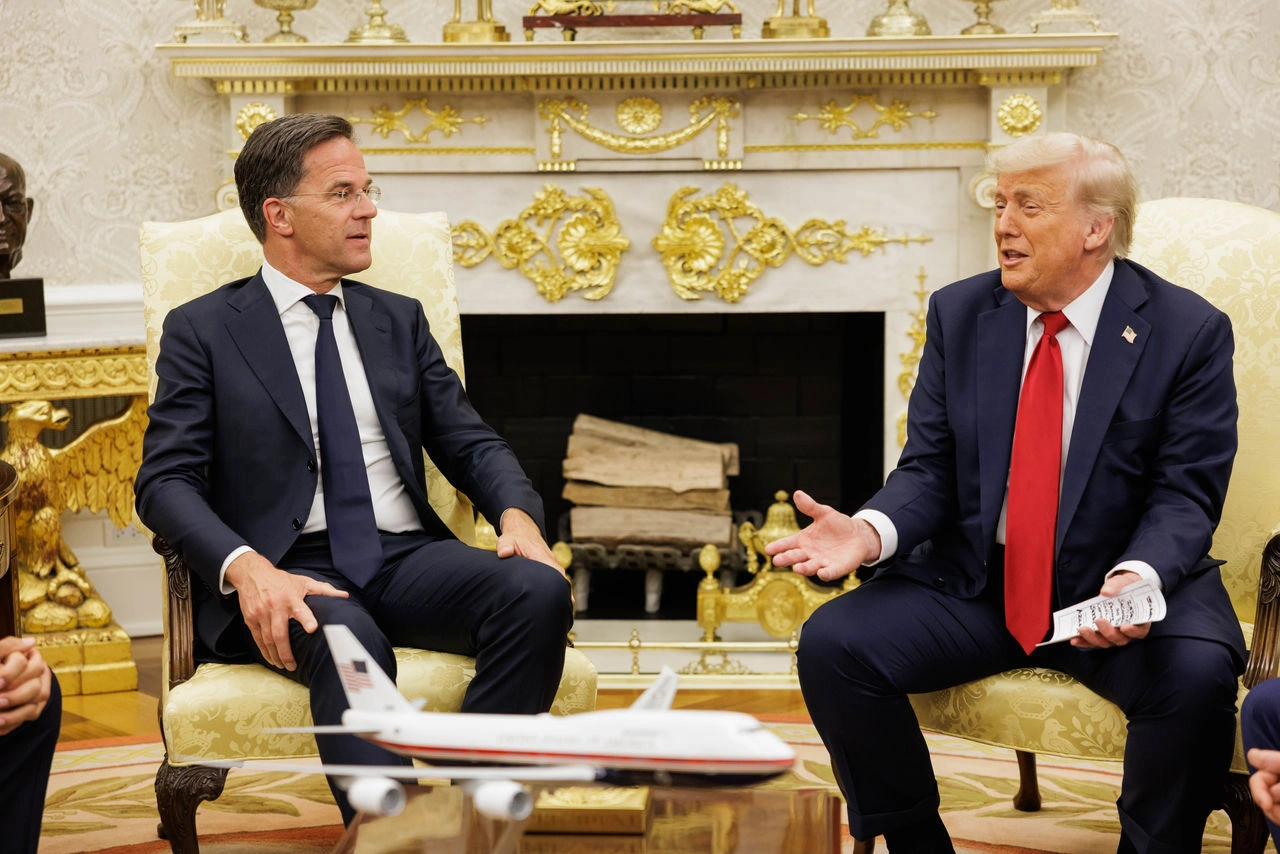
Main image: NATO Secretary General Mark Rutte meets U.S. President Donald Trump in the Oval Office to discuss allied support for Ukraine and wider transatlantic security coordination last year. Credit: NATO