Bestselling author RR Haywood takes aim at the most infuriating phrase in modern customer service – and what it reveals about a nation on the brink.
We’re all guilty of adopting the latest buzzwords and catchphrases. Running around, bumping into people and proclaiming, “I haven’t seen you in a minute!”
Despite our best efforts, the annoying bits of corporate fluff sneak into our emails too, and before we know it, we’re saying, “Let’s circle back while going forward so we can loop in some flags of visibility for the touch base.”
I’ll put a pin in trying to mimic more buzzwords – my bandwidth is a bit tight, and I need to drill down.
Ahem. Moving on.
The point is, those new fads do the rounds and spread faster than an office cold, and pretty soon they’re falling out of our mouths while we hold an oversized cup, at the same time as being on a loudspeaker phone call, telling someone else how unique and special we are – in a crowd of many others, all holding their own big cups, also on loudspeaker, and wearing ever-so-slightly different versions of the same outfit.
And do you know what? I don’t mind that one bit.
Language is a beautiful, living thing that shifts and morphs with each new wave of humans. It’s part of being human – tribal, reactive, shaped by the herd. Trends come and go, and so do the things we say.
I’ve never been a fan of rules for the sake of rules. The Oxford or Cambridge dictionaries are a good example. Just because someone wrote a rule once, doesn’t mean we all need to live by it forever – as I often (and usually unsuccessfully) try to explain to my editors.
But even my tolerance has limits.
“As I said.”
Good grief. Just writing it makes my forehead vein start twitching. And if I hear it in an actual conversation, I can literally feel my blood pressure soaring.
“As I said, Mr Haywood…”
It’s become the go-to passive-aggressive mantra adopted by every weary, bored, underpaid customer service individual in what feels like the whole country.
It’s an instant defensive position.
It’s the verbal declaration of entrenched, stubborn pig-headedness.
It means, I already told you this, so shut your stupid face because I don’t want to repeat it. And like everyone else lately, I have zero patience for anything. Which is because the experiment in capitalist culture has gone too far. I’m broke and struggling and sick and I can’t get help, so I have to come here every day and do this, and I hate it.
It’s getting worse too. I phoned my GP surgery the other day.
“Hi, I’m calling about a prescription.”
“As I said!”
I hadn’t even said anything else yet. The call-taker just leapt into it like she was mid-argument. It was nuts. I even said I hadn’t said anything. And of course, that helped…
Then there was the bank. I had to call them because they blocked an important payment from my business account.
The guy told me to use my card reader with my desktop computer.
I said, “I’m not at home. I’m out. I’ve only got the app on my phone.”
“As I said, Mr Haywood…”
Then he kept repeating it. But it was the tone with it. That instant declaration of I AM NOT MOVING ONE INCH.
It becomes instantly infuriating. I was gnawing on the edge of my desk, trying desperately to keep a neutral tone.
“Gosh. I am terribly sorry, but I can’t do that because I’m not at home. I don’t carry my card reader or my desktop computer around with me. Which is why I called you.”
He didn’t even pause.
“As I said, Mr Haywood.”
The tone. The delivery.
I couldn’t help it.
“As I said,” I said.
“Said what?” he said.
“I’m not at home.”
“As I said, Mr Haywood.”
“As I said,” I said.
Then get this – he asked me to stop doing it.
I said, “You stop doing it.”
“As I said, Mr Haywood.”
Apparently, they saw the spontaneous human combustion from the International Space Station.
I was on another call to a wonderful chap discussing a legal matter. He was super helpful and friendly, but he started every sentence with that phrase. It was a compulsion for him. A habit that he didn’t even realise he was doing.
I mentioned it to him. He denied he’d said it one time during our call. But then he became suddenly aware of saying it at the start of every sentence after that. He tied himself up in knots and got flustered trying not to say it.
“As I said” is not an evolution within language. It’s a devolution. It’s a symptom of our lack of care for one another. It’s dismissive and defensive. It’s goading and inflammatory – and it has quite clearly become a habit.
When language decays into knee-jerk habits like that, it tells us more than just what people say. It tells us how tired they are. How braced for conflict. How little room is left for generosity.
I get all that. I get how hard things are. But for me, I think it’s time we gave that phrase a rest.
As I said, I love language and the evolution of phrases, but not that one!
Let’s stick a pin in it.
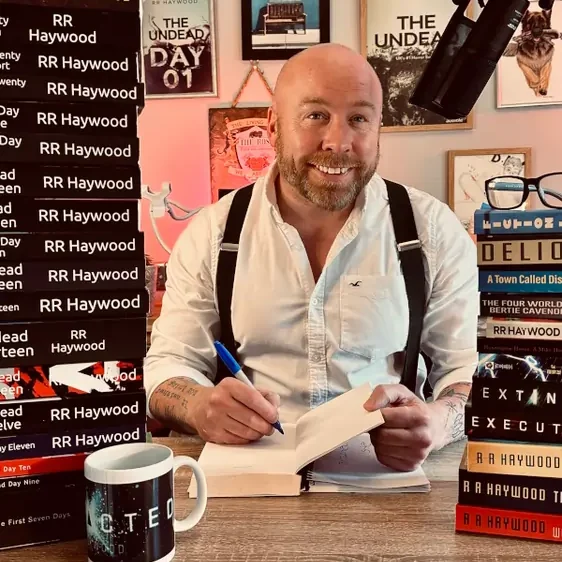
RR Haywood is one of the world’s bestselling fiction authors, known globally for his zombie and science-fiction series of books. His work, much of which was self-published, has sold millions of copies around the world, making him one of Britain’s most successful ever self-published novelists in these genres. As an Amazon “All-Star” author, RR Haywood’s books have consistently featured in the retailer’s top 100 sales chart since 2017. He has had 30 Kindle Bestsellers and is a Washington Post, Wall St Journal, Amazon & Audible bestselling author. His books Fiction Land and DELIO were nominated for the best audio book at The British Book Awards and won the Discover Sci-Fi Best New Book 2023 respectively. His latest novel, GASLIT, is a dark noir thriller about an ex-policeman manipulated into a murder plot.
Main image: Courtesy,Telesolutionscallcentr/Pixabay