A new report says Britain’s clean energy and climate-related economy is now a major industrial force, with higher wages, stronger productivity and a £455bn investment pipeline
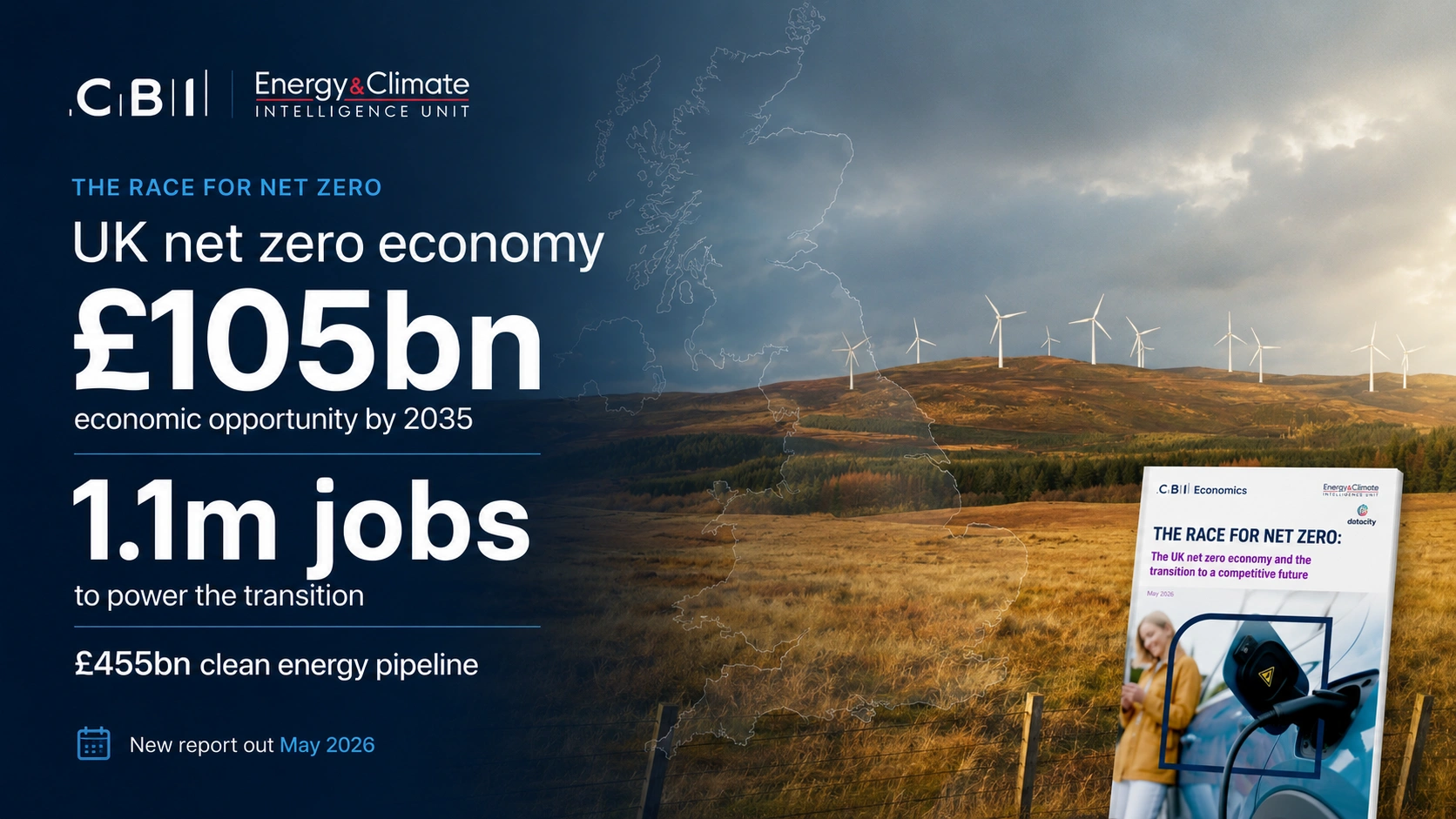
Britain’s net zero economy is now worth £105bn a year and supports 1.1m jobs, according to a new report that says clean energy and climate-related businesses have become a major part of the UK’s industrial base.
The study by CBI Economics says the sector is now embedded across energy, manufacturing, construction, professional services, finance and supply chains.
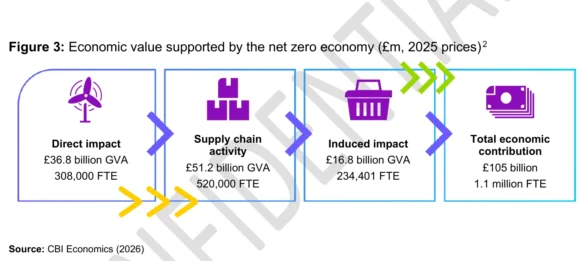
Net zero businesses directly generated £36.7bn in gross value added and supported 308,000 full-time equivalent jobs in 2025. A further £51.2bn was generated through supply chains and £16.8bn through wider economic activity linked to worker spending.
The report puts the sector’s total contribution at £104.7bn, equal to 3.8 per cent of the UK economy.
It says the net zero economy now supports as many jobs as financial and insurance services, and nearly half the number directly employed by the construction sector.
For every £1 generated directly by net zero businesses, another £1.85 is created elsewhere in the economy, according to the analysis.
The direct contribution of net zero firms is bigger than scientific research and development, valued at £29.5bn, and slightly ahead of architectural and engineering activity, valued at £36.2bn.
Direct employment in net zero businesses is also twice the number of full-time equivalent jobs supported by motor vehicle, trailer and semi-trailer manufacturing.
Louise Hellem, chief economist at the Confederation of British Industry, said: “The UK’s net zero economy is now a major part of the national industrial base.
“It supports more than a million jobs and generates over £100 billion in economic value, with activity embedded across energy, manufacturing, construction and high-value services.”
She said the transition was not being driven only by a few large projects, but by “tens of thousands of businesses, predominantly small and medium-sized firms, operating across the country”.
The report, commissioned by the Energy and Climate Intelligence Unit, the climate and energy think tank, identifies 32,500 registered net zero companies in the UK.
Its core analysis is based on 23,500 active companies with both reported turnover and at least one employee. Of those, 96.4 per cent, or about 22,700 firms, are small or medium-sized businesses.
Nearly 48 per cent of companies in the sector have been established within the past decade, while one-in-five (20 per cent) have been founded since 2020.
The report also says net zero jobs are more productive and better paid than the UK average. Jobs supported directly by net zero businesses generate £119,300 in economic value per full-time worker, about 48 per cent above the national average.
Average wages in the sector are estimated at £43,142, 11 per cent above the UK average of £39,039.
The largest part of the net zero business base is low-carbon and renewable energy generation, with 8,017 companies.
Waste management and recycling accounts for 4,441 businesses, followed by building technologies with 3,000, low-carbon consultancy, advisory and offsetting services with 2,977, and heat pumps and other renewable heating sources with 2,773.
The report says the sector’s reach now extends well beyond power generation, with activity spread through construction, transport, finance, environmental services, manufacturing and engineering.
It also identifies a renewable energy and storage pipeline of 262.3GW, requiring an estimated £455.4bn of investment. Around two-thirds of that pipeline is already active or under construction.
Battery storage accounts for the largest share, at 129.7GW, followed by offshore wind at 47.9GW, solar photovoltaics at 44.5GW and onshore wind at 22.9GW. A further 9.7GW is linked to pumped storage hydro, with smaller pipelines for hydrogen and energy-from-waste projects.
Hellem said: “This transformation is being underpinned by a substantial pipeline of investment.”
She cited large-scale offshore wind projects such as Dogger Bank and Berwick Bank, grid-scale battery storage in Yorkshire, and hydrogen and industrial decarbonisation schemes in industrial heartlands.
The report says electricity transmission will be critical to turning the pipeline into working projects, with £56bn of planned transmission investment over the next five years.
But it warns that new grid capacity is needed to connect low-carbon generation, particularly offshore wind, to centres of demand and to prevent network bottlenecks.
The economic footprint is spread across the UK, with London boasting the largest number of registered net zero businesses, at 8,948, followed by the South East with 7,436. The South West has 5,270, the North West 5,048, Scotland 5,044 and the East of England 5,043.
But net zero activity has its strongest relative economic importance in industrial and energy-focused regions contributing to 4.9 per cent of regional economic output in Scotland, 4.4 per cent in Yorkshire and the Humber, 4.3 per cent in Wales and 4.1 per cent in the East Midlands. Scotland also has the largest infrastructure pipeline, with 70.5GW of capacity, supported by offshore wind, hydrogen and energy storage.
Pete Chalkley, director of the Energy and Climate Intelligence Unit, said the economic growth, energy security and climate effort behind the transition are underpinned by “over a million UK workers and more than 20,000 small businesses”.
He described them as “the unsung heroes of the net zero economy”.
“There should be great pride in the communities right across the country, from Hull to the Central Belt and Manchester, in the importance of the work they do in driving towards net zero,” Chalkley added.
The report links the sector’s growth to wider questions over energy security and competitiveness, saying recent geopolitical volatility has highlighted the UK’s exposure to international oil and gas markets. The shift to more domestically generated low-carbon energy could, it argues, reduce exposure to external price shocks, while creating high-productivity jobs and investment across the regions.
But the report also warns that the opportunity is not guaranteed.
Hellem said: “High electricity costs and wider competitiveness pressures risk slowing progress at a critical moment.”
She added: “The politics of net zero may be fragmenting, but the economic case has never been clearer.”
READ MORE: UK organisations show rising net zero ambition despite financial pressures, new survey finds. Half of UK firms now formally committed to carbon neutrality as leadership engagement and staff participation strengthen.
Do you have news to share or expertise to contribute? The European welcomes insights from business leaders and sector specialists. Get in touch with our editorial team to find out more.
Main image: Britain’s net zero economy now generates £105bn a year and supports 1.1 million jobs, according to a report by CBI Economics and the Energy & Climate Intelligence Unit, which also highlights a £455bn clean energy pipeline. Credit: Graphic created by Belters News using a background photo by Peechie247 via Pexels, with report imagery and branding from CBI Economics and the Energy & Climate Intelligence Unit.