New reports published today lay bare the accelerating loss of ice across the Hindu Kush Himalaya, where glaciers are retreating at increasing speed in a region critical to the water security of nearly two billion people. Here, our editor-at-large Stanley Johnson, drawing on his long career as an environmentalist and ahead of the 30 March re-release of his book In the Footsteps of Marco Polo, reflects on changes to a mountain system whose fate matters far beyond the high Pamirs
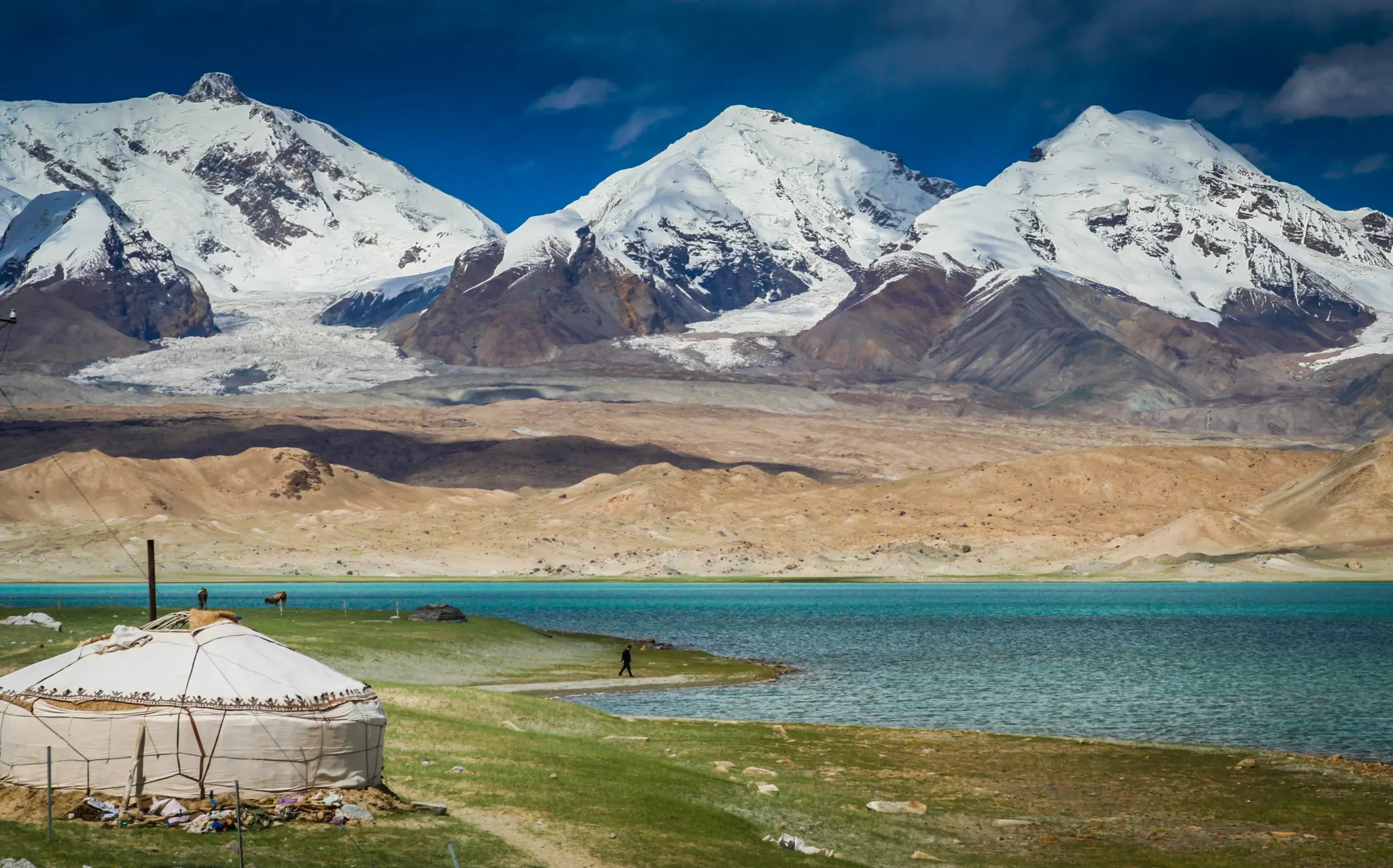
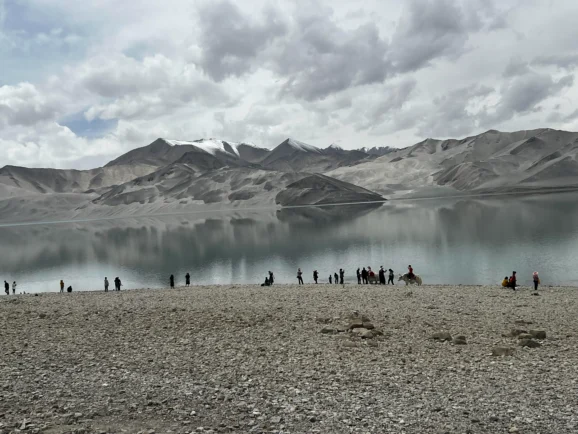
At 7,546 metres Muztagh Ata is one of three highest mountains in the Eastern Pamir/Kunlun range which forms the northern edge of the Tibetan plateau. Although Eric Shipton, then Britain’s Consul-General in Kashgar, tried to reach the summit in 1947 and got as far as the summit dome, Muztagh Ata was not conquered until a Chinese expedition reached the top in 1956.
There are fewer than 50 mountains over 7,500 metres high and Muztagh Ata is one of them, so for me the chance of seeing the mountain ‘up close and personal’ was too good to miss. It can take weeks to get to the base camp of Mt Everest. All we needed to do that day was to swing right off the G314 onto an unpaved road, go pass a yurt or two, and there we were, literally, already of the lower slopes of one of the great ‘seven thousanders.’
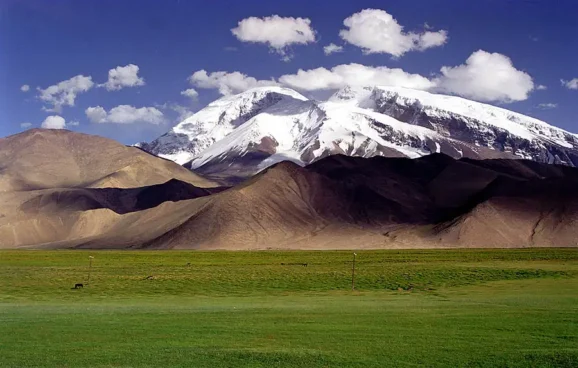
I took out my camera to take a close-up of the three almost parallel glaciers which I could clearly see had cleaved massive tracks of rock and ice down the side of the mountain which faced us. How far had those glaciers retreated? How much ice had they already lost to global warming?
This Hindu Kush-Himalaya (HKH) region, I knew, harboured more ice than anywhere else in the world outside the Arctic and Antarctica. They called it the Third Pole.
Some 250 million people live in the region, and the glaciers are a critical water store. Around 1.65 billion people rely on the great rivers that rise in these mountains and flow from the peaks into India, China, Pakistan and a half-a-dozen other nations.
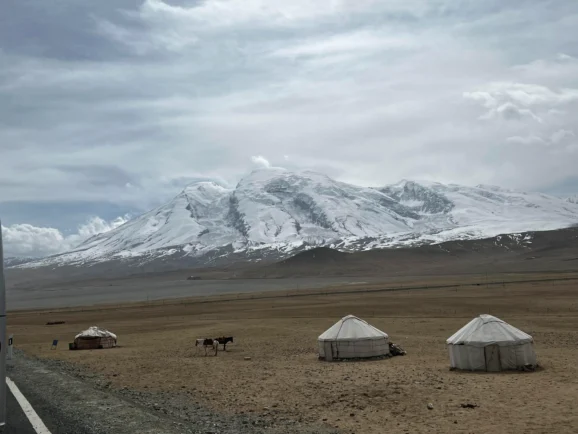
I had that first wonderful sight of the mighty Mount Muztagh Ata back in May 2023, when my son Max and I were crossing Asia in the footsteps of Marco Polo.
The memories flooded back this week when I learned that the International Centre for Integrated Mountain Development (ICIMOD) based in Kathmandu, Nepal, had just published its latest reports on the state of glaciers in the HKH region.
The reports, Changing Dynamics of Glaciers in the Hindu Kush Himalaya Region from 1990 to 2020 and HKH Glacier Outlook 2026: Insights from 50 Years of Himalayan Glacier Monitoring, provide the most comprehensive evidence yet of glacier change in the region.
Glaciers across the HKH are melting at an accelerating rate, with ice loss rates doubling since the year 2000. They reveal a total loss of up to 27 metres of ice thickness since 1975, sounding an alarm for the nearly two billion people downstream who depend on meltwater from the ‘Water Towers of Asia’.
HKH holds the largest volume of ice outside the poles, with an inventory of over 63,700 glaciers covering nearly 55,782 square kilometres. These glaciers are the source of at least 10 major Asian river systems, supporting the food, water, energy, and livelihood security of billions. However, around 78 per cent of this glacier area, located between 4,500 and 6,000 metres above sea level, is highly exposed to elevation-dependent warming.
“This isn’t a distant problem; it’s a crisis unfolding in real-time, with new disasters every summer and monsoon. The fact that ice loss rates have doubled this century should shock us all into action,” Pema Gyamtsho, Director General of ICIMOD, said. “The Hindu Kush Himalaya is at a crossroads.
“The rapidly escalating impacts we are seeing from water uncertainty to catastrophic floods underscore that we are in a critical decade for the cryosphere. We must scale up monitoring and invest in adaptation now. These aren’t blind spots becoming surprises anymore; they are our new reality.”
The comprehensive analysis reveals that between 1990 and 2020, HKH glaciers lost about 12 per cent of their total area and nine per cent of their estimated ice reserves. According to Sudan Bikash Maharjan, Remote Sensing Analyst at ICIMOD and lead author of the glacier dynamics report, the most immediate threat comes from the region’s smallest glaciers.
“Between 1990 and 2020, HKH glaciers lost about 12 per cent of their total area, but the losses are most acute for the region’s smallest glaciers—those below 0.5 km²—which are shrinking more rapidly than others,” he warned.
“This poses immediate risks of localised water shortages for high mountain communities and intensifies hazards like glacial lake outburst floods. The danger is magnified because three-quarters of the region’s glaciers fall into this vulnerable size class. We are not just losing ice; we are facing a rapid escalation of risks.”
The HKH Glacier Outlook 2026 synthesises data from 38 monitored glaciers, revealing that widespread wastage has doubled post-2000, signalling that parts of the Himalayan cryosphere may be nearing critical tipping points toward irreversible retreat. Yet the reports highlight a critical data gap: of those 38, only seven meet the global benchmark monitoring standards of the World Glacier Monitoring Service (WGMS). Major glacierised regions including the Karakoram, Sikkim, Zanskar, and Bhutan remain largely unmonitored.
Mohd Farooq Azam, a cryosphere specialist at ICIMOD and one of the report’s authors, said: “We are trying to navigate a rapidly changing future with an incomplete map.
“Large parts of the Himalaya remain blind spots. Without expanding our monitoring networks and standardising methodologies, accelerated changes in water flows and cryosphere risks could remain undetected until the impacts are severe. Sustained monitoring of representative glaciers like Mera and Rikha Samba in Nepal, and Chhota Shigri in India, is critical; they are our early warning indicators for the entire mountain system.”

The reports highlight that glacier losses are spatially skewed, with the highest percentage of area loss in the eastern Hengduan Shan mountains, where some areas lost up to 33 per cent of their glacier area in just three decades. However, the largest absolute area losses are concentrated in the Indus, Ganges, and Brahmaputra basins, where over 74 per cent of the region’s glaciers are found, underlining their critical vulnerability.
The larger glaciers above 10 km² hold nearly 40 per cent of the region’s natural water reserves. The heavily glaciated Karakoram range, home to eighteen of the twenty-five largest glaciers, remains highly vulnerable to long-term water, food, and disaster risks with ramifications for the entire region.
With 2025 designated as the International Year of Glaciers’ Preservation and the start of the Decade of Action for Cryospheric Sciences (2025–2034), these findings serve as a stark reminder of the urgent need for action. The authors call for a massive scale-up in glacier monitoring, better standardisation of methodologies, and robust investment in climate-resilient adaptation planning to mitigate the impacts of a rapidly changing cryosphere.
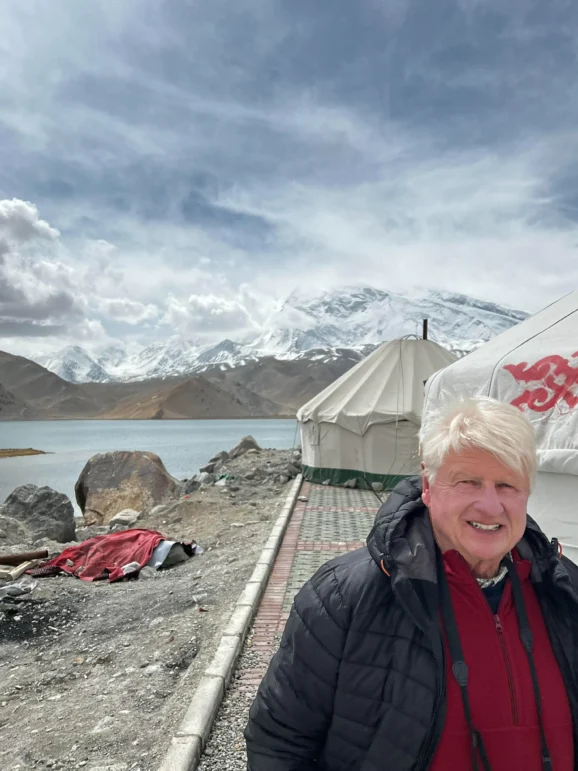
Stanley Johnson is a former Member of the European Parliament (MEP), award-winning author and long-time advocate for environmental protection and international cooperation. He served as Head of the Prevention of Pollution Division at the European Commission and played a key role in shaping early European environmental legislation on clean air, water and nature conservation.
Elected as MEP for Wight and Hampshire East in 1979, he became a leading voice on sustainability, public health and animal welfare in European policymaking. In parallel with his political career, Stanley has written more than 25 books across fiction, non-fiction and memoir, including The Commissioner and Kompromat. His work often draws on his experience in politics, development and global environmental affairs.
The new edition of his book In the Footsteps of Marco Polo is published on 30 March by Unicorn Publishing.
READ MORE: ‘The pearl of Africa: Stanley Johnson’s journey into Uganda’s wild heart‘. At 85, Stanley Johnson finally meets his mountain gorillas in Uganda’s Virunga forests — one silverback encountering another — before tracing a journey that runs from chimpanzee-filled gorges to State House in Entebbe and a one-to-one audience with Uganda’s long-serving President Yoweri Museveni.
Do you have news to share or expertise to contribute? The European welcomes insights from business leaders and sector specialists. Get in touch with our editorial team to find out more.
Main image: Shutterstock