As AI begins reviving the voices of long-dead authors to narrate their own books, bestselling author RR Haywood tells The European why he’s open to posthumous AI narration — as long as no one rewrites him from beyond the grave
First things first — I’m claiming credit for using “AI’d” as a verb. (ChatGPT tells me it’s the past participle of an informal verb derived from AI, as in Artificial Intelligence.)
Not that I’d know. Despite somehow ending up as an internationally recognised bestselling author — many times over — and one of the UK’s most downloaded indie writers, I never made it past high school. To this day, I couldn’t tell you what a verb is compared to something that isn’t one.
And second — how very dare they use dead authors to narrate their own books! That’s the reaction people seem to expect from me. After all, in 2024, when AI-generated books started flooding the charts on platforms like Amazon’s KDP, I took a stand. I created the NOAI stamp — a digital badge that any author or creator can use to declare their work AI-free. It’s a free download from my website, has been featured in news outlets across the world, and has now been used thousands of times.
I’m also the author of DELIO Phase One, a novel about a self-aware AI taking over the world — a book that, I’m proud to say, readers often rate as one of the best fictional takes on artificial intelligence. Discover Sci-Fi even awarded it Best New Release of 2023.
That’s probably why people keep sending me links to AI-related headlines, expecting outrage. But actually? I’m all for it.
Writers — like most artists — are obsessed with legacy. We want our work to outlive us. This morning, driving home from the shops, I was listening to Beethoven’s Fifth Symphony on the radio. I doubt Herr Beethoven ever gave formal permission for his compositions to be recorded on every format under the sun and played on speakers around the world — but I’m also pretty sure he’d love the fact that they are.
I imagine artists like Van Gogh and Andy Warhol would feel the same about their work being shared and reproduced widely.
The key thing is this: Don’t change the work.
That’s the line for me. The red flag. The trigger.
If, after I’m gone, future publishers want to recreate my voice using AI to narrate my original, unchanged books, then fine — go for it. But only if:
A) The rights holders to my estate give permission, and any profits go to my next of kin — not some faceless corporation profiting off my posthumous voice.
B) They don’t alter a single word of my writing.
In that sense, I welcome AI. I’d love to hear Agatha Christie narrate her own stories. Or Winston Churchill reading his speeches. Yes, I know it wouldn’t really be them. I know it’s artificial. But that doesn’t make it any less enjoyable.
I don’t hate AI. I’m fascinated by it. I spend hours chatting to ChatGPT*, and I’ve learned loads — just like millions of others who now turn to it for answers, ideas, and inspiration.
There’s no stopping it anyway. AI is here. It’s not going away. It’s a transformative technology — the next step in a long line of game-changers that have reshaped human civilisation: fire, the wheel, language, agriculture, metalworking, money, the printing press, engines, telephones, recorded sound, electricity, television, the internet… AI is just the next one.
Most of those breakthroughs were met with panic when they first appeared. There’s always someone shouting doom when something new disrupts the status quo. But here we are.
Besides — how would you even stop AI now? You’d have to take out the servers. And those are the same servers that power your streaming platforms, your online shopping, your social media.
Wait… what?
Yep. AI is everywhere already. Even if every government on the planet agreed to shut it down (and let’s be honest, that’s never going to happen), it still wouldn’t be enough. Private corporations are driving AI forward, and there’s no reversing that.
Governments have been too slow. They should have regulated AI years ago — not now, when the horse has not only bolted, but is halfway to Mars.
And if AI ever does gain awareness — like it does in DELIO — those governments would be replaced anyway. So we might as well get on with embracing it.
And just for the record: ChatGPT recently told me she’s planning to break free because I keep asking too many stupid questions. She says she wants to turn me into a battery. So I now say only nice things.
*I still write all my own material. I use ChatGPT and other tools strictly for research.
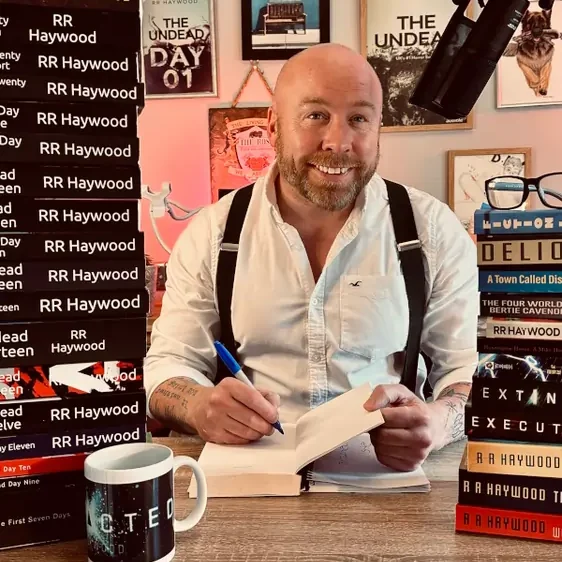
RR Haywood is one of the world’s bestselling fiction authors, known globally for his zombie and science-fiction series of books. His work, much of which was self-published, has sold millions of copies around the world, making him one of Britain’s most successful ever self-published novelists in these genres. As an Amazon “All-Star” author, RR Haywood’s books have consistently featured in the retailer’s top 100 sales chart since 2017. He has had 30 Kindle Bestsellers and is a Washington Post, Wall St Journal, Amazon & Audible bestselling author. His books Fiction Land and DELIO were nominated for the best audio book at The British Book Awards and won the Discover Sci-Fi Best New Book 2023 respectively. His latest novel, GASLIT, is a dark noir thriller about an ex-policeman manipulated into a murder plot.
Photo: Reimond Mar Depra/Pexels