
From the sacred palaces and monasteries of Lhasa to the glaciers of the Tibetan plateau and the snowy slopes of Mount Everest, Stanley Johnson fulfils a lifelong ambition to visit Tibet. Inspired by Heinrich Harrer’s Seven Years in Tibet, which captivated him as a teenager, and researching his upcoming new book, The Third Pole, he embarks on a seven-day journey through the Himalayas that culminates in an unforgettable encounter with the world’s highest mountain
For years I have wanted to visit Tibet. As a teenager back in the ‘fifties, I was enthralled, as so many were, by Heinrich Harrer’s account of his Seven Years in Tibet. Six decades later, when I was confined by Covid rules to my room on the top floor of the Serengeti Hotel in Chengdu, it was some consolation to have a glimpse of Tibet’s distant mountain peaks.
On that occasion, I was, together with my son Max, following in the footsteps of Marco Polo across China. Even if we had been able to organise it, a detour to Tibet would not have made sense. Marco Polo’s route took him (and eventually us) on a more northerly route down from the High Pamirs, across the Gobi Desert, the Yellow River and the Mongolian Steppes, before reaching Xanadu, Summer Palace of the great Mughal Emperor, Kubla Khan.
It is a journey I have described in my recently published book, In the Footsteps of Marco Polo, which I have also written about for The European.
Earlier this summer, a new, more plausible opportunity to visit Tibet arose. I found myself, at some social occasion in London, talking to John Coles, who runs Kew Bridge Travel. I mentioned en passant that I was thinking of writing another book, to be called The Third Pole. He was a travel agent. Could he help?
“The Third Pole? Where’s that?” John asked. “I know about the North Pole and the South Pole. But what’s the Third Pole?”
I explained that I had only recently come across the term.
“The astonishing thing,” I explained, “is that, outside of the North Pole and the South Pole, the largest accumulation of ice in the world is up there in the Himalaya–Hindu Kush region. They call it the Water Tower of Asia too. The sources of Asia’s greatest river systems – the Ganges, the Indus, the Amu Darya, the Salween, the Brahmaputra, the Mekong, the Yangtze and Yellow Rivers, the Irrawaddy and so on – are to be found on the Tibetan plateau. Those rivers supply water to over two billion people.”
A few days later, I met John for lunch. He had obviously done some research.
“I know it looks a long way round,” he said, “but it may be best to fly to Beijing first. Change planes there and fly on to Lhasa. Spend a day or two there seeing the sights. Then you can head west onto the plateau, if that’s what you want.”
It was indeed what I wanted. Famous explorers of the past had made their names tracking the sources of the world’s great rivers. Henry Morton Stanley, for example, became famous not only for finding the missing missionary David Livingstone in Africa but also for tracing the course of the Congo River. On the Tibetan plateau, the precise location of the headwaters of at least two of Asia’s great rivers had, even now, not been discovered.
“I’m not called Stanley for nothing,” I said.
Six weeks later, I found myself being welcomed at Lhasa Airport by two representatives of Tibet Vista, Kew Bridge Travel’s local collaborator.
The next morning, on the bus we were to use for the duration of our trip, I met my fellow travellers for the first time – five Americans, one Irish, two British and one Dutch.
Having arrived in Lhasa by various routes and at different times before me, my fellow travellers had already set up a WhatsApp group, which I was invited to join.
Tashi, our Tibetan guide and group leader, had a splendid grasp of English. He kept us to a tight schedule. He needed to. Our itinerary specified that, on this six-night journey from Lhasa to the border with Nepal, we had some very important calls to make.
Top of the list was the Potala Palace, Lhasa’s cardinal landmark and home to every Dalai Lama from the fifth to the 14th.
When, the next morning, we reached the Potala’s entrance, the rest of the group, armed with their passports, were checked through. But the guard held me back.
“Passport, passport!” he said.
I patted my pockets in search of my passport, only to realise I had left it at the hotel, much to my embarrassment as I was now holding up the queue.
Another guard came over.
“If you haven’t got your passport, what about your driving licence? Don’t you have a driving licence?”
“I left my passport in the hotel and my driving licence too.”
I fished in my wallet again, just in case the driving licence was there. It wasn’t. But I found a single passport-size photo which had obviously been surplus to requirements on some previous occasion.
“You can see that’s me,” I protested, pointing at the photo. “It’s definitely my passport photo.”
“But where is the passport?”
In the end, they let me through, but it was a close call.
That morning, before we left the hotel, I had checked what UNESCO had to say about the Potala, one of the several ‘cultural’ sites in China listed under the World Heritage Convention.
This is what I found.
“Enclosed within massive walls, gates and turrets built of rammed earth and stone the White and Red Palaces and ancillary buildings of the Potala Palace rise from Red Mountain in the centre of Lhasa Valley at an altitude of 3,700 metres. As the winter palace of the Dalai Lama from the 7th century CE the complex symbolizes Tibetan Buddhism and its central role in the traditional administration of Tibet. The White Palace contains the main ceremonial hall with the throne of the Dalai Lama, and his private rooms and audience hall are on the uppermost level. The palace contains 698 murals, almost 10,000 painted scrolls, numerous sculptures, carpets, canopies, curtains, porcelain, jade, and fine objects of gold and silver, as well as a large collection of sutras and important historical documents.”
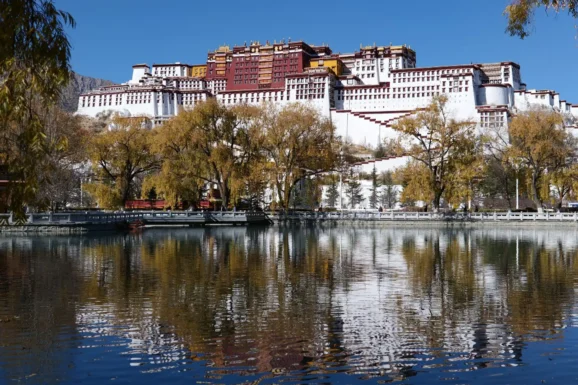
UNESCO also offered a splendid photo.
We spent most of the morning at the Potala Palace, climbing to the very top. In the Red Palace, we visited the Chapel of Three-Dimensional Mandalas, the Chapel of the Victory over the Three Worlds and the Chapel of Immortal Happiness. In the White Palace, we visited the private quarters of the 13th and 14th Dalai Lamas.
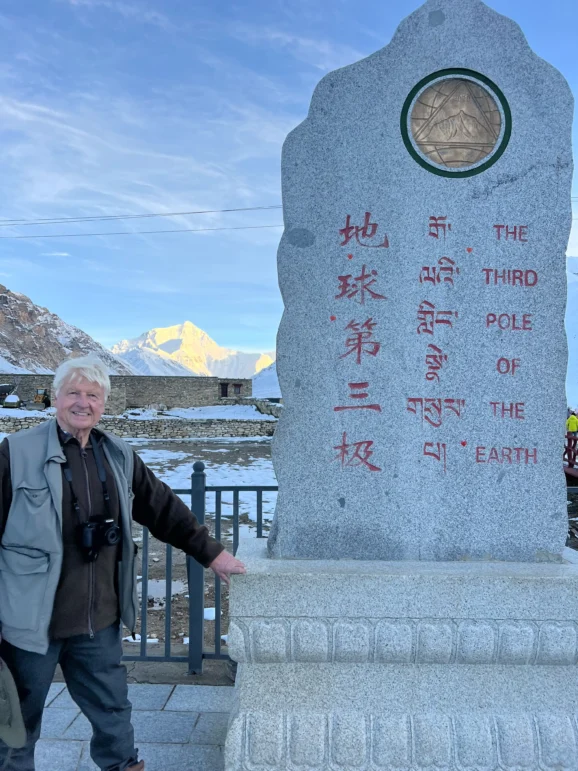
Base Camp, with Mount Everest visible in the distance. The encounter provided a
fitting conclusion to his journey and inspiration for his proposed book, The Third
Pole. Credit: Stanley Johnson.
We saw the murals, the scrolls, the sculptures and the statues. No wonder UNESCO has designated the Potala as a World Heritage Site. By the end of the morning, I felt totally overwhelmed.
Our group, of course, was just one of many. A large number of those who, like us, climbed the steps to the very top of the Palace that day would have come from other towns and regions of China. There were also many visitors – including Buddhist Tibetans, arriving singly or in groups – for whom visiting the Potala Palace was clearly much more than a sightseeing event. Most came with offerings of some kind. Small-denomination banknotes, for example. Others prostrated themselves once, twice, even three times, before moving on.
The flame of faith still seemed to me to be burning brightly.
The next day, we went to Lhasa’s Drepung and Sera monasteries. Tashi briefed us on the bus.
“Founded in 1416, Drepung was the largest monastery in the world. There were 10,000 monks here once.”
We learned that around 400 remain today.
We followed the pilgrims’ route through a cluster of colleges and chapels to the Ganden Podrang, established in 1530 by the second Dalai Lama.
This was where he and subsequent Dalai Lamas lived until the fifth built the Potala. It was also where those early Dalai Lamas exercised political as well as religious control over central Tibet. The second, third and fourth Dalai Lamas are all entombed here.
Our itinerary advertised an opportunity to “watch a monks’ debate” in the afternoon, with a 2pm start. Our little group, together with another hundred or so spectators, gathered around an open square in the courtyard of one of the buildings.
The monks – at least a hundred, I would say – sat on the ground in front of us in pairs facing each other, waiting for a tall, bald, purple-robed figure (the abbot?) to ring the bell.
We couldn’t follow much, but they seemed to go at it hammer and tongs, each man giving as good as he got. Typically, one monk sat on the ground while the other stood by and harangued him. Then they swapped places for the next bout.
The following morning, we left Lhasa early to head west over the Tibetan plateau. As we drove out of Lhasa, we crossed a great swirling river.
Tashi, sitting at the front of the bus with the microphone, told us: “We are now crossing the Yarlung Tsangpo river.”
Sitting halfway back on the bus and without a microphone of my own, I called out to Tashi: “Is that the Brahmaputra?”
“Yes. That’s what they call it when it flows through India later on.”
“Where’s the source?”
“Up near Mt Kailash.”
I sat back in my seat. What a pity we weren’t going to Mount Kailash, I thought.
I knew Kailash was the holiest of all Tibetan mountains, possibly the holiest mountain in the world. Hindus, Buddhists and Jains come from all over the world to undertake the Kora, the pilgrims’ walk around the base of the mountain. Much as I would have liked to follow in their footsteps, our itinerary simply did not allow enough time. The pilgrimage takes a minimum of three days, and considerably longer for those who, as some do, stop every few yards to prostrate themselves.
Around 11am, we stopped for a break at Khamba-la Pass (4,795m), home to – as we saw from the sign – the ‘Heavenly Xizang-themed Post Office’, apparently the world’s highest post office.
Then we zigzagged down to a shimmering turquoise lake – Yamdrok-tso – one of Tibet’s four holy lakes.
Next stop was the Karola Glacier. Located 200 kilometres southwest of Lhasa, at 5,560 metres above sea level, Karola Glacier one of the most accessible and impressive glaciers in Tibet. With climate change, it is retreating 20 metres a year.
That afternoon, the weather seemed to have taken a turn for the worse. I buttoned up my coat and trudged uphill with my camera to capture a rather grim, menacing image of the ice flow.
Tashi was worried about the weather for more practical reasons. On his mobile, he was getting weather reports from Everest. Apparently, the clouds were thick and threatening to obscure the summit and much of the mountain itself.
If Tashi was worried, so were we. He had had plenty of chances in the past to see Mount Everest – Qomolangma – in all its glory. But as far as we were concerned, this was a one-off opportunity.
We spent the night in a hotel in Shigatse.
The next morning, at breakfast, I met a disappointed American on his way back to Lhasa.
“God-darnit,” he said, “we waited all day, but the damn clouds didn’t lift. Couldn’t see a thing.”
I hadn’t realised, until that American spoke to me that morning, just how much I was counting on seeing Mt Everest. I’m not sure I have ever really had a ‘bucket list’. But now the prize was there to be grasped, I suddenly realised how much I wanted it.
What would the weather be like tomorrow? Would the clouds have lifted? If the clouds did lift, would we be in the right place at the right time?
We spent the next morning visiting Shigatse’s Tashilhumpo Monastery. It was founded in 1447 and is one of the few monasteries in Tibet to survive China’s Cultural Revolution relatively unscathed.
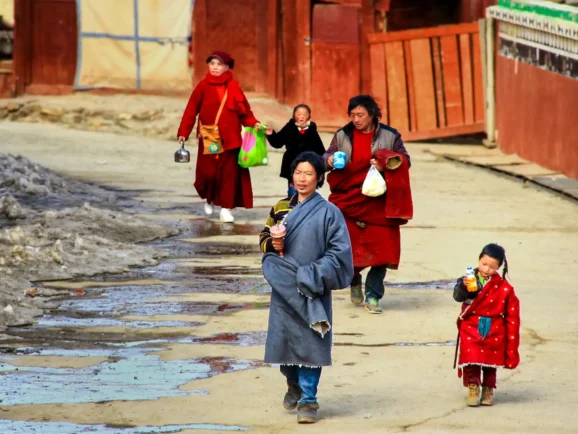
Today, Tashilhumpo, with 950 monks, is the largest functioning religious institution in Tibet. We ambled through the cobbled lanes and buildings, observing at close quarters the comings and goings of the monks.
In the Chapel of Jampa, we gazed in awe at the 26-metre-high figure of Jampa, the Future Buddha.
Tashi, always a mine of information, told us it was made in 1914 under the auspices of the ninth Panchen Lama and took some 900 artisans and labourers four years to complete.
We were not allowed to take photos inside the Chapel, but craning my neck to see the Future Buddha’s head hovering above us, I was absolutely ready to believe Tashi when he said, “this is the tallest Sitting Buddha in the world.”
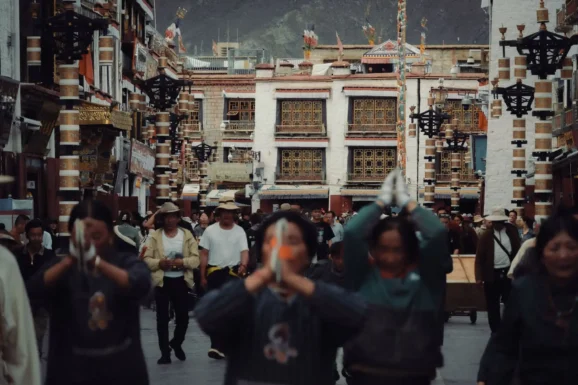
That day, September 27, was a religious festival. When we emerged from the Monastery, the streets of Shigatse had filled up with pilgrims and penitents, many of them performing ritual prostrations as they made their way along the sacred path.
As we left the town, I checked my phone. Shigatse appeared to be 350km from Everest. What if night had fallen by the time we got there?
Buses can’t go all the way up to Everest Base Camp. You have to take the camp’s own transport. Transferring people and bags from one kind of vehicle to another takes time. It always does.
When we finally got to camp, some of us jumped down from the van and ran across the packed snow to the vantage point.
Ahead of us, Mt Everest, seeming unbelievably close, gleamed like burnished gold in the late evening light.
This was indeed the glorious sunset which we had hoped to see. A few minutes later and we would have missed it.
A marker stone had been erected at the vantage point. I walked over to it and read the inscription, which helpfully was in English as well as Tibetan and Mandarin Chinese.
I don’t know for sure what the Tibetan or Chinese inscriptions said, but the English version could not have been clearer.
The bold red letters proudly proclaimed that we were at that very moment standing at:
THE THIRD POLE OF THE EARTH!
That night, from my bunk in Everest Base Camp (altitude 5,000m), I sent a photo to John Coles and got a message back.
“You’ve got the cover photo for your book, haven’t you?” he wrote.
Stanley Johnson travelled to Tibet with Kew Bridge Travel, an independent travel adviser and tour organiser, and its local partner, Tibet Vista, which has been organising tours in the region since 1984. His seven-day journey took him from Lhasa across the Tibetan plateau to Mount Everest Base Camp, following part of Tibet Vista’s Lhasa-to-Kathmandu itinerary. Stanley funded his own trip, with Kew Bridge Travel arranging the journey and Tibet Vista handling the arrangements on the ground.
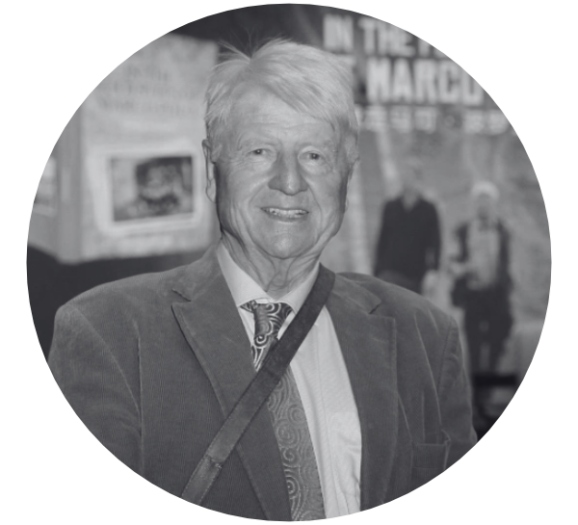
Stanley Johnson is a former Member of the European Parliament (MEP), award-winning author and long-time advocate for environmental protection and international cooperation. He served as Head of the Prevention of Pollution Division at the European Commission and played a key role in shaping early European environmental legislation on clean air, water and nature conservation.
Elected as MEP for Wight and Hampshire East in 1979, he became a leading voice on sustainability, public health and animal welfare in European policymaking. In parallel with his political career, Stanley has written more than 25 books across fiction, non-fiction and memoir, including The Commissioner and Kompromat. His work often draws on his experience in politics, development and global environmental affairs.
READ MORE: Why the UK’s reset with Europe could and must involve environmental co-operation. If Ukraine can join Europe’s environmental network in the middle of a war, the UK should return to the system it helped create – and should never have left.
Do you have news to share or expertise to contribute? The European welcomes insights from business leaders and sector specialists. Get in touch with our editorial team to find out more.
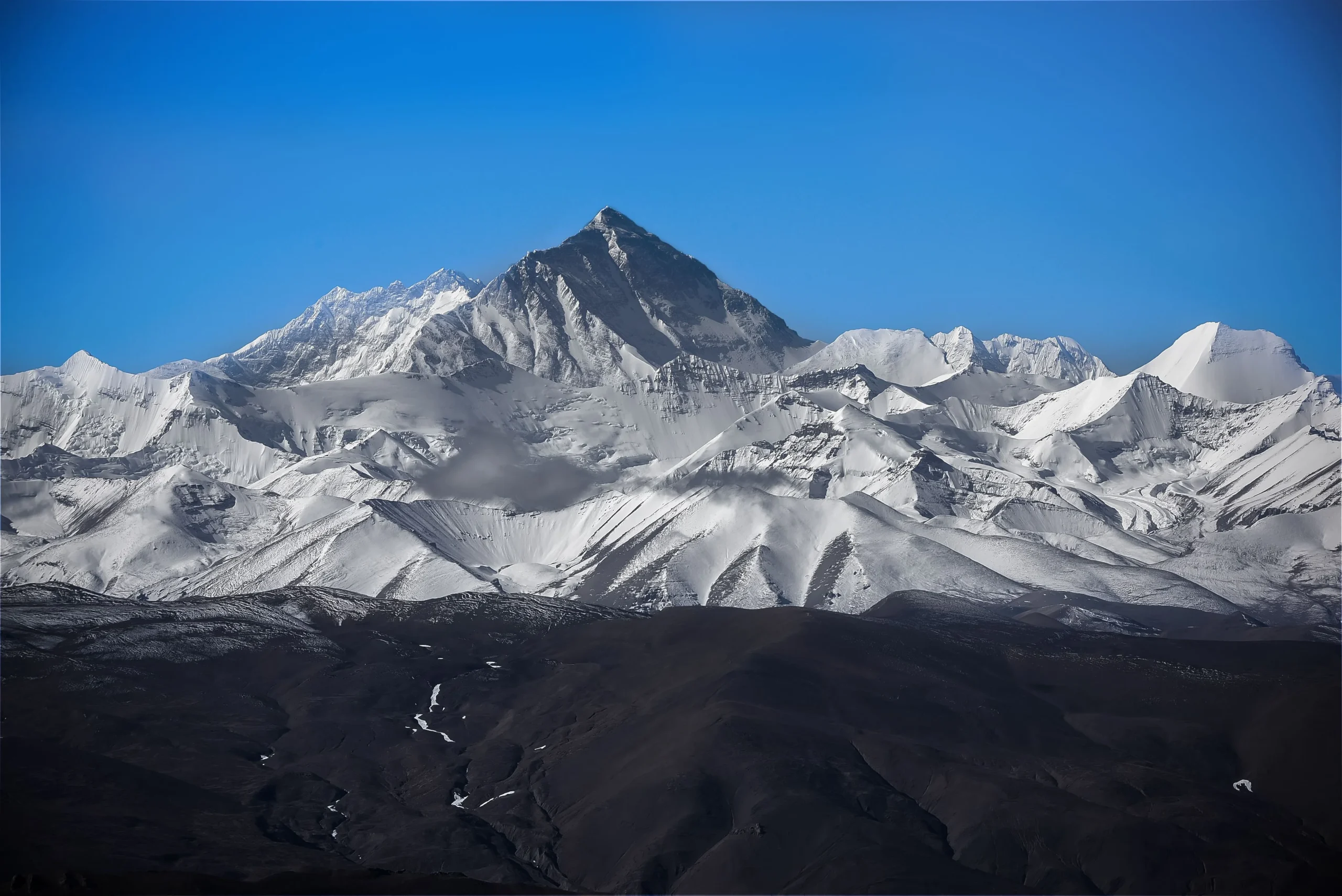
Main image: Mount Everest rises above the snow-covered peaks of the Himalayas, its towering summit dominating the landscape along the Tibetan border. Credit: zhou shen via Pexels