From communist-era bunkers and remote mountain villages to gin distilleries, wartime memorials and one of Europe’s last free-flowing rivers, Mark G Whitchurch explores Albania’s rugged interior behind the wheel of the latest Mazda CX-30
Ten hours, 560 kilometres and a route taking in everything from mountain passes and isolated villages to one of Europe’s last great wild rivers. Exploring Albania by road is an opportunity to discover a country whose spectacular interior remains less familiar to visitors than its increasingly popular Adriatic and Ionian coastlines.
Our journey began in Tirana, where Mazda UK had assembled a group of motoring journalists for its 2026 Epic Drive, a demanding circular route through central and southern Albania in the updated CX-30 crossover.
The itinerary promised motorways, rough mountain roads, river crossings, deep gorges and settlements far from the country’s main tourist centres. It would also provide an extended test of the Mazda’s handling, comfort and performance across some of the most varied terrain in the Balkans.
Albania, roughly the size of Belgium and home to around 2.3 million people, borders Montenegro, Kosovo, North Macedonia and Greece. Its position between the Adriatic and Ionian seas has made it a crossroads of competing empires and political interests for centuries.
The country declared independence from the Ottoman Empire in 1912 and endured occupation during the Second World War. It subsequently spent almost half a century under Enver Hoxha, whose communist dictatorship turned Albania into one of Europe’s most isolated states.
Foreign travel was severely restricted, contact with the outside world was limited and hundreds of thousands of concrete bunkers were constructed across the country in anticipation of foreign invasion.
The collapse of communism in 1991 began Albania’s gradual opening to the outside world. Today, it is a candidate for European Union membership, with tourism playing an increasingly important role in its development.
Many visitors head for the beaches and coastal resorts. Our route would take us towards the mountainous interior where agriculture, small settlements and the country’s turbulent history remain prominent features of the landscape.
Out of Tirana and into the mountains
Tirana itself offers plenty of evidence of Albania’s changing fortunes. Colourful apartment buildings sit alongside Ottoman mosques, communist-era monuments and contemporary cafés, with the city’s younger population contributing to a busy street and coffee culture.
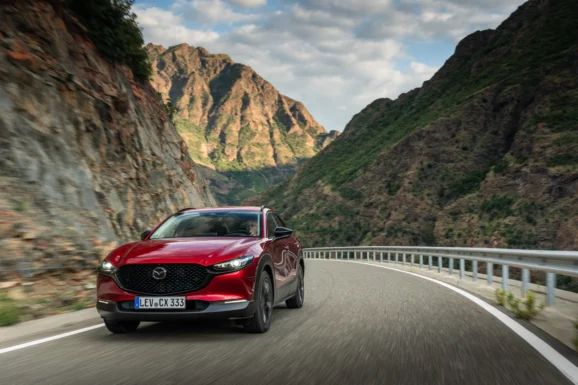
The day’s drive began outside our hotel, where the keys to the updated Mazda CX-30 were handed over before our convoy departed towards Elbasan.
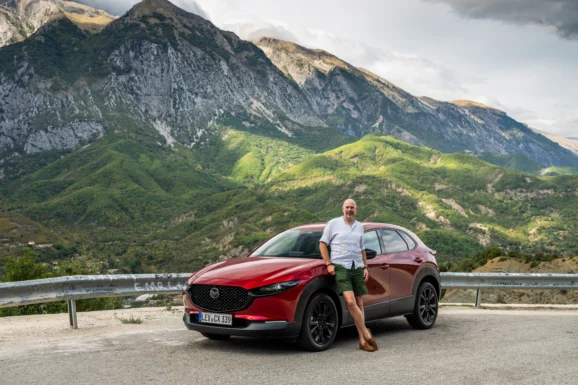
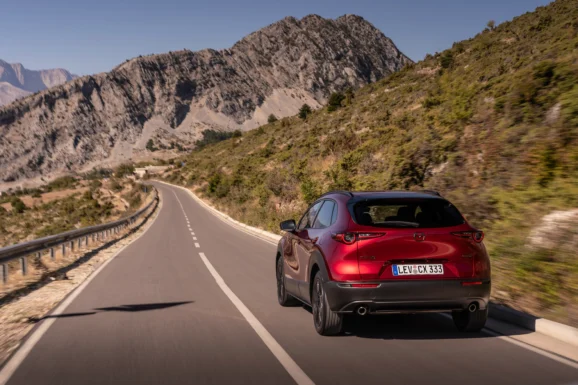
The latest changes to the crossover include black exterior detailing in place of some chrome trim, revised LED lighting signatures and new colours and materials across the available trim levels.
Christian Schulze, of Mazda’s R&D Centre Europe, who accompanied us on the trip, explained the thinking behind the exterior changes during our visit.
“On the exterior we’ve changed a number of chrome elements to black, which creates a much stronger contrast and a more unified appearance. The front mask becomes more prominent and gives the vehicle a sportier character.”
He also pointed to the revised lighting and a new green paint finish, which joins Mazda’s existing colour range.
“This new green is different. It is elegant and expressive. It has a richness that makes it a real eye-catcher without becoming overly aggressive.”
The exterior revisions are relatively modest, with the principal interest for our journey lying in how the car would perform over a full day on the road.
Leaving the capital, the traffic gradually thinned and modern highways gave way to roads requiring more attention.
Travelling south through Fier and towards Tepelenë, the terrain became increasingly mountainous. Villages occupied the hillsides, older farmhouses appeared beside more recent buildings and occasional concrete bunkers provided reminders of the country’s communist past.
The roads themselves varied considerably; wide, smooth sections encouraged steady progress, followed by patched tarmac, uneven surfaces and increasingly frequent bends as we headed into the hills.
The CX-30’s suspension proved well suited to these changing conditions. It absorbed larger compressions and rougher sections without the body becoming excessively unsettled, and maintained reasonable composure through bends taken on imperfect surfaces.
According to Schulze, Mazda has deliberately avoided relying on electronically adaptive suspension systems to achieve the balance between ride comfort and handling.
“The answer is that if you understand the entire vehicle and tune it correctly from the beginning, you can achieve an excellent balance without necessarily adding more complexity.”
He said tyres are fundamental to the process, with different suspension and tyre combinations developed for individual markets.
“In fact, we don’t use one global set-up. Europe, America and Japan all receive dedicated tuning because road conditions and customer expectations differ significantly.”
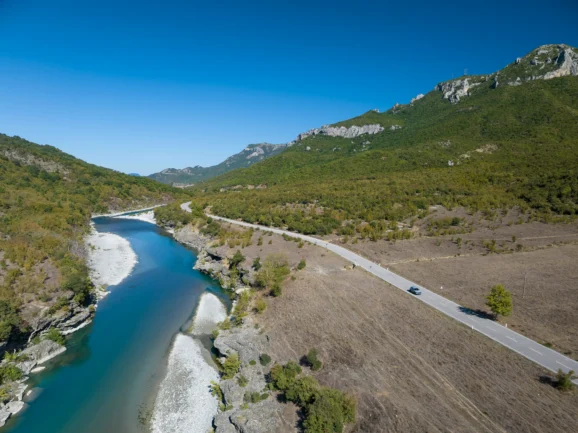
Following the Vjosa
One of the principal attractions of the route was the Vjosa River, which begins in Greece’s Pindus Mountains, where it is known as the Aoös, before flowing through Albania towards the Adriatic Sea.
The river runs for approximately 272 kilometres and is regarded as one of Europe’s last major free-flowing waterways, having escaped the extensive damming and regulation that has altered the course of many other European rivers.
In March 2023, the Albanian government designated the Vjosa and its river system as a Wild River National Park, giving additional protection to its waters, tributaries and surrounding habitats.
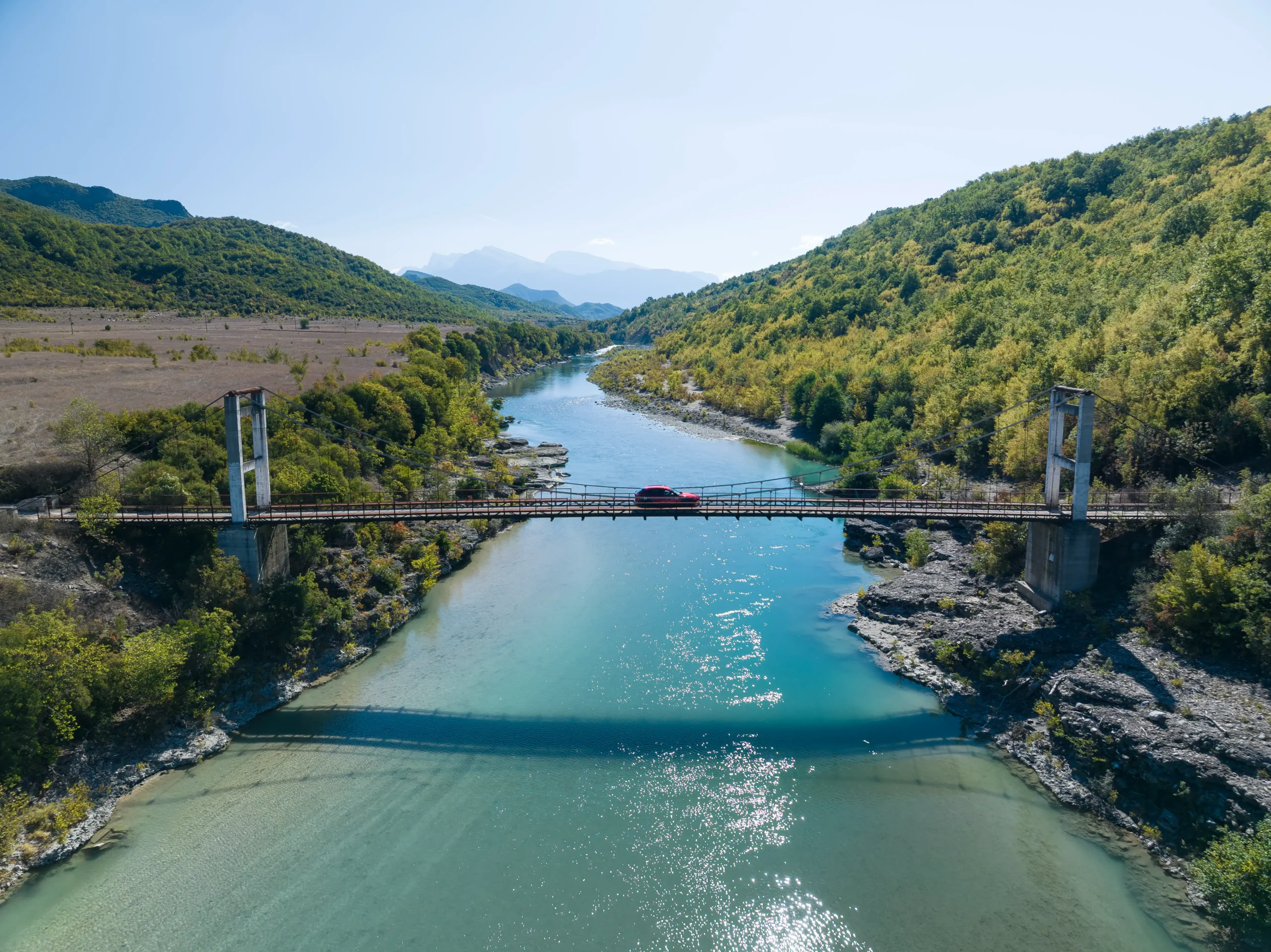
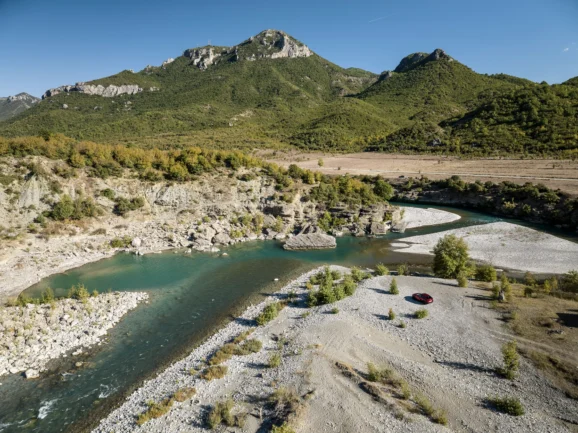
Following the river upstream, we left the principal highway for narrower roads running alongside its turquoise waters.
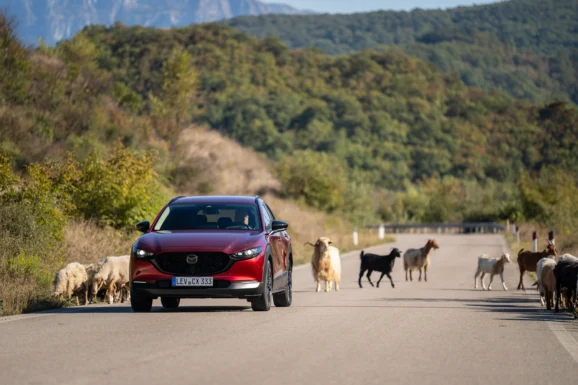
Iron bridges carried us across the Vjosa and its tributaries, some offering little more width than the car itself. Below, white-water rafting groups negotiated the rapids, while shepherds moved goats and sheep along roads where passing traffic was often sparse.
The scenery changed repeatedly as we followed the water through the valley. Steep gorges opened into broad channels divided by gravel banks, forested mountains rose above the river and small settlements appeared on distant ridgelines.
The Vjosa’s relatively unregulated flow allows its channels, gravel banks and floodplains to change naturally with water levels. The river has considerable ecological importance, supporting habitats and communities whose lives have long been shaped by its course.
The surrounding countryside remains heavily agricultural, with olive groves, vineyards and small farms occupying the lower slopes, and flocks of sheep grazing against a backdrop of mountains extending towards the Greek border.
For communities historically separated by difficult terrain and, for much of the 20th century, political isolation, agriculture has been an important source of livelihood.
Our journey offered occasional glimpses of this rural life, from farmers working small plots to livestock being moved along the roads.
The driving also became more demanding. Fast, sweeping bends gave way to tighter corners, uneven surfaces and sections where the road climbed and descended without much warning.
Over several hours, the Mazda handled these conditions consistently. Sharp surface imperfections were generally absorbed without disturbing the vehicle’s line, and its body control made the succession of bends less tiring than might have been expected.
Lunch and local spirits in Leskovik
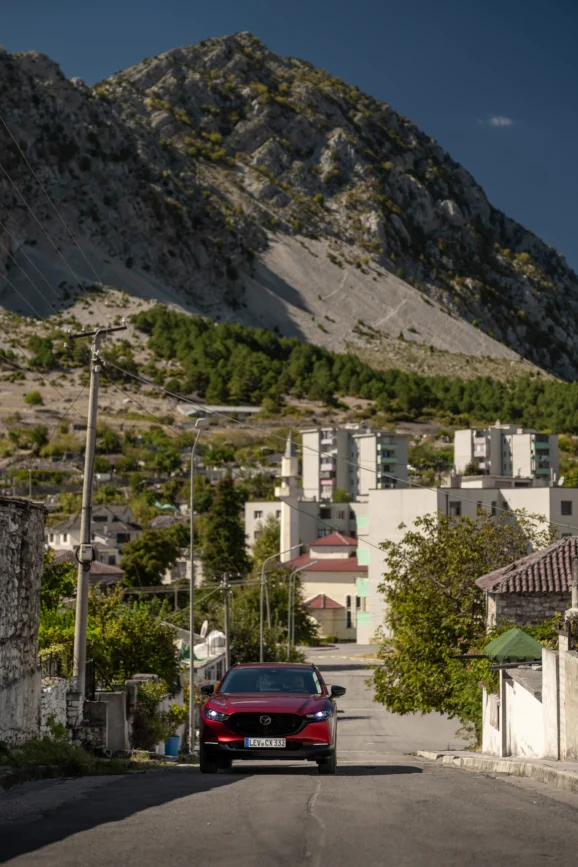
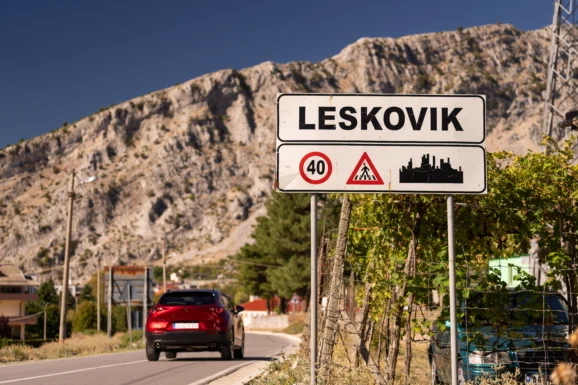
After several hours travelling upstream, we reached Leskovik, a small mountain town near the Greek border, beneath Mount Melesin.
The town and its surrounding countryside have a long association with agriculture and winemaking. More recently, one local enterprise has attracted attention well beyond Albania.
Melesin Distillery, which opened in 2023, was named among TIME magazine’s World’s Greatest Places in 2024. Combining a distillery, restaurant and boutique hotel, it has become a destination for visitors exploring this part of southern Albania.
Inside, copper stills stand among stone walls and timber beams. The business produces spirits including gin and raki using local ingredients, drawing on a regional tradition of wine and spirit production.
Lunch – meatballs, which were divine – provided an opportunity to compare impressions of the cars. One feature attracting favourable comments was the seating, which had provided good support during a morning spent negotiating roads of widely varying quality.
The cushioning, bolstering and driving position had all contributed to a comfortable journey so far. Seat design can be difficult to assess properly during a brief test drive, making a full day on the road a more useful measure.
Schulze said his preferred CX-30 interior was the Makoto specification, particularly its light-coloured cabin and fabric upholstery.
“Besides looking good, it gives excellent body support. When you’re driving on twisting roads, you’re held comfortably in place without sliding around in the seat.”
He also discussed seat ventilation, which he said could make a considerable difference during prolonged journeys in hot weather.
“On a hot day, the seat cooling actually works faster than the air conditioning because it cools your body directly.”
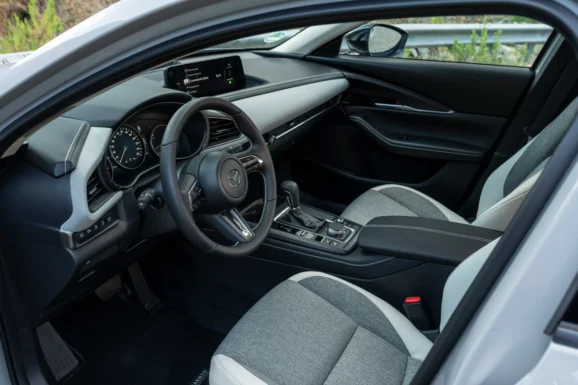
For Leskovik, businesses such as Melesin also illustrate how tourism is developing beyond the coastal resorts, with hospitality and locally produced food and drink helping to attract visitors to smaller inland communities.
The wartime history of Albania’s valleys
Leaving Leskovik, we continued through countryside where the remains of Albania’s wartime and communist history were never particularly far away.
Among the places encountered was a memorial to a Second World War engagement involving Albanian partisan fighters and German forces.
Its inscription records an attack carried out by members of the Çamëria Partisan Battalion, supported by approximately 300 volunteers from Kolonjë, Leskovik, Dangëlli, Panarit and Vithkuq.
According to the memorial, 60 German soldiers were killed in the fighting. It was a reminder that the valleys now attracting visitors for their scenery and driving routes were once the setting for armed resistance and military operations.
Elsewhere, concrete bunkers appeared beside roads and across the countryside. Other memorials stood in isolated locations, and the buildings of towns and villages reflected successive periods of political and economic change.
These were brief encounters with a complicated history, though they added considerably to the experience of crossing the country by road.
A different kind of driving test
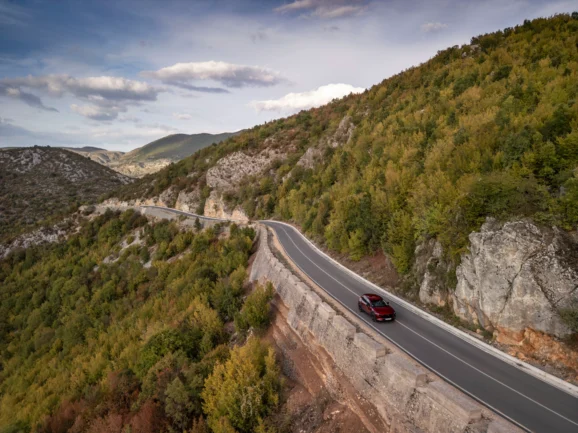
As we travelled farther into the mountains, the roads became more demanding. Limestone cliffs rose beside the carriageway, wooded slopes covered the surrounding hills and deep valleys opened up beyond the bends.
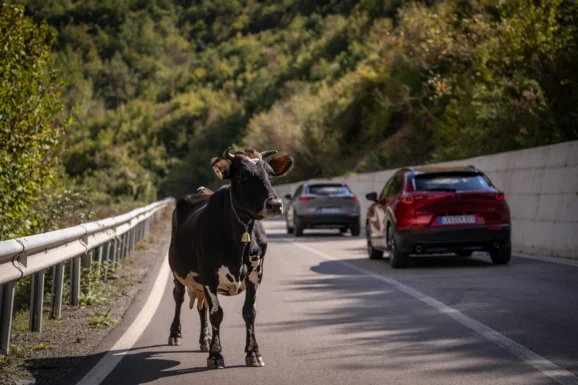
Traffic was minimal for long stretches. Occasionally we encountered a shepherd or a group of cyclists, with older Mercedes cars among the few other vehicles travelling in the opposite direction.
The conditions provided an extended opportunity to assess the CX-30’s 2.5-litre naturally aspirated petrol engine.
Mazda has retained larger-capacity, non-turbocharged petrol engines in parts of its range at a time when many manufacturers have favoured smaller turbocharged units.
The distinction was noticeable on the mountain roads, where the engine delivered power progressively as we accelerated through bends and climbed steeper sections.
Throttle response was predictable, allowing relatively precise control over the car’s speed on roads where changes in gradient and surface conditions demanded frequent adjustments.
Schulze said the decision to retain naturally aspirated engines was based partly on the relationship between throttle response and vehicle control.
“We like naturally aspirated engines because they deliver immediate, predictable response. When you’re driving on a winding mountain road, there is a precise moment when you come off the throttle and another moment when you want torque back at the wheels. The response needs to be instant.”
He also argued that larger-capacity engines could offer advantages in refinement and emissions control, including lower raw emissions before exhaust after-treatment.
On our route, the engine’s linear power delivery worked well with the car’s handling, particularly through the longer sequences of corners.
Another feature of the 2.5-litre engine is its cylinder-deactivation technology, designed to reduce fuel consumption during periods of lighter demand.
Under suitable operating conditions, such as steady motorway cruising or gentle driving through towns, the system can shut down two of the engine’s four cylinders.
This reduces pumping and frictional losses, allowing the remaining cylinders to operate more efficiently until additional power is required.
“The gains aren’t massive, but they are meaningful,” Schulze said.
“In urban driving where many customers spend a large proportion of their time, those improvements contribute to better overall efficiency without reducing performance when it’s needed.”
Mazda designed the transition to take place automatically, without intervention from the driver. During our journey, there was no obvious interruption to the engine’s delivery that drew attention to the system.
Cylinder deactivation is one of several measures employed by manufacturers to improve the efficiency of conventional petrol engines. Its contribution to fuel consumption depends on driving conditions, and the varied nature of our route made this a test of overall driveability rather than a controlled economy comparison.
Over the course of the day, the Mazda’s ride quality and predictable handling were its most useful attributes. The more demanding stretches required concentration, particularly where broken surfaces coincided with tighter corners, though the car remained comfortable through the changing conditions.
Through Tomorr’s mountainous interior
By mid-afternoon, our route had taken us towards the mountainous region surrounding Tomorri National Park.
Here, limestone formations, forested slopes and isolated villages formed a landscape quite different from the busy roads encountered around Tirana.
The road climbed through narrow passes and gorges before opening onto views across valleys and distant mountain ranges.
Along the SH71, we continued towards Moglicë Lake, a reservoir formed as part of Albania’s Devoll Hydropower scheme.
The wider project began construction in 2013, with work on the Moglicë hydropower plant starting in 2015. The principal structures were completed in 2019, and the plant entered commercial operation in 2020.
The development is one of Albania’s major hydroelectric infrastructure projects, with a dam approximately 167 metres high and a reservoir covering around 7.2 square kilometres when full.
Against the surrounding mountains, the scale of the engineering was immediately apparent. The reservoir and dam also offered an interesting counterpoint to the Vjosa encountered earlier in the day. The Vjosa remains free-flowing and protected for its natural river system, whereas Moglicë illustrates the role hydroelectric infrastructure plays in Albania’s energy production.
From there, our route continued through Gramsh and towards Banja Lake, another reservoir on the Devoll River.
The road followed hillsides above the water, with more bends and changing elevations as we gradually made our way towards the capital.
By this stage, the odometer was approaching the day’s planned distance and the cumulative effects of a lengthy drive were becoming apparent.
The Mazda’s supportive seats and compliant suspension had helped make the journey manageable, despite the time spent negotiating rough roads and mountain passes.
It was a useful reminder that the demands of a long-distance touring vehicle extend beyond acceleration and cornering ability. Comfort, visibility, predictable responses and the ability to cope with changing road surfaces become increasingly important over a journey lasting ten hours.
Returning to Tirana
As dusk approached, the mountains gradually receded and the roads became wider and busier.
The return to Tirana brought a marked change from the sparse traffic of the interior, with the capital’s urban activity signalling the end of our 560-kilometre circuit.
We finished the day at the Radisson Collection Morina Hotel, whose comfortable rooms provided an opportunity to rest after the hours spent on the road.
The hotel offered a comfortable end to a trip that had taken us through some of the country’s more remote landscapes, with little time spent in any one place.
There were plenty of locations along the route that would have justified longer visits, particularly the Vjosa valley and the villages around Leskovik.
The ten-hour itinerary also made clear the limitations of trying to cover so much ground in a single day. Albania’s mountain roads reward careful driving, and their changing conditions mean distances cannot always be judged by the number of kilometres alone.
The updated Mazda CX-30 proved a comfortable and capable companion throughout, with its suspension, seating and predictable engine response particularly well suited to the route. The journey provided a substantial test of those qualities, even if a longer assessment would be needed to establish its fuel economy and everyday practicality.
For travellers considering Albania, the greater attraction is the range of places accessible beyond the established coastal destinations.
The Vjosa River, with its gravel banks, gorges and white-water rapids, offers a landscape still shaped largely by natural processes. Leskovik provides an introduction to the country’s hospitality and winemaking traditions, and the mountain roads reveal isolated communities alongside the physical remains of Albania’s troubled twentieth-century history.
Our route also passed two substantial hydroelectric reservoirs, illustrating how modern infrastructure is altering parts of the mountainous landscape.
After 560 kilometres, we had seen considerably more of Albania than a conventional city break or coastal holiday would permit. We had also encountered enough places deserving further attention to recognise how much remained unexplored.
For anyone prepared to spend time behind the wheel, the country’s interior provides a demanding and rewarding journey, with its geography, history and rural communities offering ample reasons to venture inland.
The future of driving
Beyond the mountain roads, Schulze also discussed how Mazda expects vehicle technology to develop, particularly as manufacturers balance electrification with the continued use of petrol engines.
The company is preparing for future emissions rules, including Euro 7, while developing electric vehicles and expanding its range of electrified powertrains. Schulze confirmed plans for a full-hybrid version of the next CX-5.
He also expects artificial intelligence to play a growing role in how drivers interact with their vehicles, especially through voice commands and connected services.
“Beyond touchscreens, I think voice interaction will become increasingly important, particularly with advances in artificial intelligence.”
He acknowledged that Mazda’s traditional preference for physical controls was evolving as navigation, entertainment and vehicle-management systems became more integrated.
“Climate controls, for example, should remain straightforward because drivers shouldn’t need to navigate through multiple menus simply to adjust the temperature.”
Despite the growing emphasis on software and electrification, Schulze’s own enthusiasm for driving remains closely associated with the Mazda MX-5, the lightweight roadster first introduced in 1989.
“In many ways it’s the reason I joined Mazda,” he said, recalling his first encounter with the original Miata in the United States.
For Schulze, the car’s appeal lies in its weight distribution, direct controls and open-top driving experience.
“Remove the roof and you reconnect with your surroundings. You hear birds singing, smell the flowers and experience the world directly.”
It was an observation that seemed particularly appropriate after a day spent driving through Albania’s mountains and river valleys.

Mark G. Whitchurch is a seasoned motoring journalist whose work—covering road tests, launch reports, scenic drives, major races, and event reviews—has appeared in The Observer, Daily Telegraph, Bristol Evening Post, Classic & Sports Car Magazine, Mini Magazine, Classic Car Weekly, AutoCar Magazine, and the Western Daily Press, among others. He won the Tourism Malaysia Regional Travel Writer of the Year in 2003 and is a member of The Guild of Motoring Writers.
Mark G Whitchurch travelled to Albania with Mazda UK on behalf of The European as part of the manufacturer’s 2026 Epic Drive, joining a group of motoring journalists to explore the country’s mountainous interior and test the updated CX-30 over a 560-kilometre route.
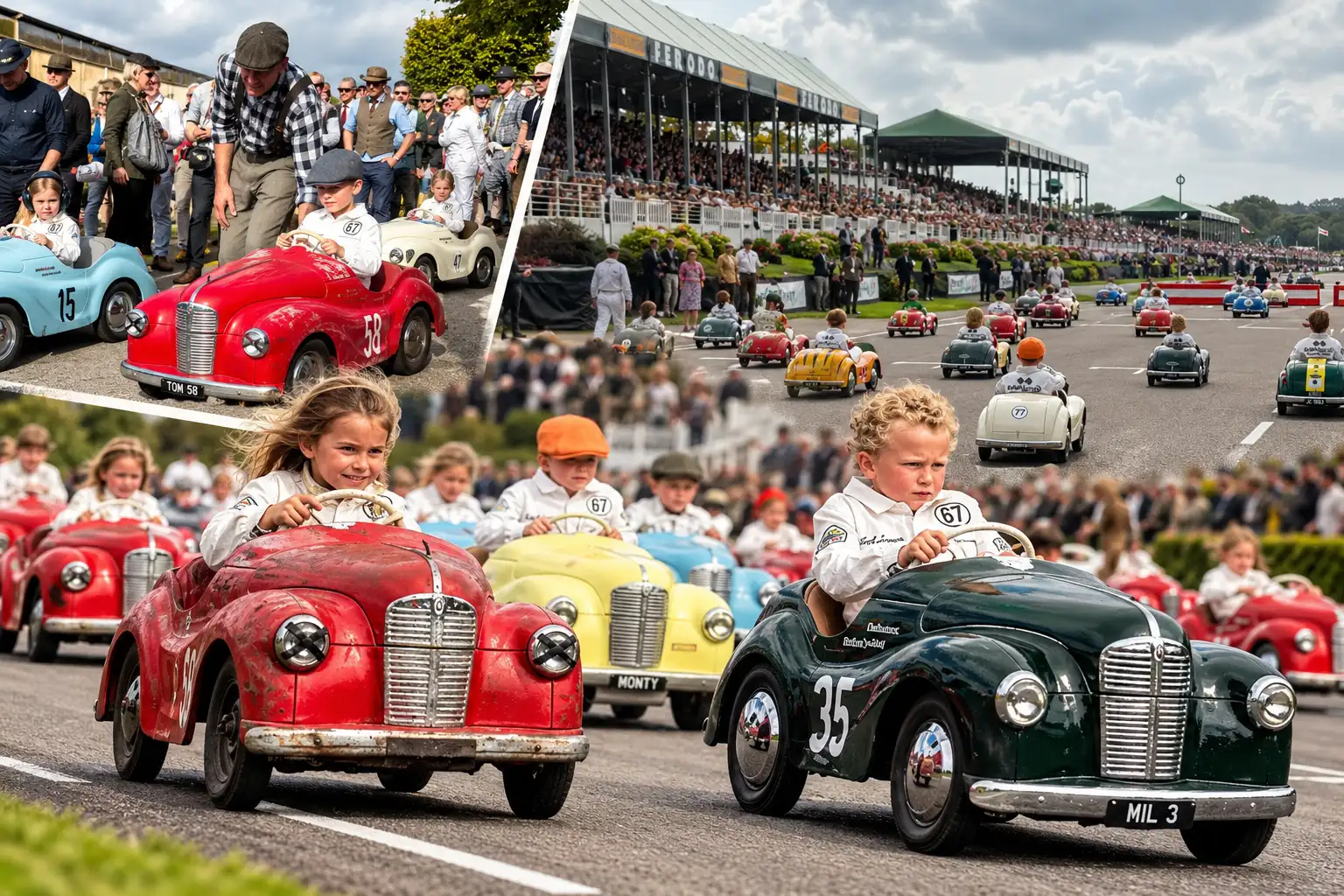
READ MORE: Meltdowns, pre-race tears and ‘joyous bedlam’: inside Goodwood’s wildest race of the weekend. Forget the supercars and star drivers – for many, the Settrington Cup was the real crowd-puller at this year’s Goodwood Revival. Motoring Editor Mark G Whitchurch speaks to Master of Ceremonies Alex Kinsman about over-eager parents, rule-bending and the happy chaos of 70 children racing historic Austin J40 pedal cars worth up to £10,000.
Do you have news to share or expertise to contribute? The European welcomes insights from business leaders and sector specialists. Get in touch with our editorial team to find out more.
Main image: A Mazda CX-30 crosses a suspension bridge over the turquoise waters of Albania’s Vjosa River during Mazda UK’s 560-kilometre Epic Drive through the country’s mountainous interior. Credit: David L F Smith Photography / www.davidlfsmith.com