From cloud infrastructure and engagement technology to compliance, payments and data, Soft2Bet sets out the foundations operators should consider when choosing a modern turnkey partner
Turnkey technology has changed as entertainment platforms have taken on a wider operational role. Early platforms were built mainly around speed to market, service integrations and site stability. Those requirements remain important, but platform decisions now influence product strategy, data control, and operational resilience.
Many operators are still working with systems that were built for simpler operating models. Product, payments, risk, CRM, reporting, and customer operations may function day to day, but they often depend on separate tools, supplier handoffs and different development cycles. Over time, that leads to slower releases, repeated integration work, fragmented data, and more pressure on operational teams.
A modern turnkey partner should be assessed by the quality of its technology decisions, its product maturity and its performance in live market conditions. Operators need a platform that can support scalability, control, customer engagement, security, and long-term product development from the same technical base.
Pillar 1: People, product discipline and technical ownership
Technology decisions are made by teams long before they appear in a product roadmap. Architecture, release cycles, data controls, security standards and partner integrations all reflect how a company is organised and how much experience it has in live operation.
For operators assessing partners for entertainment platforms, the first signal is the quality of the team and its working habits. Product leaders need to understand market entry, localisation, customer journeys and commercial performance. Engineering teams need to build for stability, security and scale. Compliance, payments and risk teams need to be involved early enough for market rules to be reflected in the product, rather than added later as extra work.
Teams that have launched and managed live brands have usually seen where product plans become difficult in practice: traffic peaks, payment provider issues, verification flows, local content needs, customer support pressure and new reporting rules. That experience should show in how the platform is built, documented, and improved.
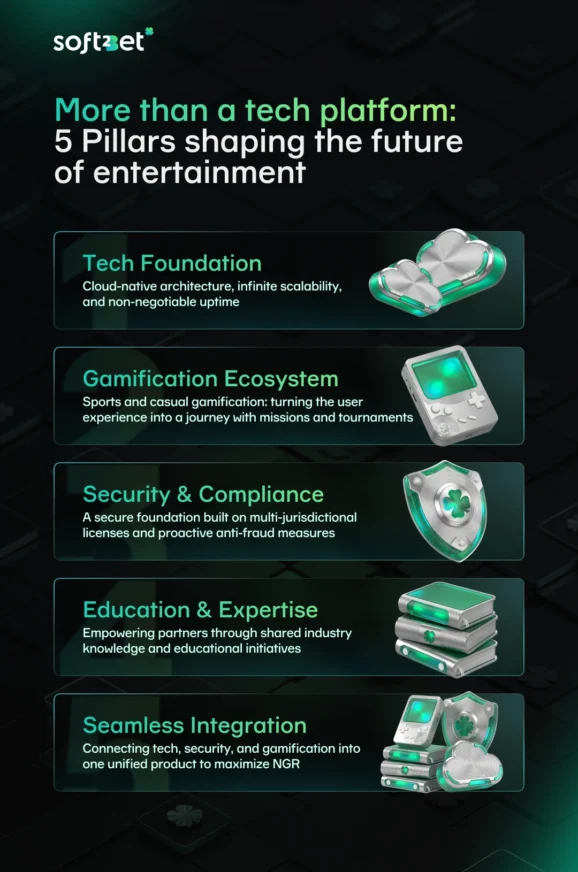
Among tech companies such as Soft2Bet, this has influenced the decision to develop and maintain core products in-house, including PAM, sportsbook, CMS and gamification. The purpose is to keep technical ownership closer to the teams responsible for product delivery, localisation, engagement, risk and operations.
Pillar 2: Cloud-native infrastructure for entertainment platforms
Customer experience on entertainment platforms depends on infrastructure before a user interacts with the product. A modern turnkey platform needs a technical foundation that can handle heavy traffic, respond quickly, stay available during busy periods and give operators a live view of performance, with uptime treated as a core product requirement.
Operators need the platform to handle major sports events, new market launches, high-volume payment periods, and large CRM campaigns without straining daily operations.
An AWS case study highlights the operational impact of this infrastructure. Soft2Bet reduced compute costs by 55 per cent, partner onboarding time by 70 per cent and proof-of-concept testing from weeks to one day, sometimes to only a few hours. Its platform runs on AWS with 99.98 per cent uptime, supports 12,500+ games and hosts more than one million live events each year. Lower latency also helped create smoother product interactions for users.
These improvements help operators in a number of ways. For instance, faster onboarding allows content and partnership teams to start work sooner. Lower latency protects player conversion, while cloud scalability gives product teams more room to test and localise.
Pillar 3: Product engagement through feedback, progress and play
Engagement on entertainment platforms is now shaped as much by technology as by content. Recommendation systems, social feeds, streaming queues, learning streaks and mobile game progress loops have made users familiar with products that respond to behaviour and guide them to the next action.
The same shift is visible in regulated digital entertainment. Retention planning now includes product architecture, data use and customer experience design. Operators need technical systems that can recognise different audience groups, adapt journeys by market and give teams a reliable way to test what keeps users active.
This changes the role of gamification in the industry. Progression, missions, tournaments, leaderboards and reward triggers work best when they are connected to data, communication, reporting and operational controls. In that setting, they help structure the customer journey and give teams clearer behavioural signals.
MEGA, Soft2Bet’s entertainment platform, is one example of a wider industry direction. Its gamification engines can be configured by reward type, trigger, user segment and difficulty level, which reflects the wider need for engagement technology that can be adjusted across audiences and markets.
The value for operators sits in measurement and control. Teams can see how users move through journeys, where activity drops, which formats create repeat use and how different segments respond. That gives engagement a clearer link to product management, market localisation and long-term customer value.
Pillar 4: Security, compliance and anti-fraud first
For entertainment platforms in licensed markets, compliance is part of product quality. It shapes onboarding, payments, reporting, promotions, customer protection and the way risk teams manage daily operations.
A compliance-led approach places regulatory, risk and security requirements into product planning from the start. The aim is to make controls clear enough for the operator, strong enough for the regulator and smooth enough for trusted customers to move through the product with fewer delays.
This approach is especially important for operators working across several markets. Verification rules, reporting duties, tax requirements, promotional controls and customer protection standards can differ by jurisdiction. If these rules are handled late, small market changes can create new technical work, slow releases and add pressure across product, legal, payments and support teams.
Soft2Bet’s own operating model is one example of this approach. The company holds 23 licences and operates across multiple regulated markets, where compliance planning must sit close to product, payments, risk, and customer operations. The platform’s role is to help teams manage those requirements without turning every local rule change into a separate operational burden.
Anti-fraud follows the same logic. Risk controls need to protect the operator without slowing every customer journey. Through its work with SEON, Soft2Bet embedded fraud checks across registration, login and deposit stages. The results included a 40 per cent reduction in manual queries, 20 per cent faster manual reviews, and stronger detection of fraudulent sign-ups, chargeback risk, and abuse patterns.
Pillar 5: Payments, data and operations across entertainment platforms
Day-to-day performance on entertainment platforms depends on how product, payments, risk, CRM, compliance and analytics work across the same customer journey. When these functions sit in separate systems, teams lose speed and visibility. A connected platform gives operators a clearer view of customer activity, payment behaviour, campaign performance, risk signals and market rules.
Payments are central to that flow. Customers expect fast deposits and clear withdrawals. Operators need routing logic, AML checks, provider control, evidence trails and early warning signs for unusual behaviour. Payment orchestration helps low-risk cases move faster, with stronger checks reserved for higher-risk activity.
The benefits extend across the wider operation. Cleaner data supports better decisions, risk teams get clearer evidence, and product teams can see where the customer journey needs work. Over time, this can support retention, margin control and stronger commercial performance.
Five pillars for a stronger turnkey decision
Taken together, these five pillars provide a practical framework for evaluating any turnkey partner. Market stakeholders should look at the company behind the platform, the technical foundation, player engagement, compliance and security, and the way payments and operations work together. That gives a more complete picture than a feature list.
This becomes most visible after launch, when product, payments, risk, CRM, compliance and analytics need to work together without slowing the business down. For CPOs, CTOs, COOs, and commercial leaders, the decision goes beyond feature lists. A trusted turnkey partner becomes the foundation for how an operator enters the market and builds a sustainable business after launch. The evaluation should therefore give as much attention to the partner’s long-term product direction as to the quality of its delivery and support.
Further information
Produced with support from Soft2Bet. To find out more about its turnkey platform, MEGA gamification technology and services for operators, visit soft2bet.com
READ MORE: ‘Burnham warned digital exclusion is now a national security risk‘. ISF chief Steve Durbin says the incoming Prime Minister must put cyber resilience, skills and access to technology at the heart of government or leave Britain exposed to hostile actors.
Do you have news to share or expertise to contribute? The European welcomes insights from business leaders and sector specialists. Get in touch with our editorial team to find out more.