From food systems to tobacco to tax justice, the EU’s most consequential policy battles are being shaped by a handful of underfunded advocates. The School for Moral Ambition is recruiting the professionals they need, writes Jan-Willem van Putten
The European Union regulates food for 450 million people. Its agricultural policy shapes what farmers grow, what companies sell, and what ends up on plates from Lisbon to Tallinn. In 2024, the EU spent more than €50 billion on agricultural subsidies – roughly a third of its entire budget. Yet the organisations working to reform that system operate with a fraction of the resources available to the industries they seek to change.
This pattern repeats across the EU’s biggest policy arenas. In tobacco control, Europe remains the world’s second-largest cigarette market. Eight million people die from tobacco-related causes every year globally, and the industry’s lobbying presence in Brussels is extensive and well-funded. The NGOs and public health bodies pushing for stronger regulation are, by contrast, chronically understaffed. They need lawyers, communications strategists, researchers, and policy experts – professionals who overwhelmingly end up in the private sector.
In tax policy, the picture is similar. The global movement for tax fairness – backed by leading economists such as Gabriel Zucman – has achieved remarkable political breakthroughs in recent years, from the OECD’s global minimum tax to the UN’s landmark tax convention. But translating political momentum into enforceable policy requires sustained, skilled work: economic analysis, legal drafting, coalition building, and public communications. The organisations doing that work are competing for talent against firms that can offer multiples of their salaries.
The problem, in short, is not a lack of good ideas or political will. It is a lack of people. Specifically, it is a lack of experienced professionals – the lawyers, strategists, economists, and communicators who know how to move policy from proposal to implementation. These are people who exist in large numbers but are, for the most part, working on problems that are neither as urgent nor as consequential as the ones described above.
The role of experienced professionals
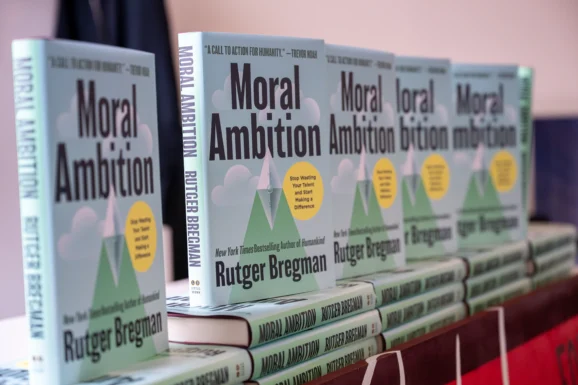
The School for Moral Ambition, a Netherlands-based nonprofit co-founded by the author Rutger Bregman, is attempting to change that equation. Since 2024, the organisation has been running fellowship programmes that recruit mid-career professionals and place them inside the advocacy organisations, think tanks, and NGOs working on these issues. Fellows receive a salary and spend seven months – one month of intensive training followed by a six-month placement – embedded in organisations at the centre of European policy fights.
The model is deliberately practical. Fellows are not interns or volunteers. They are experienced professionals, typically with five or more years in their field, who bring specific skills that their host organisations need. A former management consultant might join an organisation lobbying for reform of the Common Agricultural Policy. A communications specialist might work with a European tobacco control network. A tax lawyer might support the legal architecture of a progressive tax reform campaign.
In 2026, the School is recruiting for three European fellowship programmes: the EU Food Transition Fellowship, with placements in Brussels and Berlin focused on agricultural reform and the protein transition; the Tobacco Free Future Fellowship, which works across European networks on tobacco control advocacy and investigative journalism; and the Global Tax Fairness Fellowship, a partnership with Gabriel Zucman that places fellows in tax justice organisations across Europe, the US, Canada, and Africa.
Changing the balance
The underlying logic is that the talent gap in public-interest work is not inevitable, but the result of a labour market that systematically channels skilled professionals toward the private sector. Fellowships that offer a credible bridge – a salary, structured training, professional placements, and a network of peers – can redirect some of that talent toward the places where it is most needed.
The School’s first European cohort, which completed its fellowship in early 2025, suggests the model works. The majority of fellows have remained in the field, continuing to work in food policy, tobacco control, or adjacent areas. Several have taken permanent roles at their host organisations. The 2026 intake represents a significant expansion: more than 20 positions across the three European programmes.
Applications for the 2026 fellowships opened on 27 March 2026, with the program starting in September. The School is looking for mid-career professionals with backgrounds in law, policy, communications, economics, consultancy, and research – people who have built careers in the private or public sector and are ready to apply those skills to problems that are, in the School’s framing, sizable, solvable, and sorely overlooked.
Europe’s policy landscape is shaped as much by the people working inside advocacy organisations as by the politicians who vote on legislation. If the movements for food reform, tobacco control, and tax fairness are to succeed, they need more than good arguments. They need reinforcements.

Jan-Willem van Putten is Executive Director and Co-founder of The School for Moral Ambition, a Netherlandsbased nonprofit that helps experienced professionals move into high-impact publicinterest work. He leads the organisation’s strategy and growth, including its fellowship programmes, which place mid-career talent in advocacy organisations, think tanks and NGOs working on some of Europe’s most pressing policy challenges.
Further information
To find out more about the Moral Ambition Fellowships and apply, visit moralambition.org/fellowships
Deadline for applications is April 27, 2026
READ MORE: ‘More than half of employers say they cannot find graduates with the right AI skills, study finds‘. A six-country study by Pearson and Amazon Web Services found a widening gap between what universities think they are delivering and what employers say they need, with only 14 per cent of current graduates reporting high proficiency in applying AI tools to professional work.
Do you have news to share or expertise to contribute? The European welcomes insights from business leaders and sector specialists. Get in touch with our editorial team to find out more.