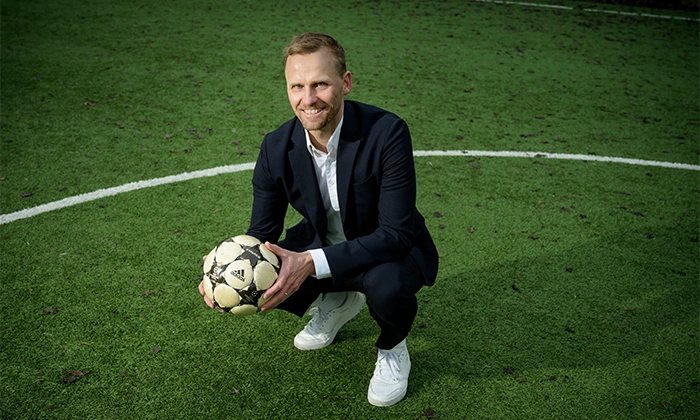
Hannu Tihinen spent two decades in professional football before building a second career in leadership and talent development. His move into executive management led him through the Aalto Executive MBA in Helsinki, where global strategy, organisational leadership, and high-performance thinking now underpin his work at FIFA. In this exclusive interview, he reflects on studying while working at the top of sport, what the EMBA added to his decision-making, and why continuous learning shapes long careers
Professional sport rarely leaves space for long-term planning, yet Hannu Tihinen treated retirement as a beginning rather than an end. The former Finland international, who won five league titles in three different countries and captained both the national team and several club teams, including FC Zurich during a title-winning period in Switzerland, quickly moved into technical and executive roles, eventually overseeing national talent development as the Technical Director of the Football Association of Finland (FA).
Managing large budgets, staff structures, and performance systems demanded more than playing experience, and the decision to pursue an Aalto Executive MBA became central to that transition. The programme deepened his leadership capabilities, broadened his view of organisational culture, and introduced him to strategic thinking outside sport. It also led to practical outcomes, including a nine-month business strategy project for the Finnish FA and the confidence to work in high-performance structures on a global level.
Today he operates within FIFA’s Global Football Development division, supporting talent development schemes across nine member associations and applying the skills gained through the EMBA to technical planning, team leadership, and long-horizon football strategy.
In this conversation with The European, he discusses motivation, study pressures, personal development, and the long view required to build a second career beyond the pitch.
The European: You retired from professional football at FC Zurich in Switzerland in 2010 at the age of 33. What were your career ambitions at the time?
Hannu Tihinen: At first, I worked as deputy sporting director and in academy coaching at FC Zurich. This experience was significant to me, and I wanted to further my education toward management and leadership. After moving back to Finland at the age of 35, I ran for chairman of the Football Association of Finland because I genuinely wanted to advance Finnish football. I didn’t succeed, but it was an excellent experience that gave me insight into the political side of sports. This path eventually led me to the role of Technical Director at the Football Association of Finland, a position I held for nine years.
What motivated you to pursue an EMBA, and why did you choose the Aalto Executive MBA programme?
My first master’s degree (UEFA Master for International Players) broadened my network and deepened my understanding of elite sports management. However, I still felt the need to develop my leadership skills further. That’s why I applied to Aalto’s high-level, international EMBA programme in Helsinki—to lead our organisation as effectively as possible. In my role as Technical Director, I was responsible for a multi-million-euro budget and a sports department of nearly 50 staff members.
How did completing the Aalto EMBA programme support you in your career development?
Completing the Aalto EMBA gave me a competitive advantage in the sports world. The broad, high-level education, featuring top leaders from diverse fields, pushed me out of my comfort zone and provided excellent modules in people, project, process, and financial management, as well as impactful communication and change management. The Personal and Organisational Leadership module, including the Self-Development Process, took me deep into analysing myself and my values, providing direction for achieving a balance of life.
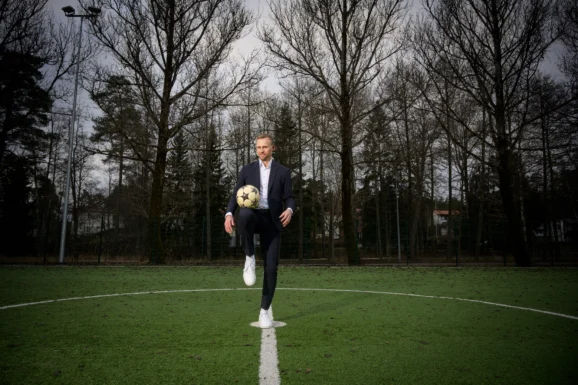
In the Business Strategy Project (BSP), our five-person team delivered a high-quality project for the Football Association of Finland using the Scrum methodology. The project lasted nine months and included 118 meetings. The intensive project in a top-performing team felt like completing a football season and winning the championship with top marks.
Today, my Aalto EMBA is extremely valuable in my work. I work in FIFA’s Global Football Development Division in the Talent Development Scheme with nine FIFA Member Associations, where we aim to give every football talent a chance. I support technical directors in talent development projects, and, thanks to my EMBA, I can contribute broadly to the development of entire technical departments when needed.
Naturally, the EMBA has opened opportunities and provided the skills to work in other industries as well. Life is full of possibilities, and nothing should ever be completely closed off. If education, a continuous desire to develop, and a love of learning are deeply embedded in your DNA, it is possible to have two or even three careers over a lifetime. For the time being, however, my primary motivation lies in the global development of football.
What was the most challenging aspect of balancing studies with your professional responsibilities?
Overall, the EMBA process was demanding in terms of time management and balancing work and family. Although I am highly disciplined, keeping up with both the pre- and post-module tasks as well as the tight deadlines of the business strategy project requires determination. Without the strong support of my wife, Mia, and our three sons, I would not have been able to succeed.
How has the EMBA experience influenced your leadership style or strategic thinking so far?
As my skills have developed, I have gained more calmness and efficiency in my work. Through the process of personal development, I have learned to view life and work more holistically, which has increased my productivity.
Can you share an example of how insights from the programme have impacted your work or organisation?
Understanding the workings of a global organisation has become easier thanks to the diverse modules offered by the EMBA, which provides a significant boost to driving initiatives forward and fostering development.
What advice would you give to professionals considering an EMBA in today’s global business environment?
No matter how well you imagine yourself as a leader, the EMBA elevates your leadership and management skills to a new level by forcing you to reflect on yourself, your environment, and your business in a comprehensive and innovative way. This ensures holistic development both personally and professionally.
Further information:
Produced with support from Aalto University Executive Education and Professional Development. To find out more about Aalto’s Executive MBA, MBA, and DBA leadership development programmes, visit www.aaltoee.fi/en/mba-and-dba-programs.
READ MORE: ‘European MBAs adapt to AI as Aalto overhauls executive education’. Finland’s Aalto University has updated its MBA and EMBA programmes with data, AI and modular learning pathways to meet demand for technology-focused executive upskilling. Professor Max Fine, its associate dean of MBA education, outlined the changes in an interview with The European.
Do you have news to share or insights to contribute? The European welcomes perspectives from business leaders and sector specialists. Contact our editorial team to learn more.