AI promises efficiency, but European leaders win when they translate that promise into safer operations, compliant processes, and durable human performance—without losing the human judgment that keeps organisations resilient, writes Dr. Sarah Chardonnens
Europe’s companies face a double imperative: reskill faster and reduce risk. My consulting practice sits at this intersection. I design adult-learning programmes that respect real-world constraints—limited time, high stakes, strict governance—and use AI where it measurably helps: fewer errors, stronger transfer, better retention. The work bridges the boardroom and the classroom, translating cognitive science into routines your teams can adopt tomorrow.
The SYNAPSE way (and why it works)
I created SYNAPSE to make complex learning science practical for managers, instructors and teachers. It organises learning into four phases that map cleanly onto adult training: Sensory Input (activate attention and relevance), Network Adaptation (reshape mental models via feedback and desirable difficulty), Participation & Self-Regulation (build metacognitive routines so skills hold under pressure), and Storage & Embodiment (consolidate through spaced retrieval and on-the-job rehearsal). Leaders use it as a shared language: Where are we in the cycle? What human guidance—and which AI support—belongs here?
A distinctive feature of SYNAPSE is that motivational dynamics are not an afterthought—they are the engine. Training sequences intentionally support purpose and relevance (the “why”), competence and visible progress, autonomy and voice, and social belonging and recognition. That’s how effort turns into mastery, rather than compliance toward a quiz.
Teaching today’s workforce—especially Gen Z
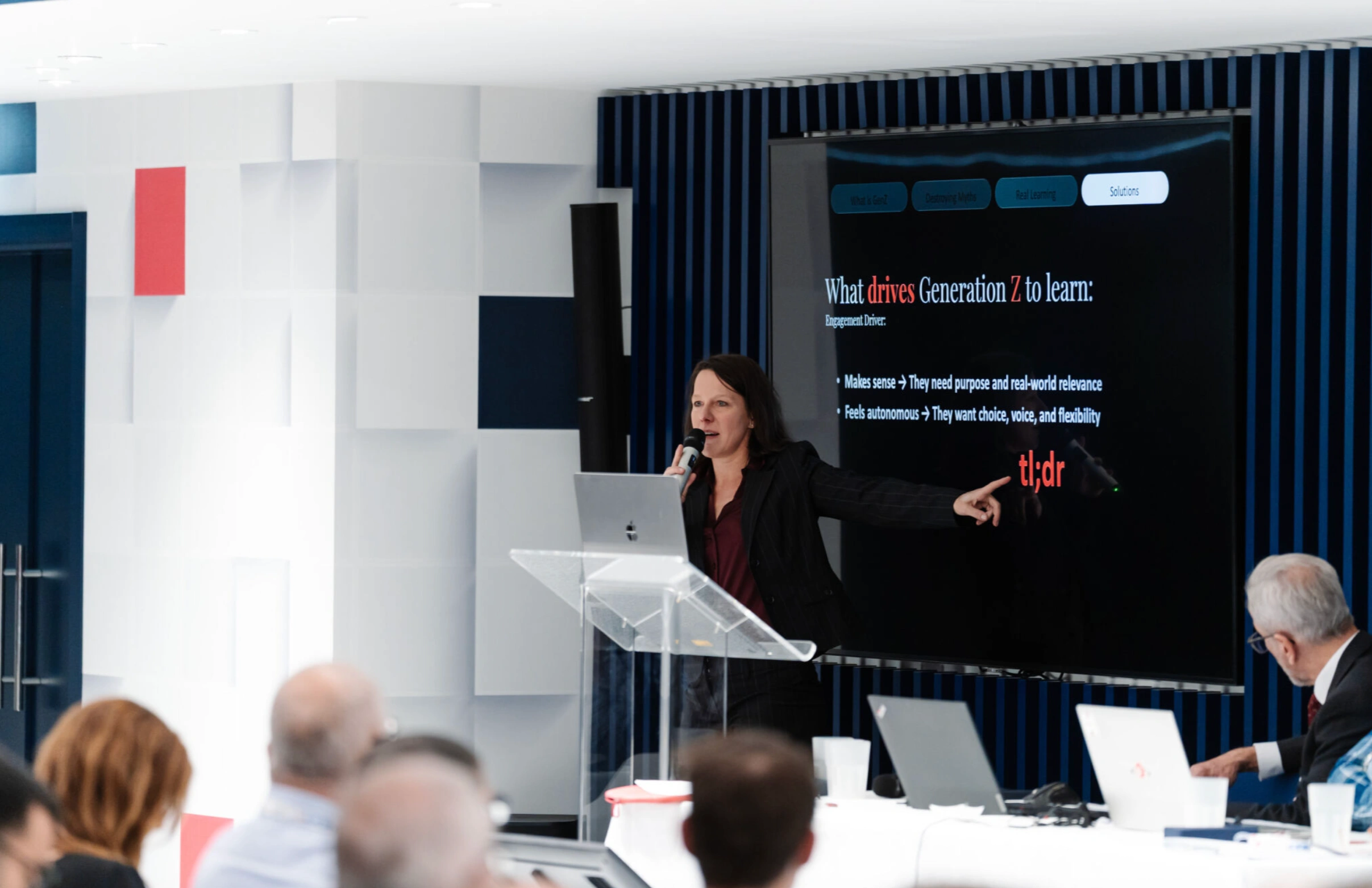
A growing share of trainees are Gen Z: mobile-native, feedback-seeking, and purpose-driven. They learn best when programmes are meaningful (authentic scenarios), autonomy-supportive (clear choices with expectations), mastery-oriented (frequent low-stakes practice with explanatory feedback), and social (collaborative problem-solving with visible recognition). In SYNAPSE terms: attention-grabbing Activation, adaptive Adjustment with branching cases, coached Self-Regulation through checklists and micro-reflection, and Consolidation via spaced retrieval and real-task rehearsal. Done this way, AI amplifies what Gen Z already values: relevance, agency, progress, and connection.
AI that helps—without hollowing out human skill
Used well, AI is a force multiplier for instructors and teams: adaptive sequencing that matches challenge to skill; simulation and scenario generators that surface edge cases; retrieval practice with instant, explanatory feedback; and nudges that strengthen self-monitoring. Used poorly, it fragments attention, over-automates judgment, and encourages “metacognitive laziness”—the illusion of knowing because a system produced a fluent answer. The antidote is procedural: think first, then compare. Learners draft a plan or solution before consulting the tool; they then interrogate the model’s output, reconcile differences, and record a rule they will apply next time. This sequence hardwires autonomy and metacognition while still using AI as a productive foil.
Managing AI risk under the EU AI Act
Corporate learning now sits within a clear European risk-based framework. I align programmes with the Act’s core expectations—risk management, transparency, human oversight, and data governance—through routines that are simple to run and easy to audit:
- Use-case inventory & risk mapping: classify tools and scenarios; prefer minimal- or limited-risk uses where possible.
- Human-in-the-loop by design: instructors sign off on generated content; escalation paths exist for borderline cases.
- Data minimisation & traceability: limit personal data; keep prompt/output logs for audit and continuous improvement.
- AI literacy for staff: role-specific modules so people know how and when to rely on AI—and when not to.
- Outcome monitoring: track incidents, rework, and the durability of compliant behaviours; iterate accordingly.
Crucially, leaders should also draw clear red lines (e.g., emotion-recognition in the workplace) and treat high-risk applications (selection, evaluation, sensitive surveillance) with elevated oversight, transparency, and documentation. The point is not to slow innovation, but to build dependable pathways where learning and compliance strengthen each other.
What executives can expect
Across sectors, clients typically pursue three outcome families—and we measure all three:
- Safety & error reduction: fewer omissions and mis-steps in complex procedures through retrieval practice + checklists + “explain-your-choice” prompts.
- Compliance that lasts: spaced micro-cases with peer discussion and supervisor sign-off outperform one-off seminars, especially for recurring obligations.
- Talent & retention: transparent skill paths and timely feedback raise perceived competence and motivation—drivers of retention as well as performance.
How we work together
A typical engagement runs in four steps:
- Diagnostic—map current training to the SYNAPSE phases and identify where AI adds value without adding noise.
- Pilot—co-create one or two high-stakes learning flows (critical onboarding; recurrent compliance).
- Measurement—track transfer to novel scenarios, reductions in rework/errors, and compliance durability.
- Scale-up—train internal leads to run SYNAPSE-aligned, AI-supported learning at speed.
A note, personally
I write this as a Swiss educator and consultant in the learning sciences and music (former virtuose musician)—fields that taught me discipline, empathy, and the value of rehearsal. As a woman in technology-adjacent spaces, I’ve learned to let results speak: clear routines, ethical guardrails, and teams who grow more confident because they understand why and how they are learning. My doctorate (PhD) in education gave me the tools to build SYNAPSE; my clients gave me the cases to refine it. I’m proud to be a member of ASFAI (American Society For AI), and to have written a book that helped a wider public engage with these ideas—but the work that matters most is still the quiet improvement you see on the floor: fewer errors, stronger judgment, better days at work.

Dr. Sarah Chardonnens, a former virtuoso musician, holds a doctorate in education sciences and is a professor and trainer at the University of Fribourg, where she prepares future teachers to design effective and ethical learning programs. She runs a consulting business for companies, helping them adapt training to current challenges—attention, motivation, digital skills, and responsible integration of AI—using her SYNAPSE model. Author of the bestseller The Learning Revolution, she is also a sought-after keynote speaker, known for her clear, concrete, and scientifically-based presentations that help CEOs and educational teams evolve their teaching and skills development methods.
Further information
Produced with support from Dr Sarah Chardonnens. Her book Learning Revolution: AI’s Influence on Intelligence and Education is a bestseller on Amazon and available now. For further information about the SYNAPSE model, visit www.sarahchardonnens.ch
READ MORE: ‘The real AI challenge is human, not technical‘. As businesses rush to implement AI tools, they risk overlooking the most critical component: the human brain. Without cognitive alignment and a deeper understanding of how people learn, automation can do more harm than good, warns Dr Sarah Chardonnens.
Do you have news to share or expertise to contribute? The European welcomes insights from business leaders and sector specialists. Get in touch with our editorial team to find out more.