In the latest instalment of her stargazing series, author Omara Williams turns to the romance of 14 February, guiding readers through the star clusters, lunar pairings and planetary encounters that make February’s night sky one of the year’s most beautiful sights from the UK
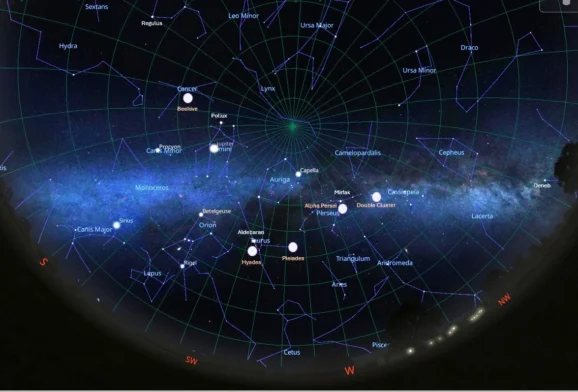
Valentine’s Day falls in a month that offers a wonderful view of the Milky Way stretching from north to south across the sky. The band of stars begins with Deneb in Cygnus, low on the northern horizon, rises high through Auriga where Capella shines brightly, and continues southwards to Sirius in Canis Major, the brightest star in the night sky.
February’s clear winter air brings exceptional visibility. The sky fills with so many stars that even familiar shapes such as Cassiopeia can be harder to pick out. The long, dark evenings provide time to enjoy several star clusters that can be seen with the naked eye, helping you feel more connected to the scale and beauty of our galaxy.
This article highlights some of the most striking and easiest clusters to find: the Pleiades (M45), the Hyades (Mel 25), and the Beehive (M44). To locate them, you can use simple stargazing apps such as Stellarium, Sky Safari, or Star Walk.
Among the easiest and most rewarding sights are the Pleiades in Taurus, which appear as a soft misty cluster of bright blue stars; the Hyades, forming the clear V-shape of the Bull’s face; the Beehive cluster in Cancer, a faint cloudy patch between Gemini and Leo; the Alpha Persei cluster gathered around the bright star Mirfak; and the remarkable Double Cluster in Perseus, where two dense star groupings sit side by side like twin jewels in the dark.
For the best view, head somewhere away from streetlights, wrap up warm, get comfortable, and look towards the south-west to begin your journey along the Milky Way.
The Pleiades (M45)
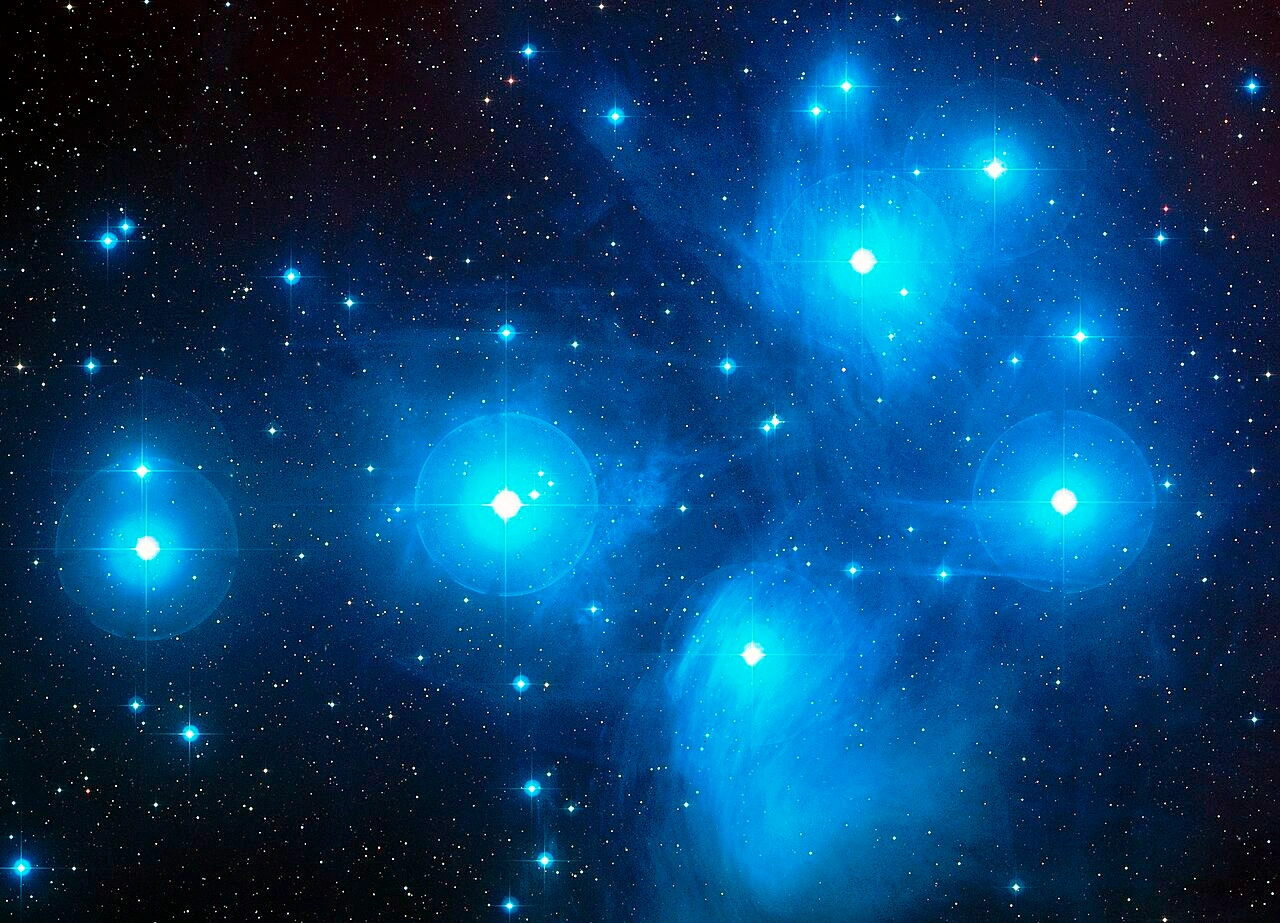
The Pleiades, also known as the Seven Sisters, is the most famous open cluster in the night sky. Situated approximately 444 light-years away, it contains over 1,000 stars, most of which are hot, blue, and young. However, only a few of these stars are visible to the naked eye.
You can find it as a hazy blueish patch to the right of the bright star Aldebaran in the Taurus constellation. Still, it’s with binoculars or telescopes that you can admire its sheer beauty as the cluster’s bright light scatters off the dust of a nearby molecular cloud, creating a stunning blue reflection nebula.
The Pleiades are recognised across numerous cultures worldwide, including Greek, Indigenous Australian, Japanese, Native American, and Hindu cultures. Its first appearance in the night sky often signalled the beginning of agricultural or seafaring seasons.
The Hyades (Mel 25)
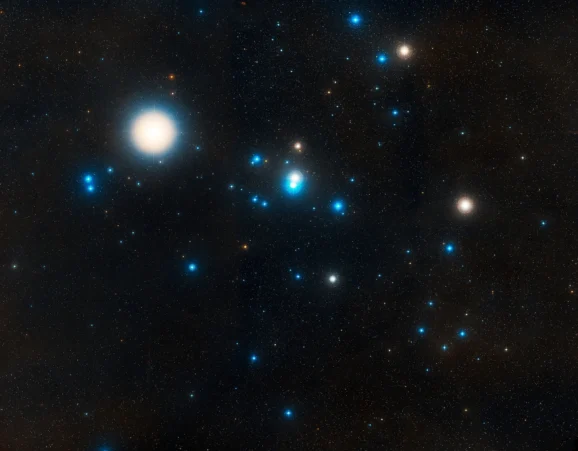
Located 150 light-years away, the Hyades is the closest and most studied open cluster in the sky, serving as a fundamental reference point for astronomy while being a beautiful naked-eye object. Within the Taurus constellation, they form the distinct V-shaped face of the Bull, with the bright red giant Aldebaran marking the Bull’s eye.
The Hyades cluster contains hundreds of stars, including red giants and white dwarfs, with about a dozen bright enough to be easily seen with the naked eye. When using binoculars or a telescope, many more stars in the cluster become visible.
In Greek mythology, the Hyades were the five daughters of Atlas, sisters to the Pleiades, who were placed in the sky as stars after mourning their brother Hyas.
The Beehive (M44)
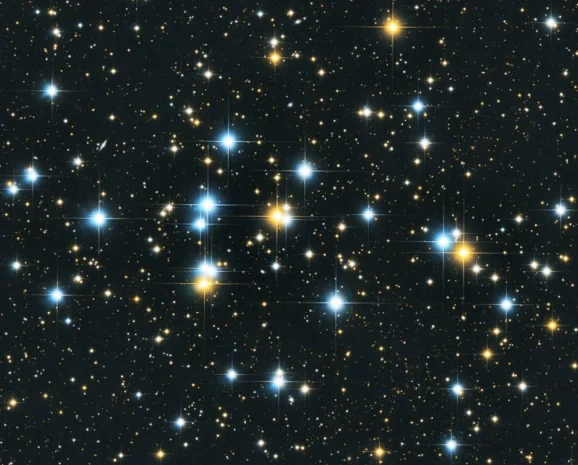
The Beehive Cluster contains over a thousand stars, lies in the faint constellation of Cancer, and is approximately 577 light-years away. It appears as a fuzzy patch between the Gemini and Leo constellations, roughly halfway along the line connecting the bright stars Pollux and Regulus. When viewed through binoculars or a telescope, dozens of stars can be resolved, revealing the “swarm” that gives the cluster its name, the “Beehive.”
The Beehive is a crucial cluster for studies of stellar evolution. It is moving through space with the Hyades cluster in Taurus, and both share the same age, motion, and chemical composition, indicating they were born from the same massive interstellar cloud.
In 1609, the renowned scientist Galileo Galilei pointed his telescope at the Beehive Cluster and made a groundbreaking discovery. He was able to resolve the “nebulous cloud” into individual stars, counting “more than 40 stars.” Galileo’s early telescope work not only revealed the true nature of star clusters but also expanded our understanding of our galaxy, marking a pivotal moment in the development of astronomy.
Alpha Persei Cluster (Mel 20)
The Alpha Persei Cluster is easily found by spotting the brilliant yellow supergiant Mirfak near the centre of the Perseus constellation. Mirfak is the brightest member of the cluster located approximately 570 light-years from Earth, making it one of the closest major open clusters to us.
The Alpha Persei Cluster contains several dozen bright, hot, blue-white stars, with Mirfak being the standout supergiant, along with many fainter members (over 500 known). It appears as a loose, scattered group of stars surrounding Mirfak, easily visible to the naked eye. Using binoculars is the best way to view the cluster, as they reveal a stunning field of bright stars against the rich backdrop of the Milky Way.
Double Cluster (Mel 14)
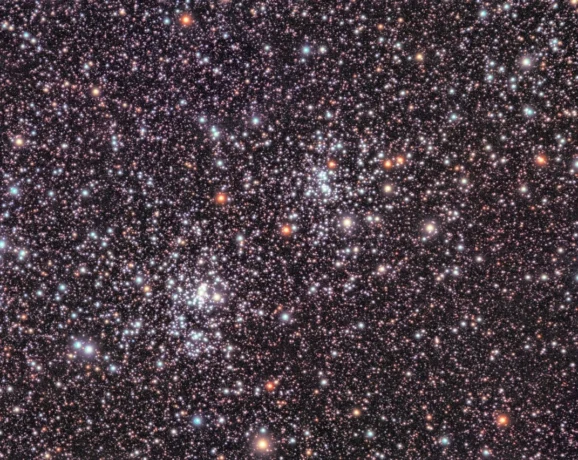
The Double Cluster in the Perseus constellation consists of two stunning open star clusters that appear very close to each other in the sky. They are rich in massive, hot, blue-white supergiant stars, which give them a brilliant, sparkling appearance.
Located approximately 7,500 light-years from Earth, the two clusters are separated by only a few hundred light-years, indicating that they likely originated from the same giant molecular cloud. The stars within these clusters are notably young, with ages ranging from 3.2 to 5.6 million years. In comparison, our Sun is 4.6 billion years old.
The Double Cluster is a stunning cosmic wonder that presents a “two-for-one” experience, featuring two equally magnificent star clusters close together. Observing the Double Cluster with binoculars is an unforgettable event, revealing two glowing concentrations of stars and offering a glimpse into the beauty and complexity of our universe. It is truly a must-see for any stargazer.
Night Sky Events in February
February is an exciting month for stargazers, filled with captivating celestial events. During this month, you can witness remarkable planetary alignments and the Moon passing by some of the brightest star clusters and planets, creating stunning visuals. Additionally, there will be a spectacular annular solar eclipse, also known as the “ring of fire.” Although this eclipse won’t be visible from England, we can still follow it online.
February 1 – The Full Moon (Snow Moon) near the Beehive star cluster.
February’s full Moon is also known as the Snow Moon, due to the heavy snowfall that occurs in many areas during this month, making it one of the snowiest times of the year. The Moon rises around 4:15 p.m. on the northeastern horizon, to the left of the Beehive star cluster in the Cancer constellation, and it remains near this beautiful star group throughout the night.
February 16 – Saturn near Neptune and above Mercury.
Look towards the western sky after 5:30 p.m. You will see Saturn shining below and to the left of Neptune. Both planets are positioned above and to the left of Mercury, gleaming low on the horizon. While Saturn and Mercury are visible to the naked eye, a telescope or binoculars are required to see Neptune.
February 17 – Annular Solar Eclipse.
During an annular eclipse, the Moon passes in front of the Sun, covering its centre while leaving a bright ring of sunlight around the edges. This creates the stunning “ring of fire” effect, visible only to observers along a narrow path in the Moon’s shadow. This February, the “ring of fire” will be visible in southern Antarctica and its nearby ocean, while southern Chile, Argentina, and South Africa will experience a partial eclipse. In the UK, the annular eclipse will occur around midday, making it ideal to follow online.
February 18 – The Moon between Mercury and Venus and below Saturn.
Look towards the western sky after 5:30 p.m. to find Mercury, the thin waxing crescent Moon and Venus tracing a diagonal line over the darkening horizon. Saturn is also visible above and to the left of Mercury. A planetary alignment not to be missed!
February 20 – The Moon near Saturn.
The waxing crescent Moon shines above and to the left of Saturn in the western sky after 6 p.m. Additionally, Mercury appears near the horizon, below and to the right of Saturn, completing a magnificent celestial triangle.
February 24 – The Moon near the Pleiades star cluster.
Look towards the southern sky after 6:30 p.m. to see the waxing gibbous Moon shining to the left of the Pleiades star cluster—a dazzling sight lasting well into midnight.
February 26 – Venus near Mercury and Saturn.
Brilliant Venus appears on the western horizon after 6 p.m., shining brightly below and to the left of Mercury. Saturn is also visible above and to the left of Mercury. However, you must hurry to spot this stunning trio, as they will soon disappear below the horizon in about an hour.
February 27 – The Moon near Jupiter.
Look towards the southern sky after 6 p.m. to see the waxing gibbous Moon shine below the bright star Pollux in Gemini and to the left of brilliant Jupiter, making for a beautiful sight that you can admire all night.
February 28 – The Moon near the Beehive star cluster.
At the end of the month, the nearly full Moon will visit the Beehive star cluster again in the Cancer constellation. While the Moon’s bright glow will temporarily overshadow the gentle twinkling of the cluster’s stars, this celestial event offers a unique opportunity to locate the Beehive cluster among the surrounding stars, allowing you to appreciate it in all its splendour on darker nights in the future.

Omara Williams is a nuclear and software engineer whose multi-award-winning debut science-fiction novel, The Space Traveller’s Lover, shot to international bestseller status. Outside of her literary pursuits, she enjoys stargazing and chasing total solar eclipses.
READ MORE: ‘2026 is looking up: a happy new year written in the stars‘. Continuing her monthly guide to the night sky, Omara Williams turns to January, when the Winter Hexagon and Orion dominate the heavens, marking the opening of the year with some of the most striking and accessible stargazing of the winter season.
Do you have news to share or expertise to contribute? The European welcomes insights from business leaders and sector specialists. Get in touch with our editorial team to find out more.
Main image: The magnificent Pleiades star cluster as seen by the Palomar Observatory, NASA. Credit: Supplied