Installations are expected to decline in 2026 and 2027 before growth resumes as the industry turns increasingly to batteries, EV charging, heat pumps and AI-controlled energy systems
Europe’s solar boom is set for a two-year slowdown after years of rapid growth, according to a new industry report.
The EU market is expected to contract in 2026 and 2027 before expanding again from 2028, with annual installations reaching around 67 gigawatts by 2030 – roughly the combined peak of 67 large power stations.
The slowdown follows a decade of rapid expansion, with the EU adding 65.1 gigawatts of new solar capacity in 2025, slightly below the 65.6 gigawatts installed the previous year.
Solar supplied around 13 per cent of the bloc’s electricity last year, while wind and solar together generated 30 per cent compared with 29 per cent from fossil fuels.
Worldwide, a record 664 gigawatts of solar capacity was installed in 2025 – equivalent to the combined peak capacity of more than 600 large power stations – taking the global total past three terawatts in early 2026.
Solar also generated more electricity than wind globally for the first time.
A new white paper from The smarter E Europe, an international exhibition and conference platform for the renewable energy sector, says the next phase of solar development will focus on making electricity available around the clock, rather than only when panels are generating.
Solar panels usually produce the most electricity in the middle of the day, when demand and prices may be lower, with households and businesses typically using more power during morning and evening peaks.
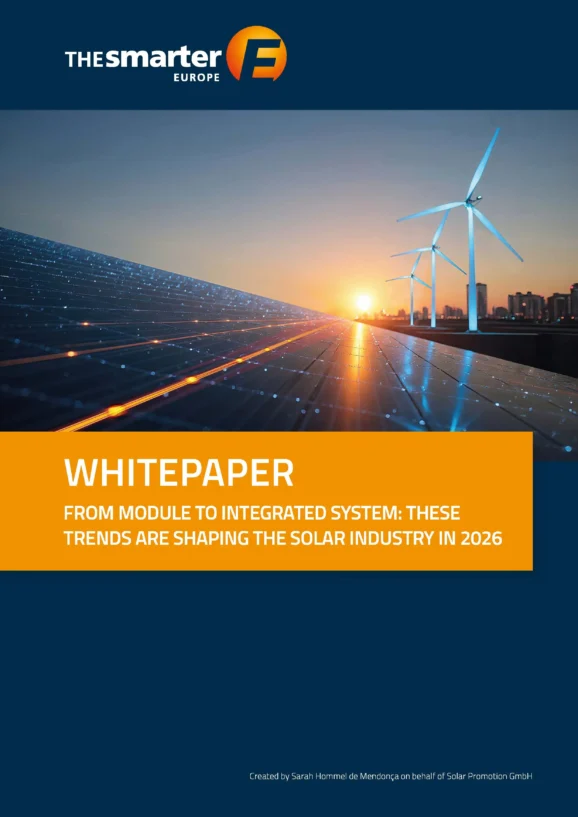
The report, which draws on forecasts from SolarPower Europe, the European solar energy industry association, and can be viewed in full here, says round-the-clock renewable electricity will increasingly depend on sophisticated batteries, electric-car chargers and heat pumps.
These are expected to work alongside energy-management software and AI systems that predict demand and determine when electricity should be stored, used or fed into the grid.
Horst Dufner is the project manager of Intersolar Europe, one of the world’s leading exhibitions for the solar industry, and head of The smarter E Europe.
He said the most important development at this June’s Intersolar Europe exhibition, held in Munich, Germany, was the industry’s progress towards a 24/7 renewable energy supply.
The greatest opportunities for innovation and new business models lay in technologies allowing solar power to be used beyond the moment it is generated, he added.
“Without a doubt, it was the role of solar energy embedded within the broader theme of a 24/7 renewable energy supply – its technical feasibility, societal benefits, and economic advantages,” he said.
“The greatest potential for innovation and new business models is directly linked to this: Solutions are emerging that no longer revolve solely around generating kilowatt-hours, but around unlocking the value of solar power beyond the moment of generation.”
READ MORE: Europe adds enough new wind power for 7m homes as record year beckons. New turbines capable of replacing fossil-fuel imports equivalent to 25 LNG tankers a year were installed in the first half of 2026 – but industry leaders warn planning and grid delays could halt the boom.
Do you have news to share or expertise to contribute? The European welcomes insights from business leaders and sector specialists. Get in touch with our editorial team to find out more.
Main image: The smarter E Europe’s latest white paper highlights the next phase of the solar market, as the industry moves from rapid panel deployment towards round-the-clock power supported by storage, smart energy systems and other integrated technologies. Credit: Photo by Dhruvan Patel via Pexels / The European