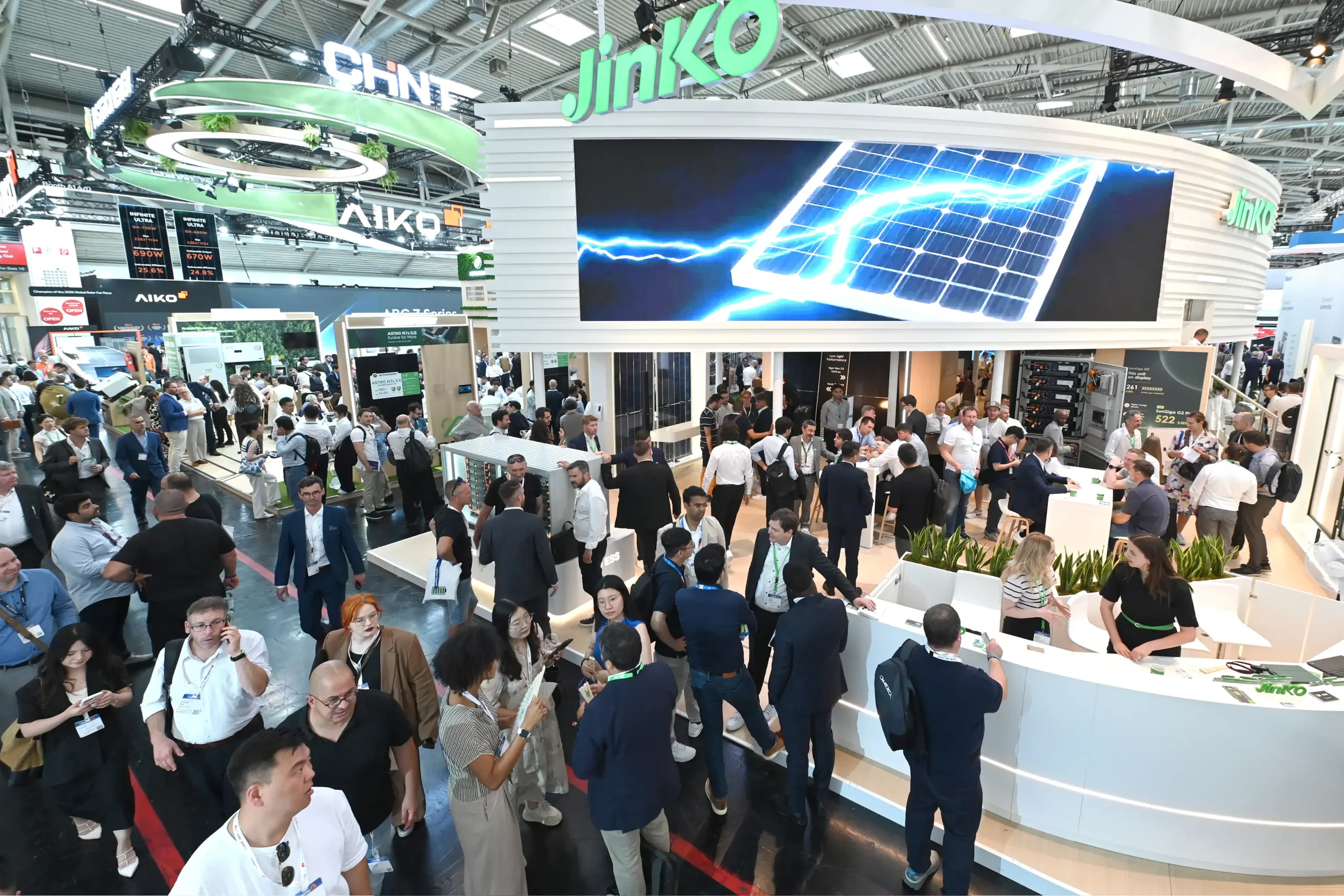
Solar power, battery storage and digital energy technologies are converging into an integrated energy system that could deliver reliable renewable electricity around the clock, writes The smarter E Europe
Suddenly, everything happened very quickly: while solar power expanded only gradually in the early years of its commercial deployment, it has since become the world’s leading source of electricity generation. The rise of renewable energies is linked to a broader systemic shift that is driving and accelerating the growth of other cleantech sectors, most notably battery storage, electromobility and heat pumps. Flexibility has also emerged as a key priority and can serve as a balancing factor for the variability of renewables. The electrification of all sectors is widely considered a fundamental prerequisite for an efficient, cost-effective and resilient energy system.
At the recent The smarter E Europe 2026, Europe’s largest alliance of exhibitions for the energy industry, 2,650 exhibitors offered around 105,000 visitors a glimpse into the components that can help make an integrated energy system successful. The Renewables 24/7 special exhibit, organised by Solar Promotion GmbH and Freiburg Wirtschaft Touristik und Messe GmbH & Co. KG, demonstrated how a round-the-clock renewable energy supply can work.
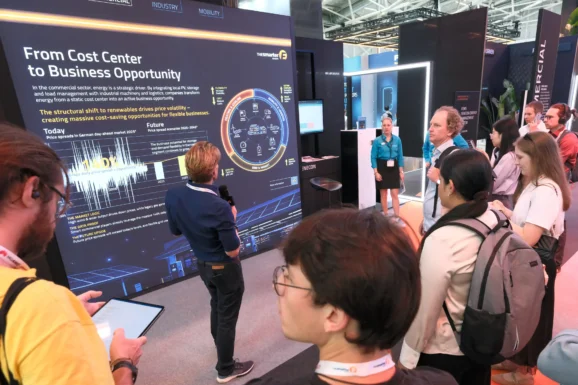
Photovoltaics and battery storage: from niche to industry standard
According to Jaran Rystad, founder and CEO of the research and consulting firm Rystad Energy, speaking at The smarter E Europe, forecasts for photovoltaic expansion have consistently underestimated the pace of deployment, including those produced by his own company, although they were often regarded as overly optimistic when they were published. According to SolarPower Europe’s Global Market Outlook for Solar Power 2026–2030, a record 664 gigawatts (GW) of new photovoltaic capacity were installed worldwide in 2025, bringing global installed solar capacity above the three terawatt (TW) mark for the first time. The milestone carries symbolic significance: In 2025, solar power produced more electricity worldwide than wind power for the first time, becoming the largest single driver of global growth in energy generation, ahead of natural gas, oil and coal.
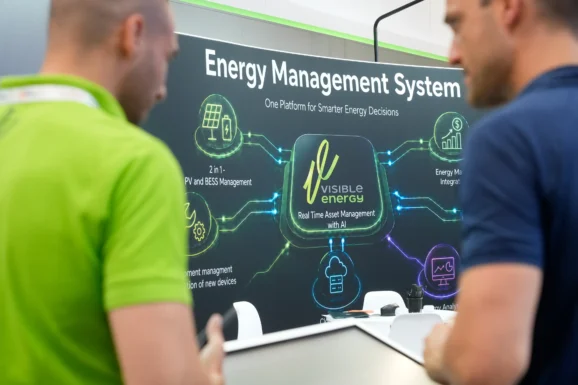
China remained the world’s largest solar market, adding 382 GW of new capacity, equivalent to 57 per cent of global installations, although policy changes are expected to result in a temporary slowdown in 2026. Europe continued to be on course for growth: In 2025, the EU-27 once again installed more solar capacity than in the previous year, reaching approximately 67 GW. Solar power has become firmly established as a cornerstone of Europe’s electricity supply. In June 2025, photovoltaics temporarily covered more than 22 per cent of total electricity demand across the EU.
Europe’s battery storage market is expanding just as rapidly. SolarPower Europe’s European Battery Market Outlook 2026–2030 reports that 36 gigawatt hours (GWh) of new storage capacity were installed in 2025, a 48 per cent increase over the previous year, bringing Europe’s total installed storage capacity above 100 GWh for the first time. Utility-scale storage accounted for more than half of all new installations, also a first. This growth has been driven in no small part by the sharp decline in battery costs: Production costs for lithium-ion battery cells have fallen by around 85 per cent since 2010. By 2030, annual installations are expected to reach 138 GWh, almost four times the 2025 level. “We are entering the battery age,” said Markus Elsässer, CEO of Solar Promotion GmbH, at The smarter E Europe.
Together, these trends – driven by rapidly expanding solar output and growing storage capacity – are laying the foundation for a round-the-clock renewable energy supply. This vision was at the heart of the Renewables 24/7 special exhibit at the recent The smarter E Europe.
Economically viable, technically feasible: 24/7 renewable energy
Too expensive. Too unreliable. Technically impossible. These are among the most common misconceptions surrounding a fully renewable energy supply. The Renewables 24/7 special exhibit at The smarter E Europe 2026 addressed these misconceptions. The exhibit was based on the study Cost-Optimal Transformation of the German Energy System by 2045, prepared by the Fraunhofer Institute for Solar Energy Systems ISE. Both the study and the special exhibit demonstrate how an industrialised country such as Germany can achieve a completely climate-neutral energy system powered entirely by renewable energy in a way that is technically feasible, economically viable and socially manageable.
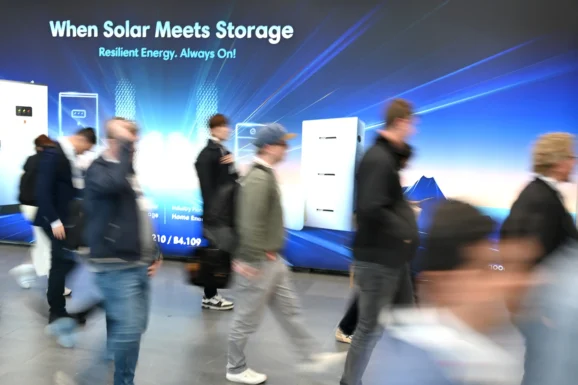
Through exhibits, expert presentations and practical examples, the special exhibit presented evidence challenging the assumption that extended periods of low wind and limited sunshine, often referred to as ‘dark doldrums’, represent an obstacle to a renewable energy system. Dr. Charlotte Senkspiel, one of the study’s lead authors at Fraunhofer ISE, explained: “The ‘dark doldrums’ account for only about one per cent of the year. Yes, we still need 100 gigawatts of dispatchable power generation for these periods, and seasonal hydrogen storage is the key to operating it.” The models used in the study and their visualisation at the special exhibit were based on the considerable expansion of storage capacity and increasing utilisation of flexibility. Examples include peak shaving in industry and commerce, demand-side flexibility across all consumption sectors and bidirectional charging of electric vehicles.
At Renewables 24/7, visitors saw to great effect how the individual technologies and applications underpinning the energy transition can efficiently work together as an integrated system. “Solar power, energy storage, e-mobility, power grids and digitalisation are not developing independently. They are converging into an integrated energy system,” said Markus Elsässer at the opening of the special exhibit.
A strong alliance of associations and industry backing the special exhibit
A broad coalition of leading industry associations supported the initiative. Supporters included the German Renewable Energy Federation (BEE), the German Association of Energy Market Innovators (bne), the German Solar Association (BSW-Solar), the German Solar Energy Society (DGS), the German Hydrogen Association (DWV), the Biogas Trade Association, VDMA (German Engineering Federation) Photovoltaics Equipment and VDMA Power Systems. It was also internationally backed by E-Mobility Europe, Energy Storage Europe (ESE), Smart Energy Europe (smartEn) and SolarPower Europe.
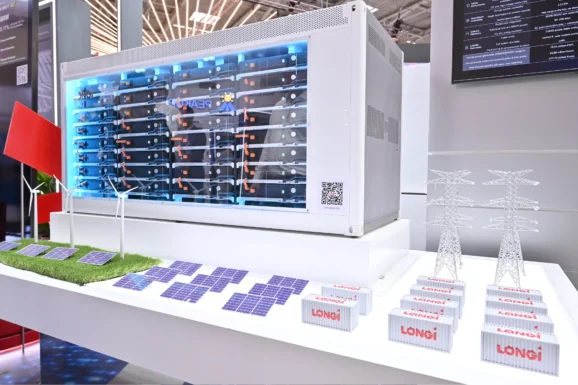
Leading technology solution partners contributed to the special exhibit, presenting technical and commercial solutions. These included CATL, Energy3000, Fenecon, FoxESS, GE Vernova, Maxsolar, Octopus Energy and Siemens AG. Together, they showcased the technologies and solutions that can enable a fully renewable, round-the-clock energy supply.
Next steps: the solutions are here; policy must follow
The smarter E Europe 2026 and its Renewables 24/7 special exhibit demonstrated that the industry is already providing many of the technologies and products needed for a resilient, climate-neutral and cost-effective energy system. What is needed now is appropriate incentives from policymakers and institutions, as well as a consistent commitment to change. This is essential to address bottlenecks such as insufficient grid capacity and regulations that do not yet adequately support an integrated energy system.
Further Information
Produced with support from The smarter E Europe. To learn more about the Renewables 24/7 initiative and the wider exhibition and conference programme, visit The smarter E Europe.
READ MORE: Students unveil world’s first solar-powered ambulance. Stella Juva is designed to transport patients, provide on-site care and power medical equipment without fuel or grid electricity.
Do you have news to share or expertise to contribute? The European welcomes insights from business leaders and sector specialists. Get in touch with our editorial team to find out more.
Main image: Thousands of visitors attended The smarter E Europe 2026, where exhibitors showcased technologies spanning photovoltaics, energy storage, grid infrastructure and digital energy management. Credit: Solar Promotion GmbH