2026 Winter Olympics close in Verona as Norway dominates medal table

Emma Strandberg
- Published
- News
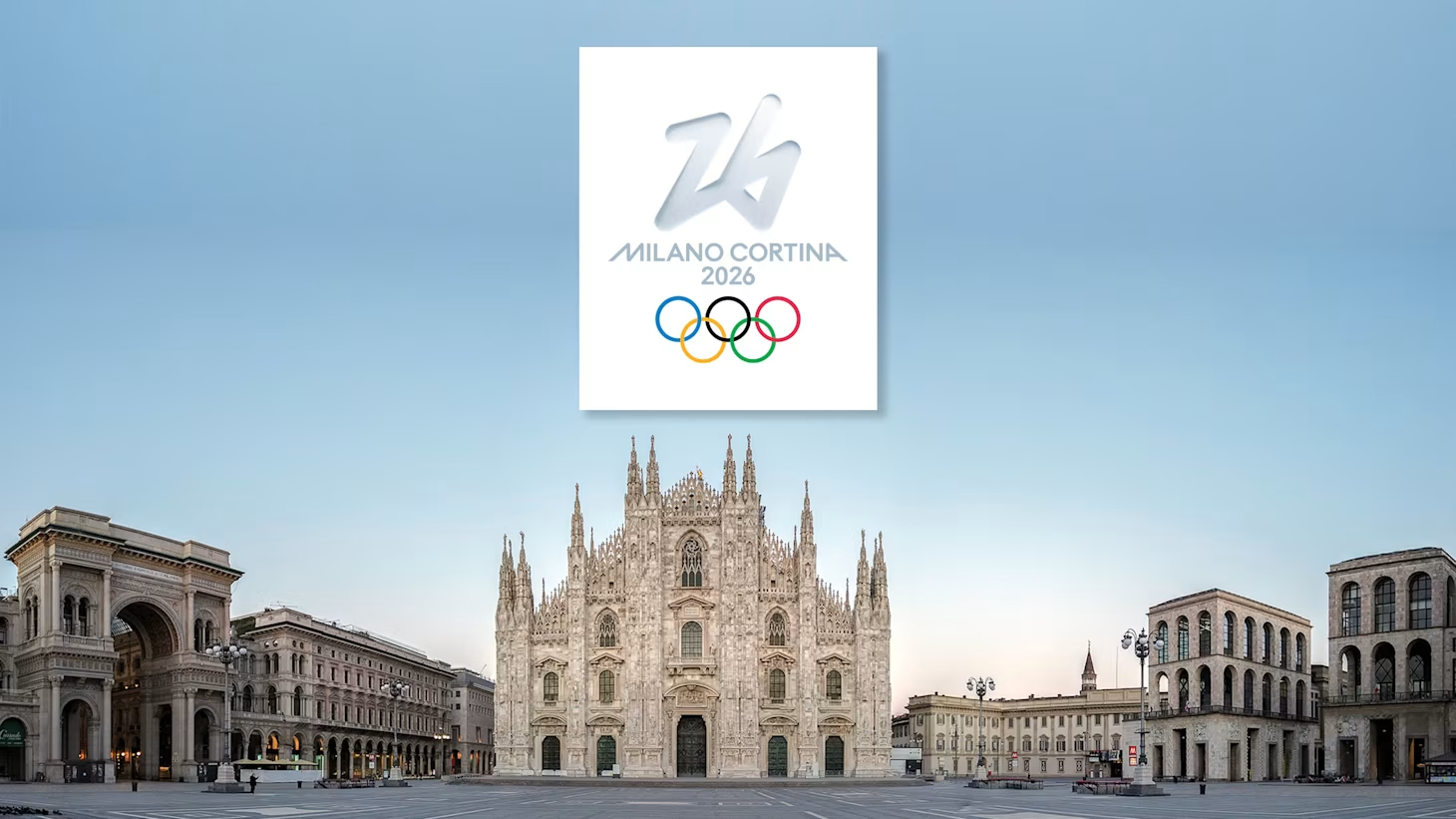
A record haul for Norway, a best-ever performance for Italy and a ceremonial handover to France marked the end of a Winter Games that stretched from the Alps to the Mediterranean
The Winter Olympic Games of Milan-Cortina 2026 concluded on Sunday night with a closing ceremony at the Verona Arena, bringing to an end more than two weeks of competition across northern Italy.
Although Verona did not stage any sporting events during the Games, the Roman amphitheatre — situated around 75 miles from Milan — hosted the final act of the Olympics.
The ceremony opened with a tribute to Italy’s operatic heritage before representatives of the 92 participating nations entered the arena, framed by large stage pieces inspired by Aida and accompanied by a medley celebrating Italian cinema. The Olympic flame, known as the “Drop of Fire” and housed in a small glass vessel, was carried into the stadium and used to illuminate the rings ahead of the athletes’ parade.
Traditionally competitors enter en masse rather than by nation, though many teams remained grouped together as they circled the arena floor.
Earlier in the evening the final medals of the Games were presented, with the men’s and women’s 50km mass start cross-country skiing events concluding the sporting programme. Volunteers were also recognised during the ceremony for their role in delivering the Games.
Performances from Italian artists Achille Lauro and Major Lazer followed before International Olympic Committee president Kirsty Coventry formally declared the Games closed. Addressing athletes, she said: “You have been incredible – every one of you. Brave. Fearless. Full of heart and passion. You left it all on the snow and ice.
“Two unforgettable weeks, living every moment to the fullest. You gave everything – and you shared it with all of us.
“This is the true Olympic spirit: competing, embracing, lifting each other up, whatever the result. You showed us what excellence, respect, and friendship look like in a world that sometimes forgets these values.
“You showed us that the Olympic Games are a place for everyone. A place where sport brings us together.”
Across 116 medal events, several nations recorded landmark achievements — among them Great Britain. Team GB secured five medals, including three golds, finishing 15th in the medal table. It marked Britain’s most successful Winter Games in terms of gold medals.
Matt Weston claimed two skeleton titles — in the individual men’s event and the team competition alongside Tabby Stoecker — while Charlotte Bankes, Britain’s female flagbearer in Verona, won snowboard cross team gold with Huw Nightingale, the first Olympic title on snow for British athletes. There was silver in men’s curling and bronze for Zoe Atkin in the women’s ski halfpipe.
Elsewhere, Brazil’s Lucas Pinheiro Braathen captured the men’s giant slalom to deliver the first Winter Olympic gold for a South American nation. Georgia earned its first Winter Games medal with silver in pairs figure skating, while Spain ended a 54-year wait for gold with victory in men’s ski mountaineering. Benin, Guinea-Bissau and the United Arab Emirates made their Winter Olympic debuts.
Hosts Italy recorded their strongest Winter Olympic showing, collecting 30 medals including 10 golds to finish fourth overall.
Norway once again headed the medal standings, claiming 18 golds and 41 medals in total. Cross-country skier Johannes Høsflot Klæbo won six medals, setting a new benchmark for individual golds at a single Winter Games. His triumph in the men’s 50km race was presented in Verona as the final medal of Milan-Cortina 2026.
Among other notable moments, Elana Meyers Taylor of the United States became the oldest individual gold medallist in Winter Olympic history at 41, winning the monobob title. Lindsey Vonn’s Olympic career concluded after she sustained a broken leg.
The Games were not without controversy. Ukraine’s Vladyslav Heraskevych was disqualified from the men’s skeleton after refusing to remove a helmet featuring artwork commemorating athletes killed during Russia’s invasion of his country. Russian competitors, including ski mountaineer Nikita Filippov, participated as Individual Neutral Athletes following Russia’s suspension. Canada’s men’s curling team, who won gold, also faced allegations of cheating during the tournament.
The ceremony concluded with the transfer of the Olympic flag to representatives of the French Alps, hosts of the 2030 Winter Games. Regional leaders Renaud Muselier and Fabrice Pannekoucke received the flag from Coventry before a re-imagined rendition of La Marseillaise and a performance involving musicians and athletes signalled the next chapter for the Winter Olympics.
READ MORE: ‘Ski hard, rest harder: inside Europe’s new winter-wellness boom‘. Forecasts show winter-wellness holidays in the Italian Alps rising from £1.1 billion to over £3.5 billion by 2033, fuelled by demand for holidays that mix big-mountain skiing with serious R&R. John E. Kaye travelled to South Tyrol’s Ahrntal, a valley now known as much for saunas and spa rituals as for its slopes, to see how the European Alpine season is changing.
Do you have news to share or expertise to contribute? The European welcomes insights from business leaders and sector specialists. Get in touch with our editorial team to find out more.
Main image: IOC
TOP STORIES
-
 Britain faces higher winter energy prices as reliance on European electricity imports grows
 -
Andy Burnham to make special Gogglebox appearance for Stand Up To Cancer
-
WPSL Golf targets £120 million valuation as billionaire-backed corporate deals and other commercial deals drive explosive global growth
-
Hackers could bring Britain’s essential services to a standstill, security chief warns after global website shutdowns
-
We're talking to almost twice as many people on the phone as a decade ago, study finds
-
TalkTalk sells majority stake in Telecom Acquisitions as founder Nigel Barnett regains control
-
Company closures soar ahead of tax rises as new Budget looms
-
Russia takes control of more European corporate assets amid Ukraine tensions
-
EU leaders resist calls to delay carbon rules as energy costs soar
-
‘A big step forward’ – PM Andy Burnham hails plans for Great British Railways HQ in Derby
-
UK economy grows just 0.1 per cent as construction falls and services stall
-
Germany risks losing €155bn a year under tighter AI data rules, new study warns
-
Pope Leo XIV diagnosed with lung cancer after surgery in Rome
-
France faces freezer meltdown as hackers strike supermarket chains
-
Bumble shares soar 50% amid $1bn takeover talks
-
China slump drives Volkswagen to sharpest quarterly fall in more than four years
-
Hollywood mega-powerhouse created as Paramount completes Warner Bros Discovery takeover
-
Gamers face gridlock as latest Grand Theft Auto download 'nears two days'
-
Samsung profits soar ninefold to record £61bn amid AI chip boom
-
New Springer books put the UN’s struggling sustainability goals to the real-world test
-
Europe’s solar boom set for two-year slowdown after record growth
-
Let it pea. Musicians turn vegetables into instruments at Beatles' Abbey Road studios
-
Golden naked Trump statue unveiled at European Parliament
-
Jaguar puts controversial rebrand on the road with £130K 1,030PS Type 01
-
Deepfakes and identity fraud drive new wave of post-hire background checks